

OXFORD, UK — In a groundbreaking discovery that challenges decades of planetary science orthodoxy, researchers at the University of Oxford have uncovered compelling evidence that Mars once harbored colossal, Earth-like magmatic systems deep within its crust. Published in the prestigious journal Nature Astronomy, the findings fundamentally alter our understanding of planetary evolution. For generations, scientists assumed that such complex geological structures required the mechanical churning of plate tectonics—a process previously believed to be unique to Earth. The revelation that the Red Planet achieved a comparable level of crustal sophistication through entirely different internal mechanisms opens up exhilarating new paradigms in the search for habitable worlds across the cosmos.
Main Facts: Rewriting the Geological History of Mars
For centuries, planetary geologists have categorized Mars as a "stagnant lid" planet. Unlike Earth, whose dynamic lithosphere is fractured into massive, shifting plates that constantly collide, slide, and subduct, Mars possesses a single, continuous, and immobile outer shell.
On Earth, plate tectonics is the engine of the geological world. It drives global volcanism, recycles crustal material back into the mantle, builds continents, and plays a fundamental role in regulating the planet’s long-term climate and geochemical cycles. Because Mars lacks this defining tectonic activity, scientists universally presumed that its geological history was comparatively simple, monotonous, and driven by stagnant, localized volcanic activity rather than systemic crustal evolution.
The new Oxford-led study shatters that assumption. Analyzing deep interior data, the research team discovered that ancient Mars developed a highly evolved, differentiated crust through vigorous internal recycling and complex magmatic fractionation. Rather than relying on the horizontal motion of crustal plates, the Red Planet appears to have sustained massive vertical magmatic engines capable of reprocessing vast portions of its crust.
Key Takeaways of the Discovery:
- The "Stagnant Lid" Paradox: Mars managed to build complex, highly evolved crustal structures without the aid of plate tectonics.
- Transcrustal Magmatism: The discovery points to the existence of continent-scale magmatic systems stretching hundreds or thousands of kilometers, a phenomenon previously thought exclusive to Earth.
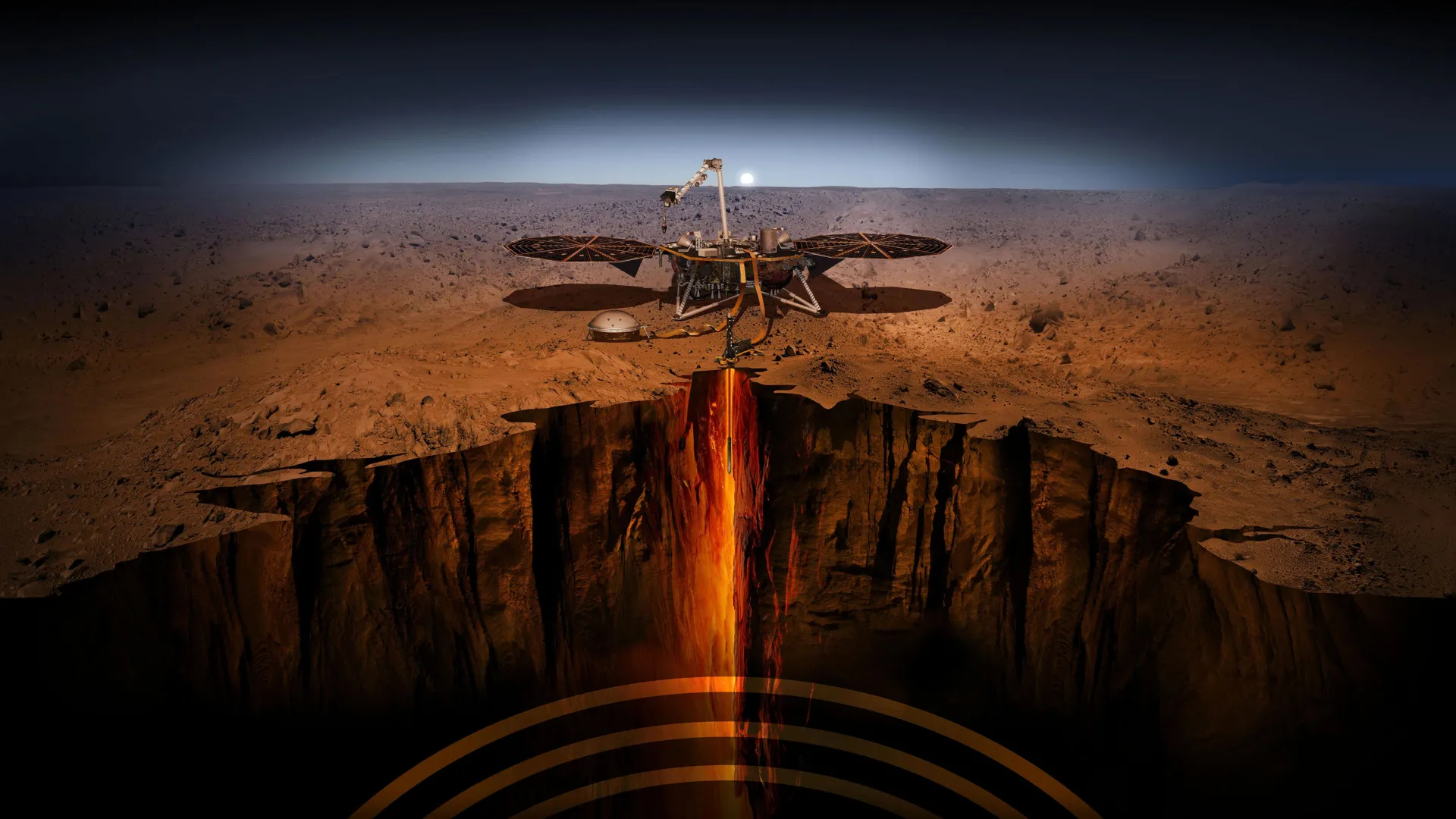
- Seismic Proof: The findings were unlocked by analyzing acoustic waves from marsquakes and meteoroid impacts captured by NASA’s retired InSight lander.
- Implications for Astrobiology: The study suggests that complex planetary evolution and geochemical recycling can occur on worlds previously dismissed as too geologically simple to support life.
Chronology: How the Discovery Unfolded
The breakthrough was not the result of a single observation, but rather the culmination of years of meticulous data collection, technological innovation, and interdisciplinary collaboration between geologists and statisticians.
1. The Arrival of InSight (2018)
The foundation for this discovery was laid when NASA successfully landed the Interior Exploration using Seismic Investigations, Geodesy and Heat Transport (InSight) spacecraft on the Elysium Planitia region of Mars in November 2018. Equipped with a highly sensitive seismometer (SEIS), InSight was designed to listen to the "heartbeat" of Mars, recording seismic waves passing through the planet’s crust, mantle, and core. Over its operational lifespan, InSight recorded over 1,300 marsquakes, alongside seismic ripples generated by high-velocity meteoroid impacts.
2. Identifying the 24-Kilometer Boundary (2021–2022)
As scientists processed InSight’s telemetry, they identified a mysterious, sharp seismic boundary located approximately 24 kilometers beneath the Martian surface. While earlier studies registered the existence of this boundary, its structural significance and compositional nature remained an enigma. Was it merely an artifact of cooling lava flows, or did it mark a profound geochemical transition within the planet’s crust?
3. Interdisciplinary Modeling (2023–2024)
To solve the mystery, researchers from Oxford’s Departments of Earth Sciences and Statistics joined forces. Recognizing that seismic velocities alone cannot definitively identify rock types, the team constructed a massive library of thermodynamic models. They simulated hundreds of potential mineralogical compositions to determine how different rock types would behave under the extreme pressures and temperatures found at varying depths beneath Mars.
4. Statistical Verification and Publication (Late 2024–2025)
By combining thermodynamic forward-modeling with advanced probabilistic statistical methods, the team mapped the seismic signatures to specific physical compositions. The statistical alignment was undeniable: the boundary at 24 kilometers marked a dramatic shift from silica-rich rocks above to iron- and magnesium-dense rocks below. These results were submitted to, peer-reviewed by, and ultimately published in Nature Astronomy, marking a milestone in planetary seismology.
Supporting Data: Decoding the Martian Underworld
The analytical core of the Oxford study rests on the precise differentiation of seismic velocities as waves propagated through the Martian lithosphere.
When researchers compared InSight’s wave propagation data with their thermodynamic models, a clear picture of the crustal architecture emerged:
- Above 24 Kilometers (Mafic Crust): The seismic properties in the upper crust matched compositions rich in silica, consistent with mafic rocks such as basalt.
- Below 24 Kilometers (Ultramafic Layer): Below the boundary, the seismic velocities required a dense, "ultramafic" material profile—rock heavily concentrated in iron and magnesium while markedly deficient in silica.
The Physics of Fractional Crystallization
This stratified layout points directly to a planetary-scale process known as fractional crystallization within a massive underground magma system.
When enormous volumes of molten rock (magma) pool deep within a planet’s crust, they do not cool uniformly. Instead, as the magma slowly cools, high-density crystals (such as olivine and pyroxene, rich in iron and magnesium) precipitate and gravitationally settle toward the bottom of the magma chamber. Meanwhile, lighter, more chemically evolved, silica-rich melts float upward.
On Earth, this exact vertical differentiation process occurs beneath major volcanic arcs and is a primary driver in the creation of continental crust. Finding evidence of this deep, protracted magmatic processing on Mars proves that the planet possessed internal thermal engines far more powerful and sophisticated than previously imagined.
Moreover, the spatial extent of this buried layer is breathtaking. The data indicates that this signature is not localized to a single volcanic province; rather, it could span hundreds or even thousands of kilometers across the Martian northern hemisphere. This implies that ancient Mars was characterized not by isolated volcanic peaks like Olympus Mons acting independently, but by interconnected, continent-spanning plumbing networks—a regime of "transcrustal magmatism."
Official Responses and Expert Insights
The geological community has received the study with immense enthusiasm, viewing it as a paradigm-shifting contribution to comparative planetology.
Dr. Tobermory Mackay-Champion, formerly of the Department of Earth Sciences at the University of Oxford and now based at the University of Bristol, served as the lead author of the study. Discussing the traditional dogma surrounding Martian volcanism, Dr. Mackay-Champion remarked:
"We’ve traditionally assumed that volcanism on Mars was relatively simple compared to that on Earth—characterized by stagnant, localized outpourings of basaltic lava. But this discovery turns that narrative on its head. It suggests Mars could sustain large, long-lived systems where molten rock evolved and reprocesses itself throughout the entire crust. It raises exciting possibilities for how common such systems might be on rocky planets beyond our solar system."
Co-author Professor Jon Wade, also from Oxford’s Department of Earth Sciences, emphasized the broader philosophical and astrobiological weight of the findings, particularly regarding the uniqueness of our home world:
"One of the big questions in planetary science is whether Earth is unique. If Mars could develop this kind of complex crust without plate tectonics, then maybe the conditions needed for habitability can emerge on more planets than we realized, including those previously dismissed based on size or their apparent lack of tectonic activity."
Independent planetary scientists have echoed these sentiments, noting that the data retrieved by the InSight mission continues to yield dividends long after the spacecraft’s solar panels fell silent due to dust accumulation in December 2022. The marriage of seismology and thermodynamic modeling pioneered in this study provides a new blueprint for probing the interiors of Venus, Mercury, and rocky exoplanets orbiting distant stars.
Implications: What This Means for Planetary Habitability and Astrobiology
The discovery of massive, Earth-like magmatic systems on a stagnant-lid planet carries profound implications that stretch far beyond academic geology, touching directly upon the quest to understand planetary habitability and the origins of life.
1. Expanding the Goldilocks Zone of Habitability
To date, astrobiologists have often treated plate tectonics as an absolute prerequisite for a rocky planet to sustain life over geological timescales. On Earth, plate tectonics drives the carbon-silicate cycle, stabilizing surface temperatures, recycling water into the mantle, and pumping volatile elements—such as carbon, nitrogen, phosphorus, and sulfur—into the biosphere. Planets lacking plate tectonics were frequently written off as geochemical dead ends, doomed to sterile stagnation.
By demonstrating that complex crustal evolution, fractional crystallization, and deep magmatic recycling can occur spontaneously on a world without moving plates, the Oxford study breaks down this rigid dichotomy. It suggests that a planet does not need a dynamic tectonic regime to process its crust and enrich its surface environment with life-essential volatile chemicals. Consequently, the cosmic roster of potentially habitable worlds expands significantly, embracing stagnant-lid exoplanets that were previously overlooked.
2. Rethinking Planetary Atmospheres and Volatiles
Extensive magmatic systems act as colossal chemical factories. As deep crustal chambers melt, fractionate, and degas, they release vast quantities of water vapor, carbon dioxide, sulfur dioxide, and other volatiles into the atmosphere.
If ancient Mars possessed continent-wide transcrustal magmatism, these systems would have served as the primary drivers of its early atmosphere and hydrosphere. Understanding how these hidden engines operated sheds light on how Mars transitioned from a warm, wet world with a thick atmosphere billions of years ago into the cold, arid desert we observe today.
3. A Legacy for Future Exploration
The findings underscore the immense scientific value of planetary seismology. While surface imagery reveals the superficial scars of impact craters and dry riverbeds, seismology acts as planetary X-ray imaging, peering deep into the mantle and core.
As space agencies look toward future missions to Venus (such as NASA’s DAVINCI and VERITAS missions) and future lunar seismic networks, the methodologies validated by the Oxford team will play a vital role in decoding the internal architecture of diverse worlds.
Conclusion
The Red Planet continues to surprise us. More than four decades after the first Viking lander touched down on its rust-colored plains, Mars is revealing that its geological soul is far more intricate than anyone dared imagine. By proving that complex, Earth-like magmatic systems can thrive without the luxury of moving tectonic plates, this Oxford-led study bridges the gap between worlds, bringing humanity one step closer to answering the ultimate question: Are we truly alone in the universe, or are complex planetary systems waiting to be unlocked across the galaxy?
