

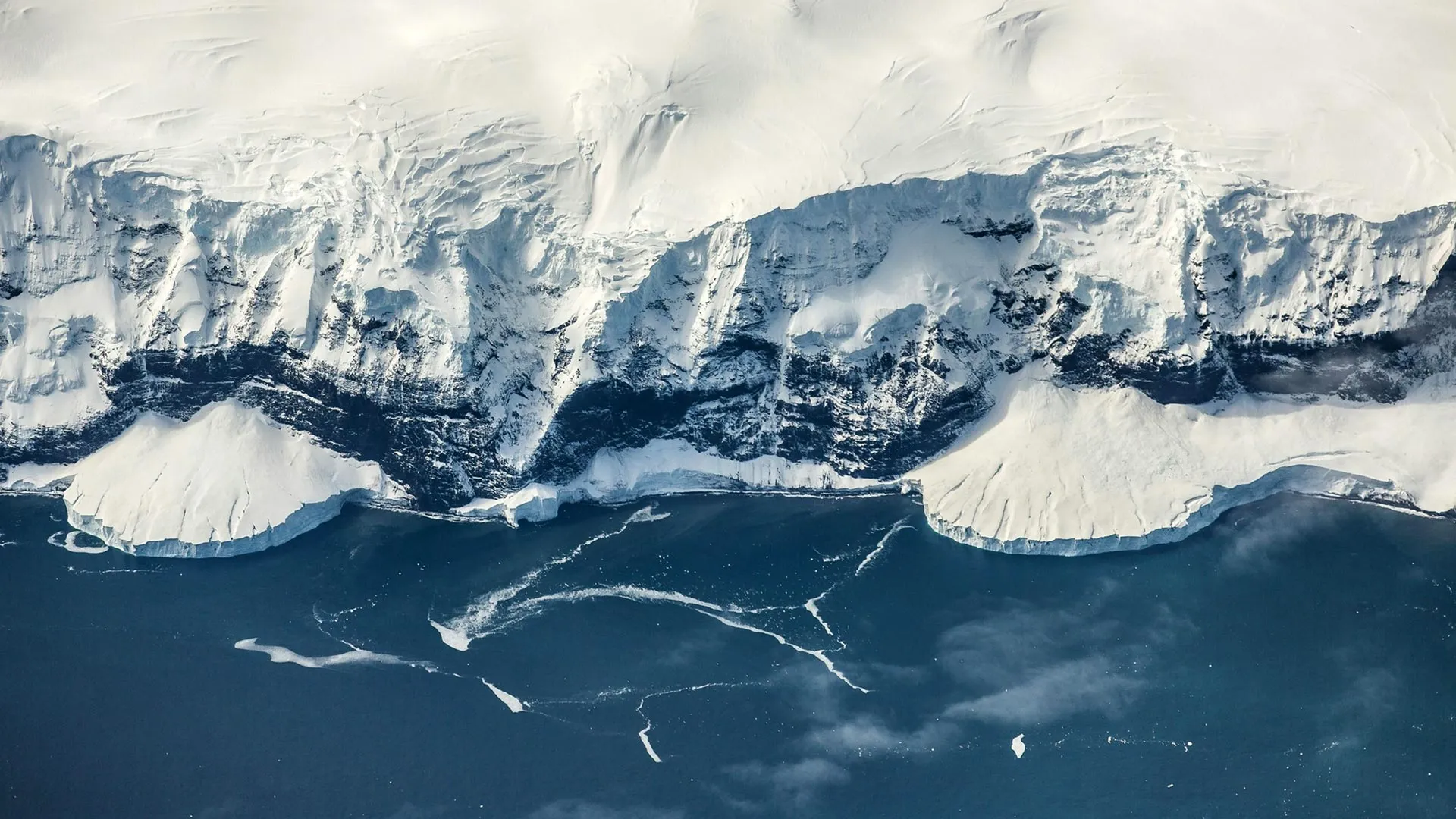
LONDON — For decades, one fundamental climatological riddle has baffled Earth scientists: How did Antarctica manage to develop a colossal, continent-spanning ice sheet roughly 34 million years ago during an epoch when global atmospheric temperatures were approximately 5°C warmer than they are today?
While falling concentrations of atmospheric carbon dioxide ($CO_2$) have long been cited as a primary driver of global cooling, they fail to completely explain the profound temporal asymmetry between the planet’s two polar regions. While Antarctica plunged into a deep, permanent freeze during the Eocene-Oligocene transition, the Arctic remained largely ice-free for millions of years longer, with its own major ice sheets failing to emerge until roughly the past five million years.
Now, an international team of geoscientists and climate researchers has unveiled a groundbreaking answer. In a study published in the prestigious journal Science, researchers reveal that the answer lies not solely in the skies or the atmosphere, but deep within the Earth’s interior. Slow, colossal tectonic movements over a span of more than 100 million years lifted the landmass of East Antarctica into the upper troposphere, creating towering plateaus and mountain ranges that provided the permanent foothold needed for ice to accumulate—long before global temperatures dropped sufficiently to freeze the rest of the planet.
Main Facts: The Tectonic Cradle of the World’s Largest Ice Sheet
The new study demonstrates that the formation of the East Antarctic Ice Sheet—currently the largest single mass of ice on Earth, containing enough frozen water to raise global sea levels by an estimated 52 meters (171 feet) if it were to melt completely—was fundamentally preconditioned by geology.
The core findings of the research can be summarized as follows:
- The Elevation Trigger: As East Antarctica’s terrain slowly rose, crossing a critical threshold of approximately 2 kilometers (1.2 miles) in elevation, regional temperatures dropped low enough for mountain glaciers to form and persist year-round.
- Mantle Waves: The primary mechanism driving this dramatic uplift was a newly discovered geological phenomenon known as "mantle waves"—slow-moving thermal and dynamic disturbances rippling through the Earth’s mantle following continental breakup.
- The Role of Topography: Before 50 million years ago, the interior Gamburtsev Mountain range sat at modest elevations. By 34 million years ago, tectonic uplift had pushed nearly half of the range above the critical 2-kilometer mark, initiating runaway glaciation.
- Global Implications: The research suggests that Earth’s internal geological processes act as a primary "preconditioner" for major climate shifts, dictating the geographical timing of global ice ages.
The research was spearheaded by the University of Southampton in the United Kingdom, in close collaboration with an elite global consortium of academic institutions. These include Durham University, the GFZ Helmholtz Centre for Geosciences in Potsdam, the University of Potsdam, Utrecht University in the Netherlands, and the University of Florence in Italy. Financial and logistical support for the complex computational modeling was provided by the WoodNext Foundation.
Chronology: A 100-Million-Year Journey to the Ice
To comprehend how the frozen continent of today evolved from a relatively temperate landmass, researchers had to look backward across a vast expanse of geological time. The timeline of Antarctic glaciation is a complex interplay between plate tectonics, mantle dynamics, and climatic tipping points.
The Jurassic Split (201–143 Million Years Ago)
The foundational stage of Antarctica’s transformation began long before the first snowflake fell on its interior. During the Jurassic Period, the ancient supercontinent of Gondwana began to break apart. Antarctica and Africa initiated their slow, inexorable separation, tearing apart the Earth’s crust and initiating deep-seated thermal and mechanical disturbances along the continental margins.
The Age of Mantle Waves (100 Million to 45 Million Years Ago)
As tectonic plates continued to drift apart, profound forces deep within the Earth’s interior were set into motion. Researchers utilized advanced computational models to simulate 100 million years of continental evolution in East Antarctica. Their models pointed directly to "mantle waves"—a phenomenon recently identified by the research team.
These slow-moving waves travel beneath continental interiors in the wake of tectonic rifting. Previously linked by scientists to the subterranean ascent of diamond-bearing volcanic pipes and mysterious episodes of regional uplift, these waves swept beneath East Antarctica over tens of millions of years. This prolonged subterranean activity steadily elevated a vast interior plateau, concurrently thrusting the hidden Gamburtsev Mountain range upward.
Crossing the Threshold (45 Million to 34 Million Years Ago)
By approximately 45 million years ago, the continuous, creeping ascent of the East Antarctic landmass pushed significant portions of the continent past a critical climatic altitude: roughly 2 kilometers above sea level.
At this elevation, lapse rates—the natural cooling of air with increasing altitude—ensured that local temperatures plummeted, dropping roughly 1°C for every 100 meters gained. Snow began to survive the summer melt season, accumulating year after year. Mountain glaciers formed, expanded, and eventually coalesced into a unified, continent-scale ice cap by roughly 34 million years ago, effectively locking the continent into a permanent deep freeze.
Supporting Data and Geophysical Mechanisms
The study’s conclusions are underpinned by sophisticated numerical modeling that integrated geodynamic simulations of the Earth’s mantle with paleotopographic reconstructions and climate system models.
Overcoming the Warm-World Paradox
The primary enigma tackled by the researchers was the coexistence of massive ice sheets with an Eocene climate that was roughly 5°C warmer than today. Standard climate simulations running purely on greenhouse gas concentrations struggle to account for permanent ice in a warm world.
The Southampton-led team demonstrated that topography provides the missing variable. Because air temperature drops systematically with altitude, tectonic uplift effectively manufactured localized "cold islands" in the sky. These elevated regions bypassed the constraints of the global background climate, remaining cold enough to sustain ice even while the surrounding Southern Ocean and global atmosphere remained balmy.
The Cascade of Climate Feedbacks
Once tectonic activity hoisted the Antarctic landscape into the cryogenic zone, a series of powerful, self-reinforcing climate feedbacks took over, accelerating the spread of ice from the mountains down to the coast:
- The Ice-Albedo Feedback: As the fledgling ice sheet expanded, its brilliant white surface began reflecting a significantly higher percentage of incoming solar radiation back out into space rather than absorbing it. This regional reduction in solar heat absorption drove local temperatures down further, a process the researchers estimate ultimately shaved about 1°C off global temperatures.
- Atmospheric Drying: As the polar atmosphere cooled, its capacity to hold water vapor—a potent greenhouse gas that acts as an atmospheric insulating blanket—diminished drastically. The resulting drop in atmospheric moisture weakened the natural greenhouse effect over the continent, dropping temperatures still further and allowing the ice sheet to surge outward toward the coast.
These combined mechanisms explain why the Southern Hemisphere experienced early, aggressive glaciation while the Northern Hemisphere—devoid of equivalent high-altitude landmasses at the time—remained largely ice-free for tens of millions of years longer.
Official Responses and Expert Insights
The study has drawn widespread praise from the international geosciences community for bridging the traditional gap between solid-earth geodynamics and atmospheric climate science.
Thomas Gernon, Professor of Earth Science at the University of Southampton and lead author of the study, emphasized the profound shift in how scientists must view paleoclimate history:
"Antarctica’s land surface was gradually lifted to the point where ice could gain a permanent foothold, even while the surrounding polar oceans as well as global temperatures remained surprisingly warm."
Gernon noted that viewing polar history through the lens of atmospheric chemistry alone creates a misleading picture of symmetry between the hemispheres:
"If falling levels of $CO_2$ acted alone, you would expect the poles to respond more symmetrically. Instead, Antarctica gained a major head start because geological processes had raised land to higher elevations, making it colder."
Dr. Thea Hincks, Senior Research Fellow at the University of Southampton and co-lead author of the research, highlighted the precision of the team’s modeling techniques:
"We found that our models can realistically capture the evolution of the two-kilometer-high coastal escarpment, elevated plateau, and inland mountains, eventually seeding the East Antarctic Ice Sheet."
Commenting on the critical role played by localized geography, Dr. Guy Paxman, a Royal Society University Research Fellow at Durham University and co-author of the study, underscored the direct link between elevation and thermal drop:
"Topography is fundamentally important for glaciation. Air temperatures can drop by up to 1°C for every 100 meters of altitude gained."
Meanwhile, Dr. Philip Goodwin, a climate physicist at the University of Southampton who contributed to the study, elaborated on the compounding nature of the regional cooling:
"As the ice sheet expanded, its bright surface reflected more sunlight back into space, cooling the region further. Together, these feedbacks allowed the Antarctic ice sheet to spread from the mountains across the continent, eventually reaching the coast."
Implications for Ancient Ice Ages and Future Climate Tipping Points
Beyond solving a longstanding paleoclimatic mystery regarding the Eocene-Oligocene transition, these findings carry profound implications for the broader study of Earth history and future climate forecasting.
For decades, paleoclimatologists have heavily emphasized atmospheric greenhouse gas concentrations as the master dial controlling global ice ages. This new research suggests a far more complex, interdependent paradigm: Earth’s solid interior acts as a preconditioning agent for climate change.
By altering the topography of continents, tectonic forces determine when and where major planetary climate transitions become physically possible. Without the slow, subterranean march of mantle waves lifting East Antarctica into the sky, the planet might have remained ice-free for millions of years longer, drastically altering the course of evolutionary history, oceanic circulation, and global sea-level fluctuations.
As scientists look forward, understanding the intricate coupling between deep-earth geology and surface climate systems is more critical than ever. Recognizing how geological preconditioning influences planetary tipping points provides researchers with sharper tools to model not only the ancient epochs of our dynamic planet, but also the sensitivities and vulnerabilities of Earth’s modern climate system in an era of rapid anthropogenic change.
