

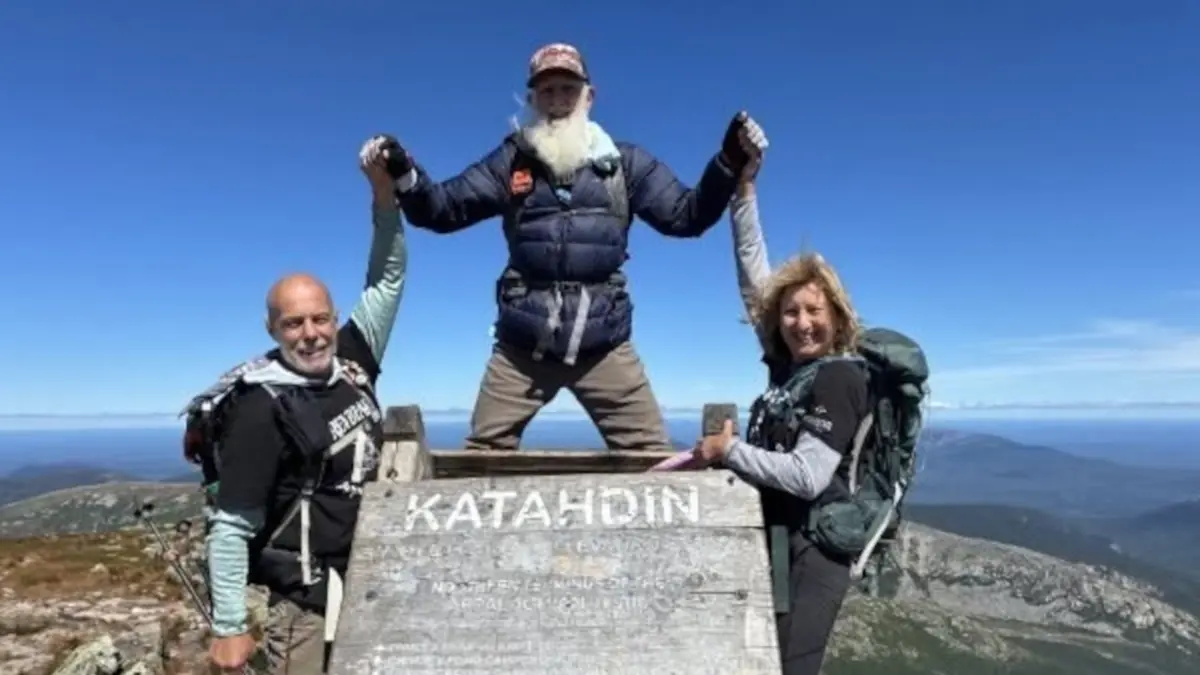
MOUNTAIN KATAHDIN, Maine — In the crisp, high-altitude air of Maine on a Monday morning, history was quietly made atop the iconic 5,269-foot summit of Mt. Katahdin. Standing proudly at the northern terminus of the Appalachian Trail (AT), Dale “Grey Beard” Sanders etched his name into the annals of outdoor lore. At 91 years old, Sanders officially became the oldest person in recorded history to successfully thru-hike the legendary, punishing 2,200-mile trail.
Reaching the end of the line required far more than just putting one foot in front of the other; it demanded a grueling calendar-year expedition that tested the absolute limits of human endurance, mental fortitude, and physiological resilience. For Sanders, the victory was the culmination of a lifelong passion for the wild, a testament to enduring friendship, and a masterclass in defying expectations.
Main Facts
The core achievement of Sanders’ journey is staggering by any demographic standard, let alone for a nonagenarian. To secure the official thru-hiking record, Sanders completed the entire 2,200-mile stretch of the Appalachian Trail—spanning from Springer Mountain in Georgia all the way to Maine’s Mt. Katahdin—within a single calendar year.
However, the journey was far from a celebratory stroll through the woods. Sanders faced a barrage of compounding crises along the trail. Severe physical fatigue, the emotional grief of losing a loved one, and a sudden, debilitating injury threatened to halt his progress entirely. The medical setback was severe enough to land him in the hospital, occurring with just 142 miles remaining between him and the northern terminus.
Despite these near-catastrophic obstacles, Sanders persevered through intense rehabilitation and sheer willpower. He crossed the finish line at Mt. Katahdin with a mere six days to spare before his self-imposed and calendar-year record cutoffs. In doing so, he eclipsed the previous record held by his close friend and fellow long-distance backpacking icon, M.J. “Nimblewill Nomad” Eberhart.
Chronology: A History of Ambition and Records
Sanders’ monumental 2026 hike is just the latest chapter in an extraordinary multi-decade legacy of endurance athletics. His relationship with the Appalachian Trail and other major American wilderness landmarks spans many years, marked by friendly competition, mutual respect, and relentless ambition.
2015: Mastering the Mississippi
Long before he was capturing national headlines for his pedestrian feats, Sanders was conquering America’s waterways. In 2015, at an age when most of his peers had been retired for decades, Sanders set the age record for paddling the entire 2,300-mile length of the Mississippi River. The feat required months of isolated river navigation, testing his upper-body strength, navigational skills, and mental stamina against changing currents and unpredictable weather.
2017: The First AT Record
Sanders first entered the mainstream backpacking consciousness in 2017 when he claimed the Appalachian Trail age record for the very first time at the age of 82. Speaking with Outside magazine shortly after that completion, Sanders admitted that it was one of the most physically punishing experiences of his life. He recalled enduring single-digit temperatures that made it the coldest he had ever been. When asked about his greatest fear during the trek, Sanders confessed it was the terrifying prospect of being wet, freezing, and entirely unable to warm himself while isolated deep in the wilderness. Despite those harrowing moments, he pushed through the elements to complete the route.
2021: Passing the Torch to a Friend
Sanders’ record did not stand forever. Four years after his 2017 triumph, his long-time friend and fellow adventurer M.J. “Nimblewill Nomad” Eberhart stepped onto the trail and captured the record at the age of 83. Rather than stoking bitterness, the transition of the record fostered a unique bond. Eberhart remarked at the time that Sanders was likely the only human being on the planet who could truly comprehend the physical and psychological toll of thru-hiking at such an advanced age, solidifying a deep, lifelong camaraderie between the two men.
2020–2026: Canyonlands and the Final Push
In 2020, proving that water and forests were not his only domains, Sanders claimed yet another age record—this time for completing the Grand Canyon’s grueling Rim-to-Rim-to-Rim hike. At 85 years old, he successfully navigated over 40 miles of rugged desert terrain and accumulated more than 20,000 feet of total elevation change.
Yet, the call of the Appalachian Trail remained irresistible. Returning to the AT in his nineties, Sanders faced his ultimate test, culminating in his triumphant return to the summit of Mt. Katahdin in August 2026.
Supporting Data and Trail Realities
To understand the magnitude of what Sanders accomplished, one must examine the raw data of an Appalachian Trail thru-hike. The AT covers approximately 2,200 miles of rugged terrain across 14 states, featuring a cumulative elevation gain roughly equivalent to climbing Mount Everest from sea level nearly 16 times.
- Distance: ~2,200 miles
- States Traversed: 14 (Georgia, North Carolina, Tennessee, Virginia, West Virginia, Maryland, Pennsylvania, New Jersey, New York, Connecticut, Massachusetts, Vermont, New Hampshire, Maine)
- Total Elevation Change: ~464,500 feet of elevation gain (equivalent to climbing Everest 16 times)
- Success Rate: Roughly only 1 in 4 aspiring thru-hikers successfully complete the entire trail in a single attempt, regardless of age. For a 91-year-old, the physiological hurdles—including muscle mass degradation, joint wear, cardiovascular stress, and nutritional deficits—make the success rate statistically near-zero.
Sanders himself was acutely aware of these brutal metrics. Earlier in August 2026, as he battled through the final stretches of his journey, Sanders took to social media to strip away any romanticized notions of long-distance backpacking.
"Hiking the AT is never a simple task," Sanders wrote in a candid Facebook post detailing his struggles. "Very complex for any age hiker. For me this past week was no exception. Thank God it’s behind me. Now it’s time to clear the air, the full truth, let it all hang out to dry."
His brutal honesty resonated with the outdoor community, laying bare the blisters, the arthritic flare-ups, the existential exhaustion, and the profound mental weight of pushing an aging body far past its prescribed boundaries.
Official Responses and Peer Reactions
The outdoor recreation industry and Sanders’ inner circle have responded to his latest world-record achievement with a mixture of awe, reverence, and profound relief.
M.J. "Nimblewill Nomad" Eberhart, who held the record for the past five years, watched his friend’s grueling journey with a mixture of anxiety and enthusiastic support. Having spent months cheering Sanders on from afar, Eberhart spoke candidly to Backpacker magazine following the historic summit.
"I’m way more than ready to pass the torch," Eberhart said, signaling not just an athletic handover, but a deep sense of shared brotherhood. Eberhart noted that watching Sanders endure hospitalizations, grief, and exhaustion on the trail was difficult, but ultimately reinforced his belief in Sanders’ indomitable spirit.
Hiking forums, social media channels, and wilderness conservation groups have similarly flooded with congratulatory messages. Younger thru-hikers—many in their twenties and thirties who frequently post about quitting due to shin splints or homesickness—have pointed to Sanders as the ultimate yardstick for perseverance.
Implications: Redefining Aging and Human Potential
Dale “Grey Beard” Sanders’ successful 2026 thru-hike of the Appalachian Trail transcends the realm of sports trivia or record-book statistics. It forces a profound cultural re-evaluation of what society expects from the aging process and redefines the outer boundaries of human potential.
Challenging Societal Perceptions of Aging
In modern industrialized societies, aging is frequently medicalized, sidelined, and associated with inevitable decline, institutionalization, and physical passivity. Nonagenarians are typically depicted in rocking chairs, navigating assisted living facilities, or managing chronic illnesses from the comfort of a living room.
Sanders shatters this paradigm with sledgehammer force. By traversing 2,200 miles of unforgiving wilderness, navigating boulder fields, braving hypothermic conditions, and recovering from acute hospitalizations at age 91, he demonstrates that vitality, purpose, and physical capability can extend far deeper into the human lifespan than conventional wisdom suggests. His journey serves as a living, breathing rebuttal to ageism, proving that passions need not expire with a birth certificate.
The Mental Health and Wilderness Connection
Beyond physical fitness, Sanders’ accomplishment underscores the powerful therapeutic symbiosis between the human mind and the natural world. Experts in gerontology and environmental psychology note that extreme endurance endeavors late in life often rely less on raw muscular power and more on psychological resilience, a deep sense of purpose, and emotional regulation—qualties that Sanders accumulated over nearly a century of life experience. The wilderness provided not only a physical obstacle course, but a canvas for spiritual and mental endurance.
Inspiring Future Generations
The ripple effects of Sanders’ hike will likely be felt for generations. For middle-aged and older adults contemplating lifestyle changes, Sanders is a beacon of possibility. His philosophy rejects the idea that adventure has an expiration date.
As Dale “Grey Beard” Sanders stood atop Mt. Katahdin taking in the sweeping views of the Maine wilderness—having survived the mountains, the elements, his own breaking body, and the relentless march of time—he did more than just reclaim a record from a friend. He left an indelible blueprint for anyone daring enough to ask just how far they can go, no matter what number is next to their name.
