

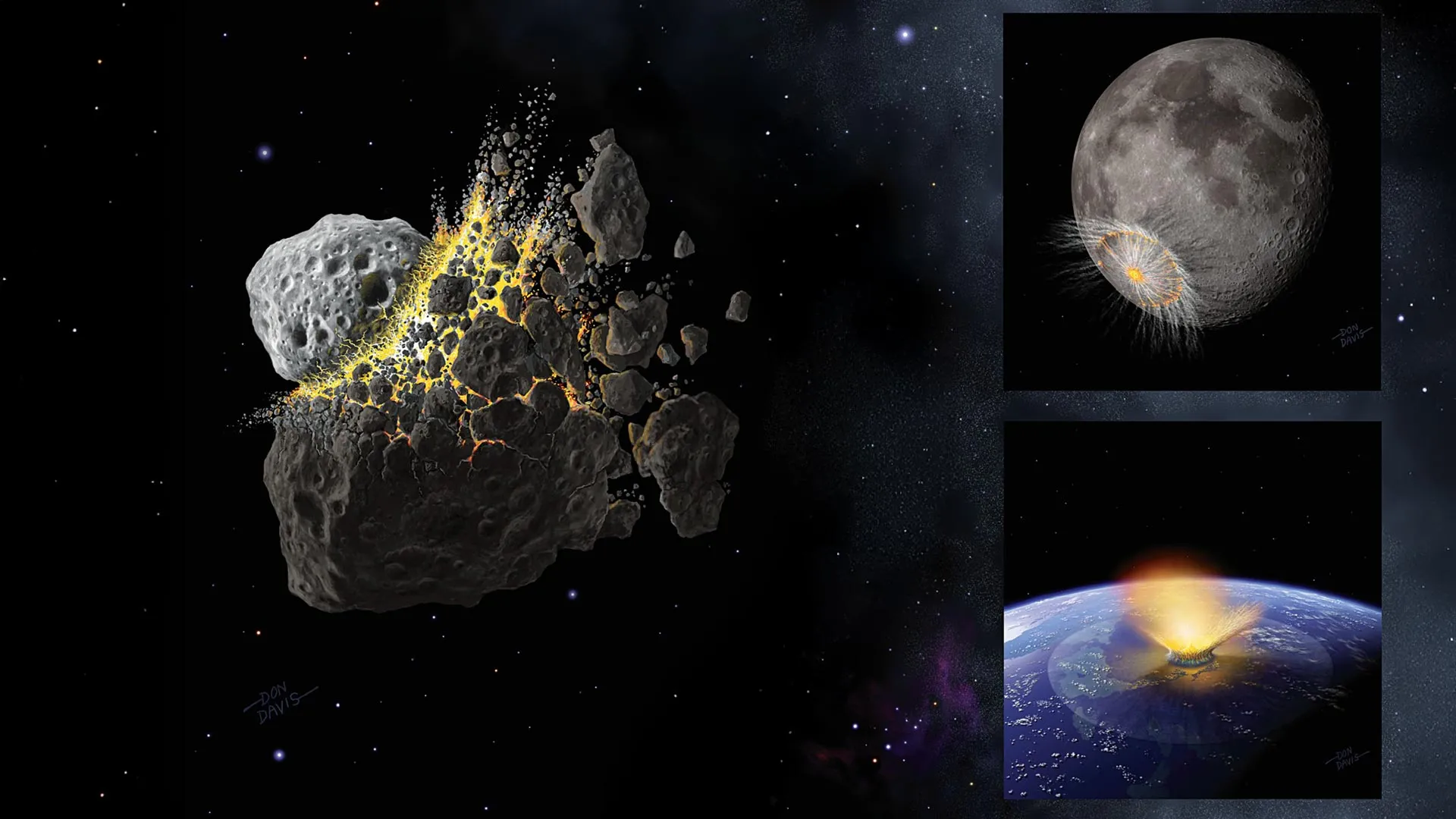
WASHINGTON — In the cosmic theater of our solar system, Earth and its rocky neighbors have long played the roles of both survivors and targets. While the catastrophic impact that wiped out the nonavian dinosaurs 66 million years ago remains a well-documented turning point in planetary history, scientists are now peering much further back into the primordial past to uncover an even grander celestial bombardment.
According to a groundbreaking study led by the Southwest Research Institute (SwRI), a violent, high-speed collision in the main asteroid belt approximately 800 million years ago triggered a prolonged wave of planetary impacts. This cosmic shrapnel rained down not just on the Moon, but heavily pelted Earth, Mars, and other inner solar system bodies.
The research suggests that the breakup of a massive parent object—the progenitor of the Eulalia asteroid family—sent trillions of tons of debris hurtling toward the terrestrial planets. Far from being a mere astronomical footnote, this ancient bombardment may have fundamentally altered geological landscapes, driven planetary-scale climate shifts, and potentially influenced the very trajectory of early life on Earth.
Main Facts: Uncovering the Eulalia Breakup
At the heart of this new planetary reconstruction is the identification of a single, catastrophic event in the main asteroid belt, situated between Mars and Jupiter. Researchers used advanced collisional and dynamical computer models to trace the genealogy of the Eulalia asteroid family back to a colossal prehistoric smashup.
- The Culprit: A primitive, carbon-rich parent body—resembling carbonaceous chondrites, some of the most ancient and volatile-rich materials in the solar system—was shattered by an impact.
- The Location: The breakup occurred dangerously close to a gravitational sweet spot known as the 3:1 mean motion resonance with Jupiter.
- The Scale of Debris: The cataclysm launched a continuous shower of fragments into the inner solar system, creating an impact spike that lasted for over a hundred million years.
- The Planetary Toll: Because Earth possesses a significantly larger surface area and stronger gravitational pull than the Moon, scientists calculate that for every large impact crater carved into the lunar surface, roughly twenty comparable or larger objects slammed into Earth.
Despite the monumental scale of this prehistoric meteor storm, finding direct physical evidence of it on Earth has proven exceptionally difficult. While the Moon preserves its craters in near-pristine vacuum conditions, Earth is a living, geologically active planet. Over hundreds of millions of years, plate tectonics, continental drift, volcanic eruptions, and relentless weathering have erased or buried the vast majority of Earth’s ancient impact structures. Consequently, scientists had to look elsewhere to read the scars of deep-time history.
Chronology of a Cosmic Event: From Belt to Biosphere
To understand how an event deep in the asteroid belt translated into a barrage across the inner solar system, researchers mapped out a precise chronological sequence of events spanning hundreds of millions of years.
Phase 1: The Initial Cataclysm (Approx. 800 Million Years Ago)
Two primitive asteroids collided within the main belt at devastating velocities. Because the parent body of the Eulalia family was positioned precariously near Jupiter’s gravitational influence—specifically the J3:1 resonance zone—the mechanics of the breakup were uniquely efficient. Approximately half of all the resulting fragments were immediately swept into unstable, elongated orbits that crossed the paths of the inner planets.
Phase 2: The Immediate Bombardment
In the immediate aftermath of the breakup, a sudden surge of meteoroids and asteroids cascaded inward. Both the Moon and Earth experienced a sharp, dramatic spike in impact rates. While the Moon’s static surface absorbed these hits and locked them into its geological history, Earth endured a multi-pronged barrage of massive impactors that dwarfed anything seen in modern human history.
Phase 3: The Yarkovsky Effect and the Long Tail (800 to 650 Million Years Ago)
The bombardment did not stop with the initial spray of debris. Over the next 100 to 150 million years, another 25% of the remaining Eulalia fragments gradually migrated into the J3:1 resonance zone through a subtle physical phenomenon known as the Yarkovsky effect.
As asteroids absorb sunlight and later radiate that energy away as infrared heat, the uneven thermal emission creates a microscopic jet-propulsion effect. Over millions of years, this gentle, continuous thermal push alters the orbits of space rocks, steadily feeding them into gravitational escape routes and ensuring a prolonged, multi-stage rain of terror across the inner solar system.
Phase 4: Coincidence with Global Environmental Shifting
By 650 million years ago, the impact storm finally tapered off. Intriguingly, this timeline places the tail end of the asteroid shower right on the doorstep of profound terrestrial transformations, including globally widespread cooling periods and significant shifts in Earth’s biosphere.
Supporting Data: Reading the Lunar Archive and Dynamical Models
Because Earth’s active geology destroys its ancient history books, researchers relied heavily on the Moon as a cosmic proxy.
"These rare events, triggered by large, well-positioned collisions in the main asteroid belt, bombard all inner solar system worlds," explains Dr. William Bottke, an executive director in SwRI’s Solar System Science and Exploration Division in Boulder, Colorado, and lead author of the study. "So, evidence preserved on the Moon’s static surface can be used to infer what happened on Earth and Mars in ancient times."
The Significance of Impact Glass
The lunar hypothesis is built upon decades of data, including the analysis of impact glass collected by Apollo astronauts. When hypervelocity asteroids strike a rocky body, the kinetic energy transforms into intense heat, melting local rock. This molten material rapidly cools into glassy beads.
By dating these impact glasses, scientists discovered a clustering of ages pointing to a massive surge in lunar cratering roughly 800 million years ago. But finding where that material came from remained the missing link until Bottke’s team ran their advanced dynamical models.
Carbonaceous Chondrites and Jupiter’s Gravity
The model highlights the critical role of Jupiter. In the J3:1 resonance configuration, an asteroid completes three orbits around the Sun for every single orbit completed by Jupiter. The gas giant’s repeated gravitational nudges act like a cosmic slingshot, destabilizing objects and ejecting them from the safety of the asteroid belt into planet-crossing trajectories.
The chemical makeup of the Eulalia family—consisting of carbonaceous material, which can also carry water-bearing minerals and complex organic molecules—means that this specific asteroid family didn’t just deliver destruction; it also seeded the inner solar system with vast quantities of primitive, volatile-rich material.
Official Responses and Expert Perspectives
The study, published by leading planetary scientists, has opened new avenues for cross-disciplinary research, bridging the gap between astronomy, geology, and evolutionary biology.
Dr. Bottke, who also directs the Center for Lunar Origin and Evolution (CLOE)—part of NASA’s Solar System Exploration Research Virtual Institute—emphasizes just how little we currently know about the deep history of life’s interactions with space debris.
"The role impacts have played in shaping the origin and evolution of life in our solar system is poorly understood," Bottke said. "The heavily cratered surface of the Moon serves as a reminder of the large impacts in Earth’s past, but so far, only the Chicxulub impact event 66 million years ago has been strongly linked to a specific effect on life, namely the mass extinction of the dinosaurs."
While the Chicxulub crater buried beneath Mexico’s Yucatán Peninsula remains the undisputed smoking gun for the demise of the nonavian dinosaurs, researchers point out that prehistoric bombardments were on an entirely different scale. A prolonged shower lasting over 100 million years would have subjected Earth’s primitive ecosystems to repeated, systemic shocks rather than a single, sudden apocalypse.
Other planetary geologists note that Mars also bears the chronological scars of this era. According to the modeling data, the impacts on the Red Planet would have triggered immense episodes of seismic shaking, potentially shaking entire tectonic and volcanic provinces awake and aligning temporally with known surges in Martian volcanic activity.
Implications: A New Lens on Terrestrial Evolution
The realization that an asteroid belt collision could initiate an 800-million-year-old planetary bombardment forces scientists to reconsider how external cosmic forces drive internal planetary evolution.
1. Rewriting Earth’s Climate and Biological History
The precise overlap between the peak of the asteroid barrage and Earth’s descent into severe cooling periods—such as the dramatic "Snowball Earth" ice ages of the Cryogenian period—presents an irresistible scientific puzzle. While the SwRI study stops short of definitively claiming the asteroid shower caused these global ice ages, the chronological coincidence provides a compelling framework for future paleoclimatology research. Dust clouds kicked up by countless impacts, combined with the delivery of volatiles and atmospheric alterations, could easily have disrupted Earth’s delicate climate equilibrium.
2. Redefining Planetary Interconnectedness
The study underscores that the inner solar system does not operate in isolation. A localized kinetic event involving two minor bodies in the distant asteroid belt can send ripples across millions of miles of space, systematically altering the geological and atmospheric destinies of Earth, the Moon, and Mars.
3. Future Exploration Horizons
As space agencies like NASA and international partners look toward future crewed and robotic lunar missions—such as the Artemis program—obtaining deeper, more pristine core samples from ancient lunar basins will become paramount. These future samples will allow scientists to test the Eulalia hypothesis further, refining our understanding of the exact cadence of the bombardment.
Ultimately, the research serves as a humbling reminder of our place in the cosmos. Earth is not a static island floating safely in a serene void; it is an active participant in a dynamic, sometimes violent solar system where ancient collisions light up the night sky and ripple through time, quietly shaping the world we inherit today.
