

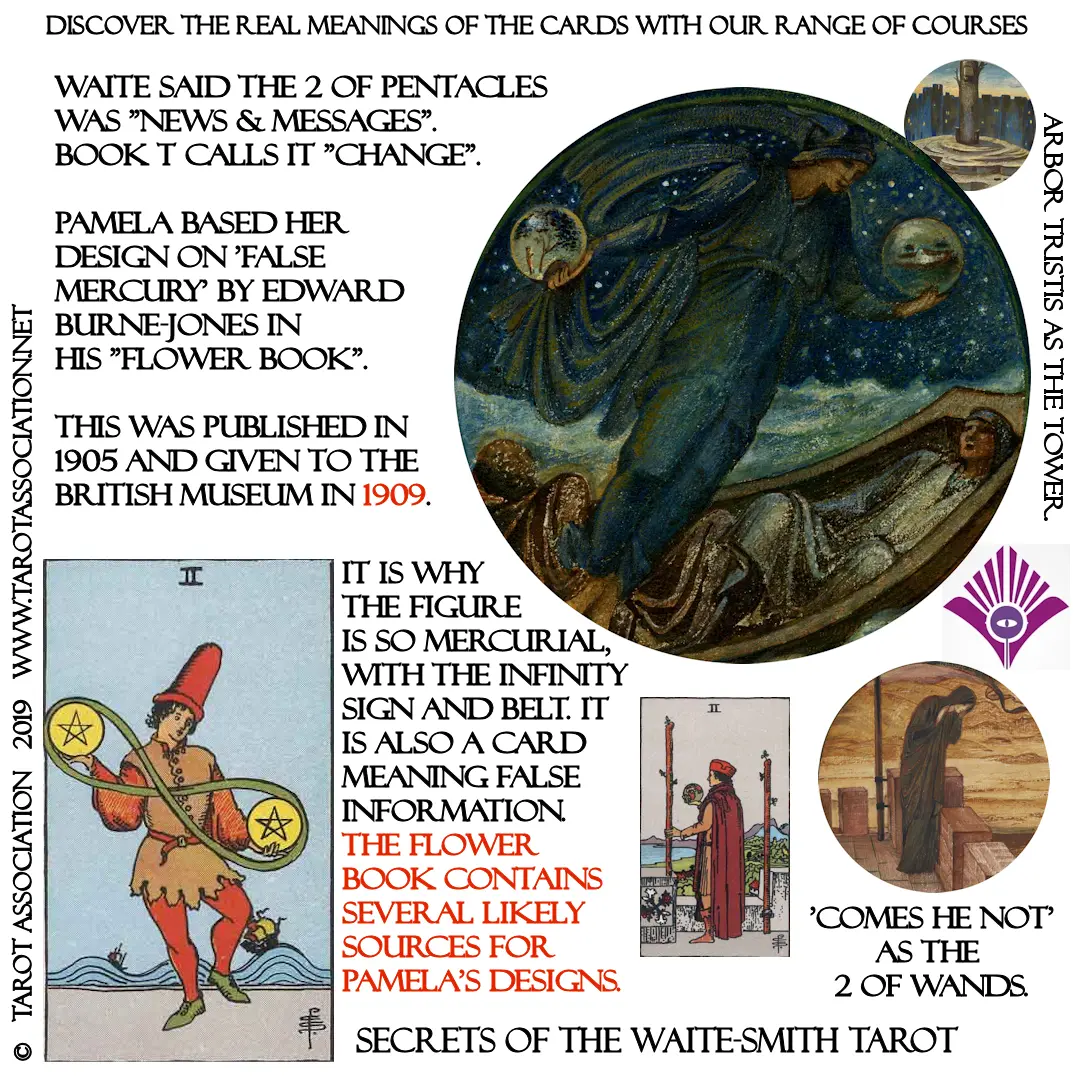
LONDON — For generations, modern tarot enthusiasts have viewed the Two of Pentacles as a benign emblem of time management, fiscal budgeting, and the delicate art of juggling everyday life’s various demands. However, deep archival research and historical occult analysis reveal a much darker, more complex reality. Far from being a simple reminder to balance one’s checkbook, the Two of Pentacles is, in fact, the original "gaslighting" card—steeped in a history of deceptive communications, mercurial double-dealing, and toxic illusions.
A closer look at the foundational texts of Western esoteric traditions, paired with the hidden artistic inspirations of the iconic Rider-Waite-Smith deck, exposes how this classic card has drifted far from its original, cautionary message.
Main Facts: Re-Examining the Two of Pentacles
At its surface level, the Two of Pentacles has long been taught as a symbol of adaptability. Readers interpret the imagery of a figure balancing two coins in a continuous, flowing loop as a sign of navigating financial fluctuations or managing a busy schedule. Yet, occult historians and researchers point out that this interpretation glosses over the profound psychological and communicative perils embedded in the card’s pedigree.
The card’s historical lineage ties it directly to the concepts of alternation, instability, and conflicting messages. Rather than a stable, harmonious balancing act, the traditional esoteric framework views it as a rolling, unpredictable shift between opposing currents.
Key takeaways from the re-evaluation of the card include:
- The Communication Trap: The card’s traditional rulership under Mercury highlights its deep connection to messages, writing, and intellectual exchange—making it a prime indicator of miscommunication, deceit, and manipulated narratives.
- The Poisonous Muse: Artist Pamela Colman Smith’s iconic illustration was directly inspired by a lesser-known botanical drawing of "False Mercury" (Dog’s Mercury), a toxic plant historically associated with false promises and delusions.
- The Modern Relevance: Beyond everyday time management, contemporary readings in romance, finance, and career must account for the card’s latent warnings regarding deliberate deception, insincerity, and psychological manipulation.
Chronology: The Evolution of an Esoteric Symbol
To understand how the Two of Pentacles acquired its modern, sanitized reputation, one must trace its development through the milestones of modern tarot history.
1. The Golden Dawn Foundation
Long before the Rider-Waite-Smith deck captured the public imagination, the Hermetic Order of the Golden Dawn established the foundational magical correspondences for the tarot. In the Golden Dawn’s Book T—the secret instructional manuscript utilized by both A.E. Waite and Aleister Crowley—the Two of Pentacles was assigned to Chockmah of Assiah (Wisdom of Action) and the astrological decan of Jupiter in Capricorn.
The Golden Dawn’s original designation for the card was "The Lord of Harmonious Change." However, the descriptive text paints a far more volatile picture: "The harmony of change, alternation of gain and loss; weakness and strength; everchanging occupation; wandering, discontented with any fixed condition of things; now elated, then melancholy; industrious, yet unreliable… alternatively talkative and suspicious."
2. The Publication of the Pictorial Key (1910)
When A.E. Waite published his Pictorial Key to the Tarot alongside Pamela Colman Smith’s revolutionary artwork, he struggled to explicitly reference the secret doctrines of Book T. Instead, Waite framed the card as a duality: on one hand representing gaiety and recreation, but on the other hand portending news, messages in writing, obstacles, agitation, and imaginary troubles. Reversed, the card took on even darker connotations, pointing to enforced gaiety, simulated enjoyment, bad omen, ignorance, and injustice.
3. The 1909 British Museum Discovery
The true visual genesis of the card was locked away until 1909, the very year Waite and Smith visited the British Museum for artistic inspiration. During this visit, a privately printed, illustrated botanical and poetic notebook by artist Edward Burne-Jones was deposited in the museum’s archives.
Burne-Jones had created illustrations based on the folk names of herbs and flowers. Among them was a depiction of "False Mercury"—a toxic woodland plant (Mercurialis perennis) known for misleading sailors with visions of shelter and home during their delirious states. Smith borrowed this exact motif for the Two of Pentacles, placing a mercurial figure balancing spheres atop a tossing ocean wave, effectively encoding the concept of a "false messenger" into the fabric of the tarot.
Supporting Data: Esoteric Frameworks and Modern Interpretations
The table below illustrates the stark contrast between the traditional esoteric roots of the Two of Pentacles and its widely accepted modern adaptations:
| Category | Traditional / Esoteric Meaning | Modern Popular Interpretation |
|---|---|---|
| Primary Theme | Volatile change, alternating currents, duplicity | Time management, multitasking, budgeting |
| Communicative Tone | Conflicting messages, suspicion, gaslighting | Open dialogue, adjusting schedules |
| Astrological/Magical | Jupiter in Capricorn, Chockmah in Assiah | Practical earthly stability |
| Visual Symbolism | False Mercury, toxic illusions, turbulent seas | Juggling coins in a playful or steady rhythm |
Implications Across Life Domains
When the Two of Pentacles appears in a contemporary tarot reading, its expanded, historically accurate meaning demands a closer examination of the querent’s environment. Beyond simple logistics, practitioners must look out for underlying manipulation.
Romance and Relationships
While surface readings suggest the normal ebb and flow of relationship dynamics, a deeper evaluation warns against deliberate psychological manipulation. If communication feels erratic, or if one partner is altering narratives to keep the other off-balance, this card serves as a red flag. It is time to test the ground and verify where you truly stand.
Finance and Career
In professional and financial contexts, the card moves past simple budgeting. It cautions that someone may be actively misleading you regarding the true potential of an investment, project, or workplace agreement. Vague verbal promises must be put into writing immediately to protect against underhanded dealings.
Spiritual and Esoteric Integration
For those traversing a path of spiritual initiation, the card represents the ultimate test of grounding esoteric principles in the material world. It acknowledges the friction between worldly realities and mystical pursuits, urging the seeker to remain authentic and avoid self-deception during periods of rapid transition.
Expert Insights and Official Perspectives
Modern tarot scholars who have exhaustively researched the archives of the Golden Dawn and the personal papers of the Rider-Waite-Smith creators emphasize that modern readers have frequently diluted the rich, psychological depth of the Minor Arcana.
In their seminal work Secrets of the Waite-Smith Tarot, researchers Marcus Katz and Tali Goodwin highlight how Smith embedded subtle historical and artistic references throughout the deck, drawing heavily from obscure Victorian texts and museum artifacts. By tying the Two of Pentacles directly to Edward Burne-Jones’s concept of "False Mercury," Smith intentionally signaled themes of unreliability, double-dealing, and manufactured instability.
As esoteric researcher and author David Bain notes, the energetic signature of the card represents a "rolling change"—a state of perpetual shifting that leaves individuals vulnerable to external manipulation if they fail to ground themselves in objective reality.
Conclusion: A Qualified Verdict
When evaluated as a Yes/No query, the Two of Pentacles delivers a qualified YES. The overarching trajectory of the situation points toward a positive, harmonious outcome, but it demands that the querent navigate a landscape of temporary setbacks, fluctuating narratives, and shifting priorities.
Ultimately, the true wisdom of the Two of Pentacles can be summed up in a single directive: "Balance your resources and keep it real during a period of positive change." By stripping away the modern illusion that the card is merely about a busy schedule, seekers can reclaim its original warning against deception, recognizing the subtle signs of gaslighting before they disrupt their foundation.
