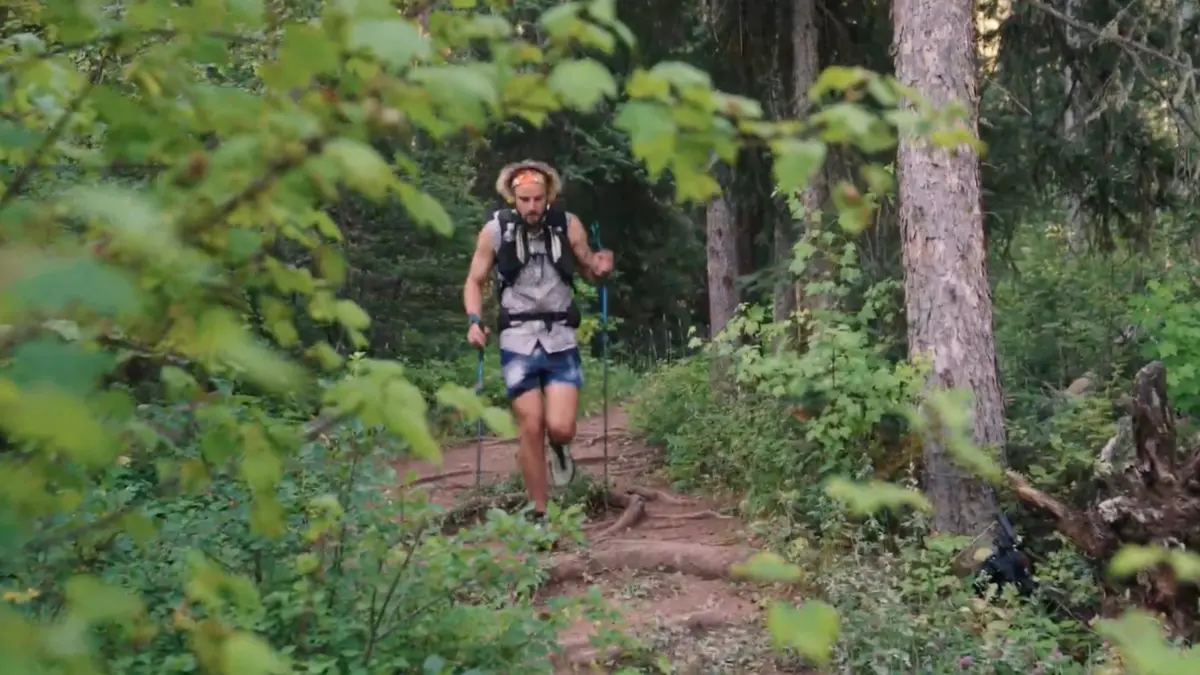
For elite ultrarunner and adventure athlete Jeff “Legend” Garmire, moving fast is a way of life. Over a career defined by breathtaking speed and relentless endurance, Garmire has secured Fastest Known Times (FKTs) across more than 20 major routes in the United States and abroad, including elite markers on the John Muir, Wonderland, and Colorado Trails. Yet, his most recent achievement is in a league of its own.
In 2025, Garmire completed a grueling, self-supported thru-hike of the 2,190-mile Appalachian Trail (AT) in a staggering 45 days, 8 hours, and 37 minutes. The effort shattered an eight-year-old self-supported record by a razor-thin margin of just four hours. While the physical toll was historic, the emotional stakes were immeasurably higher. This grueling race against the clock marked Garmire’s triumphant return to the very ribbon of dirt that, a decade prior, literally saved his life.
The raw, unfiltered journey is captured in Rewritten, a new documentary directed and co-produced by his fiancée, Allison Powell. Debuting on YouTube on August 28, the film weaves together gripping on-trail footage and intimate interviews, chronicling Garmire’s month-and-a-half-long ordeal of logging 50-plus-mile days on as little as an hour of sleep per night.
Main Facts: The Anatomy of a Record-Breaking Thru-Hike
The numbers behind Garmire’s 2025 Appalachian Trail push underline the absolute extreme of modern ultrarunning and fastpacking:
Total Distance: Approximately 2,190 miles spanning from Mount Springer, Georgia, to Mount Katahdin, Maine.
Total Time: 45 days, 8 hours, and 37 minutes.
Record Broken: The 8-year-old men’s self-supported Appalachian Trail FKT, beaten by 4 hours.
Daily Average: Over 50 miles per day.
Sleep Deprivation: Operating on as little as 60 minutes of sleep per night during the final stretches.
Logistical Failures: Two left shoes mailed in a resupply box, an entire resupply box discarded due to mice infestation in Shenandoah National Park, and a lost tech-charger bag in the Smokies.
Documentary Release:Rewritten, directed by Allison Powell, premieres on YouTube on August 28, 2026.
Chronology: From the Brink of Despair to the White Mountains
The Descent and the Lifeline (Pre-2015)
Before becoming a fixture in the endurance community, Garmire was trapped in a lifestyle that many young professionals recognize all too well. Working as a contract CFO in Denver, Colorado, he found himself suffocated by corporate routine, mounting pressure, and profound depression.
"The last time I did this trail was the closest I’ve ever been to wanting to take my own life," Garmire shares in Rewritten. Facing dark thoughts of suicide, he realized he had nothing left to lose. He made a radical choice: he quit his career, abandoned financial security, and set off to thru-hike the Calendar Year Triple Crown. That initial eight-month immersion in the wilderness changed the trajectory of his existence, pulling him from the brink and teaching him that freedom existed far beyond the boundaries of billable hours and fluorescent-lit offices.
The Training Ground: Dialing in the White Mountains
Living in Montana, Garmire nonetheless chose to head east to the rugged terrain of New Hampshire’s White Mountains to prepare for his historic 2025 FKT attempt. Facing off against some of the fiercest competition in the sport, he refused to leave anything to chance.
Spending two weeks running the most punishing section of the AT, Garmire sought to stress-test his nutrition strategy, gear configurations, and physical resolve. While minor tweaks were required, the primary victory of the training block was mental. It quieted his internal doubts and built the unshakeable confidence required to tackle the trail’s most punishing vertical gain without the cushion of modern conveniences.
Supporting Data: Managing Chaos When the Margin is Zero
In a self-supported FKT attempt, accepting outside assistance is strictly forbidden. Every calorie, every piece of gear, and every repair must be managed through pre-sent mail drops or trailside towns. For Garmire, maintaining a blistering pace while executing logistics alone proved to be an uphill battle against Murphy’s Law.
The Two Left Shoes Incident
Shortly after navigating the brutal White Mountains, Garmire opened a resupply box anticipating a fresh pair of trail runners. Instead, he discovered he had mailed himself two left shoes.
"I’ve done that before, so it’s just my personality, I guess, to be great at doing things but less good at planning perfectly," Garmire reflects.
Unable to wear the mismatched footwear, he was forced to continue logging ultramarathon-length miles in shoes already riddled with structural holes. Worse still, realizing his prior planning error, he had to frantically order four new pairs of shoes to upcoming resupply boxes, swallowing an unexpected $800 expense mid-attempt rather than letting logistical failure halt his progress.
The Shenandoah Mouse Catastrophe
Perhaps the lowest logistical point occurred in Shenandoah National Park. Unbeknownst to Garmire, mice had breached several resupply caches, prompting park staff to discard the compromised boxes—including his.
Arriving at the checkpoint expecting food, a power bank, and spare socks, Garmire found nothing. He was forced to push 33 miles on an empty stomach just to reach a local gas station, where he subsisted on a grueling diet of candy bars for the next 140 miles. The nutritional deficit left his gastrointestinal system severely compromised.
Later, just 200 miles from the northern terminus—while operating on a single hour of sleep per night—he inadvertently left his entire tech-charger bag behind at a shelter in the Great Smoky Mountains. Yet, Garmire’s extensive FKT history has forged a unique resilience: rather than melting down under pressure, he views disasters simply as puzzles requiring immediate, calm improvisation.
Official Responses and Reflections: The Psychology of Speed
The Physical Toll: "Christmas Toes" and Shattered Circadian Rhythms
Pushing the human body to cover upwards of 50 miles a day for six weeks straight leaves permanent signatures. Garmire emerged from the trail in a state of severe physical depletion. His circadian rhythm was profoundly broken; for months following the finish, his brain struggled to process normal sleep patterns, waking him up every three hours to eat and stay awake before attempting another micro-rest.
Chronic numbness in his extremities—colloquially known in the ultrarunning community as "Christmas toes" because feeling often fails to return until the winter holidays—became a lasting souvenir. Joint fatigue, deep tissue wear, and foot trauma persisted for nearly seven months post-hike, illustrating the brutal physical tax exacted by high-speed self-supported endurance efforts.
Traditional Thru-Hike vs. High-Speed FKT
When asked how speeding through a landscape alters the spiritual or mental nature of a long-distance trail, Garmire draws a sharp contrast between casual backpacking and elite FKT pushing.
"In a standard, traditional thru-hike… you ride this level plane where there’s adversity, highs and lows, but they’re more muted," Garmire explains. "You have this beauty that’s incredible, you have these feelings of self-fulfillment and self-empowerment… But on an FKT, the highs and lows are so much bigger."
Stripped of sleep and reduced to the primitive triad of eat, sleep, move, Garmire describes a state of hyper-raw vulnerability. Without the buffer of comfort, moments of simple grace—such as a morning sunrise, a bird’s call, or the realization that Virginia’s terrain was relenting—brought him to tears multiple times a day. Gratitude became concentrated, intense, and overwhelming.
Implications: The Future of Fastest Known Times
Garmire’s finishing time of 45 days, 8 hours, and 37 minutes places his self-supported effort uncomfortably close to supported records. To put it in perspective, his self-supported time is now less than five days shy of Tara Dower’s blistering 2024 supported record of 40 days, 18 hours, and 6 minutes—a benchmark aided by a dedicated crew providing food, shelter, and medical support.
The evolution of FKT culture on historic routes like the Appalachian Trail has fundamentally shifted. Once the domain of highly efficient traditional thru-hikers, the space is now increasingly dominated by elite ultrarunners capable of sustaining multi-marathon daily averages.
What Lies Ahead for Long-Trail FKTs?
According to Garmire, the future of FKTs will see even tighter margins as sports science, advanced nutrition, and professionalization infiltrate the ultra-endurance world. However, he emphasizes that technology alone cannot conquer a trail like the AT.
"You have to be so comfortable mentally being alone for that long, and there’s so few ways in life to get that experience," Garmire notes. Furthermore, he points out that external variables—such as shifting climate patterns, intensifying wildfires, and unpredictable weather events—ensure that raw athleticism will increasingly share the stage with sheer luck.
Full Circle: A Message to His Younger Self
Reflecting on his journey from a desperate corporate worker contemplating an end to his life to a record-holding endurance athlete and filmmaker, Garmire offers a perspective grounded in deep gratitude.
If the young man who walked away from his desk in Denver a decade ago could see him now, Garmire believes he would feel a profound sense of validation. Not necessarily because of the numbers in the record books, but because he stayed true to the sanctuary that saved him.
"I think he’d be really proud that when I was at the lowest point, I knew the way I could find some happiness or find some space for my mind to figure out what to do with my life," Garmire reflects. "I went to this place, the outdoors. Just sticking to that is the biggest thing that version of me would be proud of. I think he’d be like, ‘It’s cool you got the record, but it’s also cool you’re still doing this.’"
If you or someone you know is struggling with mental health, depression, or thoughts of self-harm, confidential support is available 24/7. Call, text, or chat with the Suicide and Crisis Lifeline at 988.