

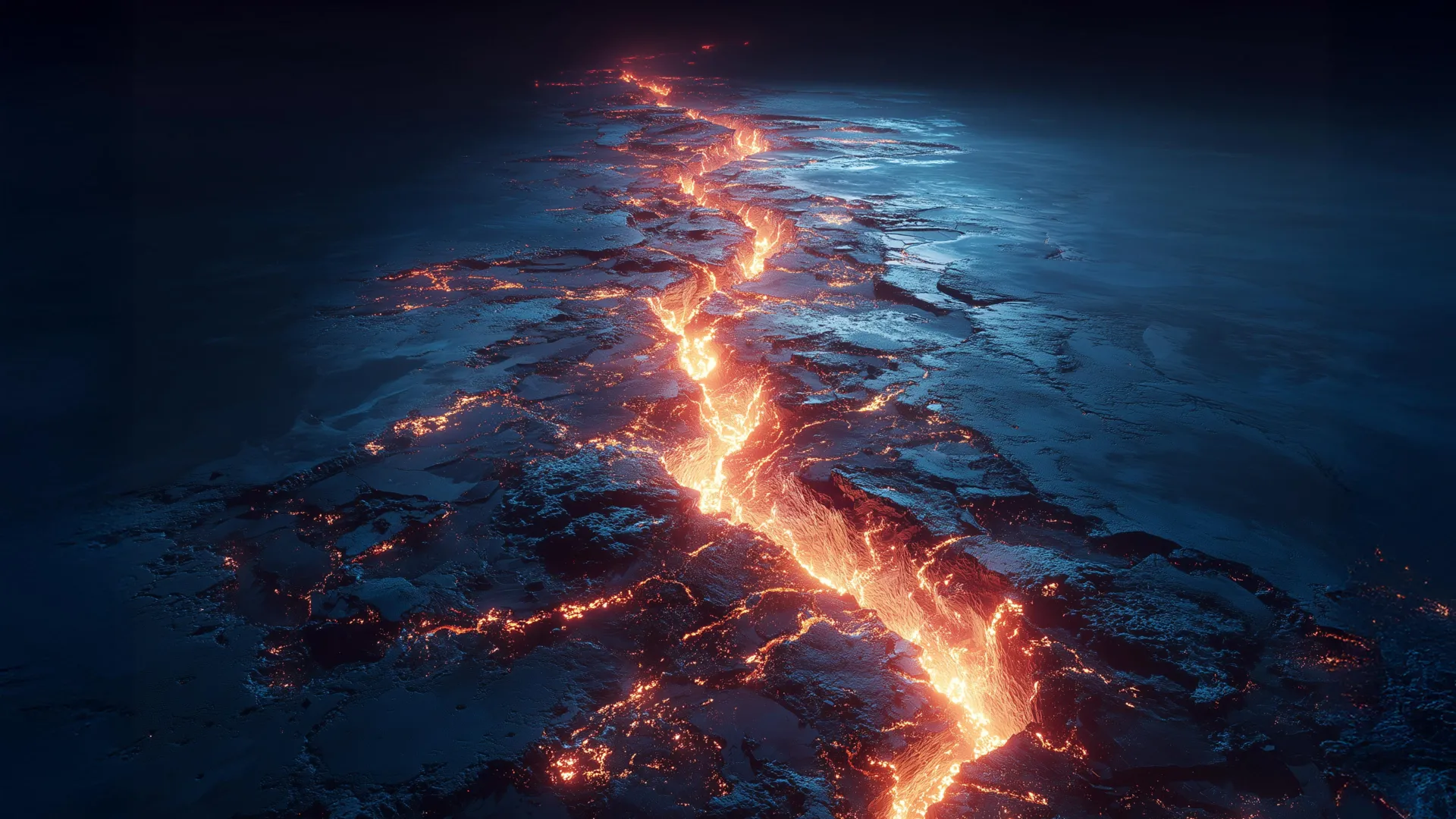
TOKYO & OKAYAMA — In the shadowy depths of the western Pacific Ocean lies the Ontong Java Plateau, a colossal underwater expanse of basalt that represents the single most voluminous volcanic outpouring in Earth’s history. For decades, geologists viewed this monumental feature primarily as a product of surface-level destruction—a catastrophic effusion of lava that smothered the ancient seafloor some 120 million years ago.
Now, a team of geoscientists has uncovered evidence that this prehistoric cataclysm did far more than simply build a massive mountain range on the ocean bottom. By probing the deep architecture of the oceanic plate beneath the plateau, researchers have discovered that the colossal thermal engine responsible for the plateau fundamentally fractured, reshaped, and chemically regenerated the solid Earth beneath it.
The findings, published in the journal Geophysical Research Letters, were spearheaded by a research collaborative led by Lecturer Azusa Shito of the Okayama University of Science, alongside Associate Professor Akira Ishikawa of the Institute of Science Tokyo and Professor Masako Yoshikawa of Hiroshima University. Using sophisticated seismic wave analysis, the team has revealed a hidden inner complexity that challenges long-held assumptions about how oceanic plates respond to deep-mantle plumes.
Main Facts: A Composite Interior Carved by Magma
At the heart of the new study is a radical rethinking of the lithospheric plate underlying the Ontong Java Plateau (OJP). Traditional geological models hold that oceanic plates possess a relatively uniform, predictable internal structure formed as cooling magma spreads away from mid-ocean ridges.
The OJP, however, breaks every rule in the textbook. According to the research team’s seismic data, the plate beneath the plateau is not a simple, homogenous slab of rock. Instead, it features a complex, composite interior characterized by horizontal laminations intersected by dense swarms of vertical magma pathways, known to geologists as dikes.
- Dike Swarms: These vertical structures form when pressurized molten rock forces its way through fractures in the crust and solidifies. The discovery of extensive dike swarms beneath the OJP proves that magma did not merely erupt onto the surface; it aggressively tore through the pre-existing plate in a vast, interconnected subterranean plumbing system.
- Anomalous Seismic Velocities: Both high-frequency Po and So seismic waves recorded beneath the plateau traveled at significantly slower speeds than normal. This sluggishness cannot be explained by physical fracturing alone, pointing to a profound chemical alteration of the mantle rock itself.
- The Mechanism of Refertilization: The researchers propose that rising magma chemically transformed the surrounding rock through a process called refertilization, where molten rock reintroduces vital chemical components into mantle peridotite that had been depleted by earlier melting events.
Chronology: Unraveling a 120-Million-Year-Old Mystery
To understand the magnitude of the discovery, geologists must look back to a turbulent chapter in Earth’s history, tracing a timeline that spans from prehistoric cataclysms to modern seismic laboratories.
110–120 Million Years Ago: The Cataclysm
During the Cretaceous period, the western Pacific was the site of unparalleled geological violence. A massive thermochemical plume—a column of abnormally hot, chemically distinct material originating deep within Earth’s mantle—rose toward the surface. As it breached the crust, it triggered the largest oceanic plateau-forming event known to science. The resulting eruptions poured out millions of cubic kilometers of lava, releasing gases and heat severe enough to disrupt global ocean chemistry, suffocate marine life, and potentially trigger mass extinction events.
The Decades of Surface-Level Study
For years, oceanographers mapped the vast topography of the OJP, noting its towering underwater mass, which covers an area comparable in size to the Alaskan landmass. However, limitations in technology left the thousands of meters of solid rock beneath the plateau largely shrouded in mystery. Scientists could map the surface basalts, but the deep mantle root remained a black box.
The Modern Seismic Investigation
Recently, a multi-institutional team led by Dr. Shito, Dr. Ishikawa, and Dr. Prof. Yoshikawa deployed a high-resolution strategy. By utilizing ocean-bottom seismometers encircling the plateau alongside instruments stationed on neighboring oceanic islands, the team captured the behavior of specialized high-frequency seismic waves—specifically, Po and So waves—as they propagated through the deep oceanic plate. By running advanced waveform models against these recordings, the researchers decoded the hidden structural and chemical signature of the plate, culminating in the breakthrough publication in Geophysical Research Letters.
Supporting Data: Decoding Seismic Whispers
The methodology behind the discovery relies on the physics of seismic wave propagation. Typically, high-frequency Po and So waves are generated when primary (P) and secondary (S) seismic waves undergo repeated scattering through layered structures inside an oceanic plate. This continuous internal reflection allows the signals to travel efficiently across vast distances—often thousands of kilometers—acting as a natural acoustic scan of the Earth’s interior.
When researchers analyzed the waves traveling through the OJP region, however, they observed a striking anomaly:
- Efficient Po Waves: Po waves managed to propagate through the region relatively unimpeded.
- Attenuated So Waves: Conversely, So waves weakened and dissipated dramatically.
This divergent behavior provided the critical mathematical clue. The team’s waveform modeling demonstrated that a dual-natured interior—one featuring horizontal layering (which permits wave travel) crossed by vertical dike networks (which scatter and disrupt specific shear waves)—was the only geological model capable of producing the observed seismic data.
Furthermore, the overall reduction in wave speeds pointed directly to thermal and compositional shifts. Because seismic waves decelerate when moving through rocks that are hotter, less rigid, or chemically modified, the data confirmed that the passage of voluminous mantle-plume magma had fundamentally altered the mineralogy of the plate’s peridotite framework.
Official Perspectives and Academic Insight
The implications of the study extend far beyond the regional geology of the western Pacific, offering new frameworks for how geologists interpret large igneous provinces (LIPs) across the globe.
"An oceanic plate is traditionally viewed as a relatively passive foundation that simply carries volcanic material on its back," noted a summary of the research framework. "What our findings demonstrate is that extreme mantle plume activity is an active, transformative agent. It guts the plate from the inside out."
Associate Professor Akira Ishikawa emphasized the significance of the chemical transformation, noting that the "refertilization" process provides a vital window into the deep carbon and volatile cycles of the Earth. When ancient mantle rock loses its melt components, it becomes chemically impoverished. The injection of plume-derived magma reverses this depletion, effectively resetting the chemical clock of the mantle lithosphere.
Professor Masako Yoshikawa added that understanding the interplay between mantle plumes and existing lithospheric plates helps bridge a critical gap in geodynamics. "We have long understood the surface expressions of mantle plumes," Yoshikawa noted. "Now, we are beginning to map the complex plumbing and chemical alchemy that occurs miles beneath the ocean floor."
Broader Implications: Rewriting the Lifecycle of Oceanic Plates
The discovery that massive volcanic events can fundamentally alter the physics and chemistry of an oceanic plate forces a paradigm shift in several fields of Earth science:
- Plate Tectonics and Rheology: Standard models of plate tectonics often treat the lithosphere as a mechanically rigid layer that floats atop the asthenosphere. The presence of pervasive vertical dike swarms suggests that ancient volcanic events can structurally weaken or heterogeneously reinforce plates, potentially influencing how they eventually subduct back into the Earth’s mantle.
- Global Chemical Cycling: By demonstrating that magma can extensively "refertilize" depleted mantle rock, the study provides a mechanism for recycling elements between the deep mantle and the shallow lithosphere. This challenges static views of mantle composition and aids in modeling geochemical reservoirs over geological timescales.
- Reassessing Other Large Igneous Provinces: With a new seismic methodology proven effective at the Ontong Java Plateau, researchers now have a blueprint to investigate other massive underwater plateaus—such as the Kerguelen Plateau or the Hikurangi Plateau—to see if internal dike swarms and chemical modification are universal features of extreme volcanism.
As geoscientists continue to mine seismic data for clues about Earth’s violent past, the Ontong Java Plateau stands as a prime example of a subterranean titan—a structure whose true power was hidden not in the mountains of basalt towering above the seafloor, but in the intricate, chemically transformed web of stone lying deep beneath the ocean’s crust.
