

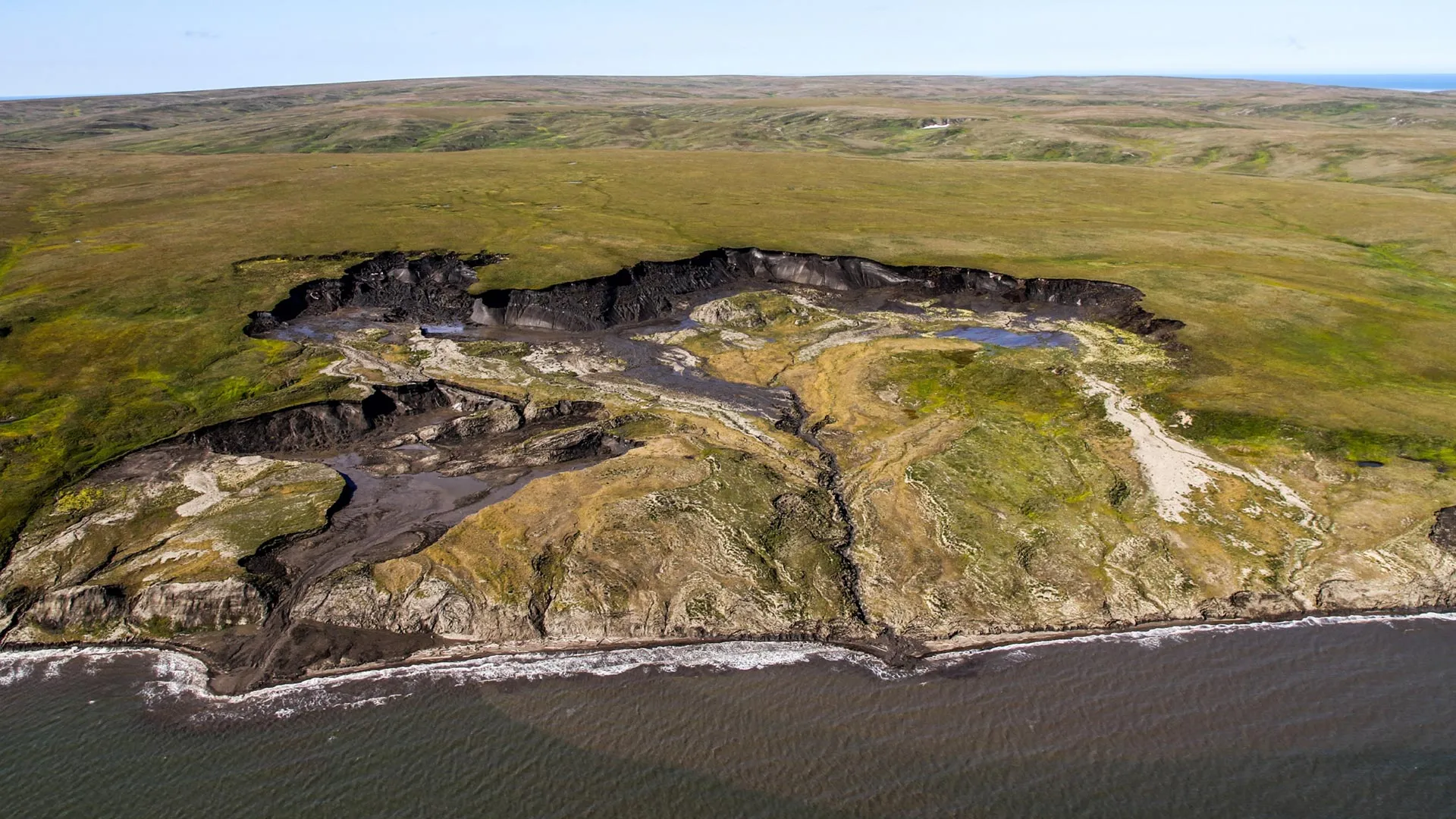
HAMBURG / BREMEN — In the remote expanses of the Canadian Arctic, a silent and profound transformation is underway. As global temperatures climb, the region’s ancient, frozen foundation—permafrost—is thawing at an unprecedented rate. Along coastlines and riverbanks, massive tracts of land are eroding into the sea, dragging colossal stores of organic carbon into the Arctic Ocean. For decades, climate scientists have recognized this phenomenon as a ticking carbon bomb: as microorganisms break down this newly freed organic matter, they release greenhouse gases that accelerate global warming.
However, a critical piece of the puzzle has long remained missing. While researchers could measure the volume of land eroding into the ocean, they had limited empirical data on what happened next. How much of that terrestrial carbon actually returned to the atmosphere as carbon dioxide or methane? And how much was permanently locked away in marine sediments?
A groundbreaking study recently published in the journal Nature Geoscience provides definitive answers. Conducted by an international team of researchers from the Alfred Wegener Institute (AWI) and MARUM – Centre for Marine Environmental Sciences at the University of Bremen, the investigation reveals that the seafloor acts as a far more effective carbon vault than previously assumed. Furthermore, the study uncovers surprising behavior among marine microorganisms, showing that microscopic life in the seabed is remarkably selective about its diet.
These findings offer a vital new baseline for climate scientists, drastically improving our understanding of how thawing permafrost interacts with the global carbon cycle and reshaping the predictive models used to forecast our environmental future.
Main Facts: The Terrestrial-Marine Carbon Pipeline
To understand the scope of the new research, it is essential to examine the sheer magnitude of carbon stored within the Arctic landscape.
- The Global Carbon Reservoir: Terrestrial permafrost ecosystems across the Arctic currently hold approximately 1,300 gigatonnes of organic carbon, accumulated over millennia largely from decayed plant remains. An additional 400 gigatonnes are stored separately within ocean sediments and river deltas.
- A Warming Epicenter: The Arctic is warming between two and four times faster than the rest of the planet. This rapid thermal shift is destabilizing frozen soils, causing ground subsidence, catastrophic coastal erosion, and increased river runoff.
- The Flux of Carbon: Approximately 0.02 gigatonnes of organic carbon are currently washed into the Arctic Ocean each year. According to robust climate forecasts, this fluvial and coastal outflow could surge by 70 to 150 percent by the year 2100.
- The Seafloor Sink: Contrary to fears that nearly all eroded permafrost carbon would be converted into greenhouse gases, the AWI and MARUM study discovered that roughly 90 percent of the organic carbon deposited off the coast remains safely buried in seabed sediments. Only about 10 percent is processed by microorganisms and released as gases into the water column and, ultimately, the atmosphere.
Chronology: Unraveling the Secrets of Qikiqtaruk
The journey toward these discoveries required a meticulous, multi-step scientific campaign that combined field operations in brutal Arctic conditions with advanced laboratory geochemistry.
Phase One: Fieldwork and Core Sampling
The research centered around the permafrost coast of Qikiqtaruk, internationally known as Herschel Island, located in the Canadian Beaufort Sea. This coastline is subject to rapid erosion, making it a natural laboratory for studying land-to-sea carbon transfer.
Between 2018 and subsequent field expeditions, research teams utilized specialized coring equipment to extract sediment cores from several strategic locations off the island’s coast. These cylindrical columns of mud and silt captured a stratigraphic record of material deposited over roughly the past 50 years, acting as a historical archive of environmental change in the region.
Phase Two: Laboratory Analysis and Isotope Tracing
Back in the laboratories of the Alfred Wegener Institute and the University of Bremen, the sediment cores underwent rigorous physical and chemical scrutiny.
Scientists analyzed the overall composition of the sediment layers and measured accumulation rates to determine how swiftly permafrost-derived material settled onto the ocean floor. Crucially, the team examined pore water—the water trapped in the microscopic spaces between sediment particles. By measuring dissolved inorganic carbon within this pore water, researchers could calculate the exact volume of carbon dioxide respired by microorganisms as they consumed organic matter.
To trace the origins of this organic matter, the team deployed atomic indicators: carbon isotopes.
- The Carbon-13 ($^13textC$) Isotope: This isotope acted as a dietary tracer, distinguishing whether the microorganisms were consuming carbon originating from terrestrial plants or marine sources like algae.
- The Carbon-14 ($^14textC$) Isotope: This radioactive isotope allowed scientists to determine the age of the carbon consumed. Specifically, it revealed whether the microbes preferred ancient organic carbon leached from thawing permafrost or fresh organic carbon derived from recent marine primary production.
Phase Three: Synthesis and Publication
Following months of data processing, modeling, and peer review, the team synthesized their findings. The resulting paper, detailing the surprisingly high retention rate of terrestrial carbon in Arctic sediments and the selective feeding habits of benthic microbes, was published in Nature Geoscience, instantly drawing the attention of the global climate modeling community.
Supporting Data: The "Gourmet" Microbes of the Seafloor
The most startling revelation of the Nature Geoscience study lies in the behavior of the single-celled organisms inhabiting the seafloor sediments.
When organic carbon from land is washed into the ocean, it enters an environment already rich in organic material produced naturally within the marine ecosystem, such as sinking dead algae and phytoplankton. Scientists had long debated whether bacteria and other microorganisms would indiscriminately consume any carbon source available, or if they would exhibit preferences.
The isotopic data from the pore water provided a definitive answer: the microbes are remarkably picky eaters.
"The sediment is home to ‘gourmet’ bacteria that apparently prefer fresh carbon stemming from, for example, more recent algal remains over the ‘old’ carbon from permafrost deposits," explains Prof. Gesine Mollenhauer, a geochemist at the Alfred Wegener Institute and co-spokesperson for the ‘The Ocean Floor – Earth’s Unexplored Interface’ Cluster of Excellence.
Because these benthic microorganisms actively favor fresh marine carbon, the ancient, degraded carbon washing off the eroding permafrost cliffs is largely bypassed. Instead of being metabolized into carbon dioxide and methane, it is bypassed, buried deeper by accumulating sedimentation, and locked away in the geological record of the seabed.
However, the research team maintains a cautious stance regarding this natural mitigation effect. Dr. Manuel Ruben, lead author of the study from AWI, notes that while the seafloor acts as an efficient trap, some portion of the permafrost carbon may still be degraded before it ever reaches the ocean floor—either during its transport down rivers or in the turbulent coastal zone. Quantifying that pre-transport loss remains a primary objective for future studies.
Official Responses and Expert Perspectives
The academic community has widely praised the study for bridging a critical knowledge gap in Arctic carbon budgets. For years, climate models have struggled to accurately account for the land-to-ocean carbon flux, often relying on generalized assumptions about microbial degradation rates.
"Our study shows, more precisely than ever before, how much carbon is safely stored in the seabed—and just how much of the decomposed material actually originates from the old permafrost," states Dr. Manuel Ruben. "This provides an important foundation for climate models that can predict the consequences of permafrost thawing for the global climate."
Prof. Gesine Mollenhauer emphasizes the power of isotopic geochemistry in unlocking these microscopic mysteries.
"Carbon isotopes represent our atomic indicators that can identify the food source of the microorganisms," Mollenhauer notes. "By way of the $^14textC$ isotope, we were able to determine whether the single-celled organisms preferred old organic carbon from permafrost or fresh organic carbon from algae remains. This level of precision was previously unattainable on such regional scales."
Institutions involved in the research stress that these findings do not mean the threat of permafrost thaw has been overstated. Rather, they highlight the complex, interconnected nature of Earth systems, where negative feedback loops (such as seabed carbon burial) can partially counterbalance positive feedback loops (such as atmospheric greenhouse gas release).
Implications: Beyond Greenhouse Gases
While the containment of terrestrial carbon in seafloor sediments is welcome news for global climate projections, the physical movement of land into the sea carries profound consequences for Arctic coastal ecosystems and the communities that rely upon them.
Altering Light and Primary Production
The massive influx of sediment and dissolved organic carbon from eroding coastlines fundamentally alters the physical properties of nearshore Arctic waters.
- Increased Turbidity: Suspended mineral particles make coastal waters cloudy and opaque.
- Water Darkening: Dissolved organic carbon absorbs specific wavelengths of light, effectively darkening the water column.
This dramatic reduction in light penetration severely impacts single-celled algae and phytoplankton, which rely on sunlight for photosynthesis. Because these microscopic primary producers form the base of the entire Arctic marine food web—sustaining everything from zooplankton and fish to ringed seals, polar bears, and indigenous subsistence fisheries—any disruption to primary production cascades upward through the ecosystem.
The Road Ahead: The 2027 ‘Arctic Pulse’ Campaign
Recognizing that carbon dynamics cannot be viewed in isolation from broader ecological shifts, researchers are already preparing for the next major leap in Arctic science.
The international ‘Arctic Pulse’ campaign, scheduled for 2027, will represent one of the most comprehensive coordinated observation efforts in polar history. Scientists plan to integrate data collection across multiple platforms:
- Deploying the German research icebreaker Polarstern into key Arctic marine corridors.
- Operating specialized AWI research aircraft to map coastal erosion and atmospheric fluxes from above.
- Maintaining rigorous, long-term monitoring sites on land and along vulnerable permafrost coastlines.
The overarching goal of the Arctic Pulse campaign is to paint a holistic picture of how rapid environmental change is transforming the Arctic system from the bedrock up to the atmosphere.
Conclusion
The research led by the Alfred Wegener Institute and MARUM fundamentally changes how we view the Arctic’s melting margins. By proving that the seafloor safely sequesters the vast majority of eroded permafrost carbon—thanks to the surprisingly refined palates of microbial life—the study removes a degree of uncertainty from global climate forecasting.
Yet, as the Arctic continues to warm at an unprecedented rate, the cascading effects of coastal erosion, shifting light regimes, and transforming marine food webs remind us that the frozen north remains ground zero for global environmental change. Armed with more precise data and refined models, scientists are now better equipped than ever to navigate the uncertain climate horizon that lies ahead.
