

Main Facts: The Enduring Philosophy of a Tarot Master
In the vast and often mystifying world of esoteric arts, few figures have left as indelible a mark as the late Rachel Pollack. Author, poet, comic book writer, and preeminent tarot authority, Pollack approached the ancient cards not merely as tools for divination or rigid spiritual dogmas, but as a dynamic technology for narrative.
Originally penned for World Tarot Day on May 25, 2015, one of Pollack’s most profound essays—titled simply "Story, It’s All Story"—encapsulates the core of her worldview. In this reflective piece, Pollack explores the nature of human existence, truth, and reality through the lens of the tarot. She famously muses on what she might want written on her eventual tombstone, discarding traditional notions of solemnity in favor of a profound realization: "Story. It’s all story."
This article examines Pollack’s foundational philosophy, tracing her journey from her first encounter with the cards in 1970 to her status as a global luminary in tarot scholarship. By analyzing her views on narrative, science, and the mystical mechanics of a tarot reading, we uncover why her work continues to resonate deeply with practitioners and thinkers worldwide.
Chronology: A Lifelong Romance with Narrative and Cards
To understand Pollack’s revolutionary approach to the tarot, one must trace the timeline of her intellectual and creative awakening:
- Early Spring 1970: Pollack is introduced to the tarot by a friend who lays out the cards and consults Eden Gray’s instructional book. Rather than focusing on predictive futures, Pollack is instantly captivated by the visual imagery, viewing each card as a "frozen moment in a story." The mysterious Six of Swords becomes permanently etched in her memory from this initial session.
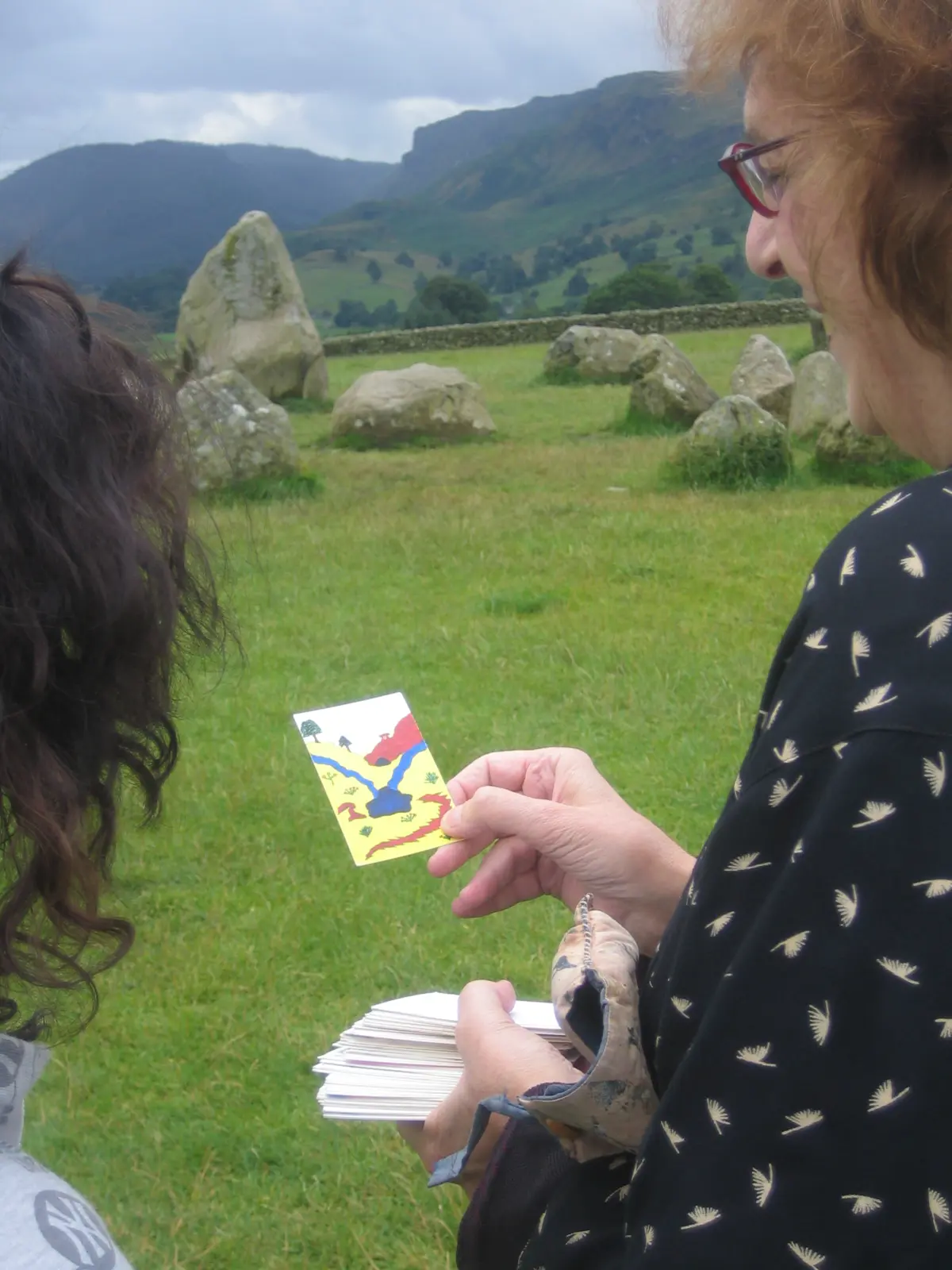
- July 2009: Pollack attends the Tarosophy Tarot Conference in the scenic Lake District, UK, where she is photographed at the historic Castlerigg Stone Circle—a moment that captures her deep connection to both ancient earth mysteries and modern tarot communities.
- May 25, 2015: In celebration of World Tarot Day, Pollack publishes her essay "Story, It’s All Story," synthesizing decades of thought on how humans construct meaning, reality, and destiny through narrative.
- April 2023: The Tarot Association publishes archival reflections and imagery of Pollack, honoring her enduring influence following her passing, cementing her status as a foundational pillar of modern esoteric literature.
Supporting Data: Influences, Quotes, and Metaphysical Parallels
Pollack’s essay is rich with intertextual references, drawing from anthropology, literature, and quantum-adjacent philosophy to validate her thesis that reality itself is narrative-driven.
The Architecture of Meaning
In “Story, It’s All Story,” Pollack shares her playful yet deeply philosophical exercise of contemplating potential epitaphs. She considers:
- A line from a Gabon Pygmy song celebrating consciousness: “All lives, all dances, and all is loud.”
- A poetic translation from Normandi Ellis’s Awakening Osiris (an interpretation of the Egyptian Book of the Dead): “Give me not words of consolation. Give me magic.”
- Her ultimate, simplified conclusion: “Story. It’s all story.”
To reinforce this premise, Pollack invokes Italian literary giant Italo Calvino, who famously observed, "The tarot is a machine for constructing stories." She also pairs this with a foundational Hasidic teaching: "God made humans because God loves stories."
Challenging the Boundaries of "Truth"
Critics of Pollack’s narrative-centric view might argue that treating tarot as a story strips it of objective truth. However, Pollack pushes back against this dichotomy, arguing that truth is not a static object like a rock lying on the ground. Instead, humanity actively engages with and brings truth into being.

To illustrate this, Pollack recalls a conversation with a physicist friend regarding subatomic particles. When she asked whether complex arrays of particles might not actually exist until scientists predict and look for them, the physicist confirmed that such a scenario was entirely plausible. For Pollack, complex esoteric structures like the Kabbalistic Tree of Life, modern physics, and tarot readings operate on the exact same principle: they are interlocking systems of stories that shape human reality.
Official Responses and Perspectives: How the Tarot Community Views Pollack’s Legacy
Within the global esoteric community, Rachel Pollack is widely revered not just as a historian of the cards, but as a spiritual innovator who democratized and intellectualized tarot interpretation.
The Triad of a Reading
In her 2015 essay, Pollack breaks down the mechanics of a tarot consultation, noting that every reading involves three distinct participants:
- The Subject (the seeker),
- The Reader (the facilitator), and
- The Cards Themselves (the visual catalysts).
Together, these three elements form a collaborative environment where a personal narrative can emerge. When clients inevitably ask the age-old question, "How does the tarot work?" Pollack embraced a stance of radical honesty, simply replying, "Nobody knows, but it does."
She observed a recurring phenomenon that every experienced reader recognizes: while general readings offer comforting or broad insights, the deck occasionally produces a staggering, mathematically improbable direct hit—precisely when a seeker faces a critical life decision. This uncanny precision led Pollack to her second great epitaph-worthy realization: "The world is not what we think it is."
Academic and Cultural Impact
Scholars of esotericism note that Pollack’s work bridged the gap between 20th-century occultism and 21st-century psychological self-reflection. By removing the fear-based, fatalistic predictions often associated with older cartomancy, she empowered individuals to view their lives as malleable narratives. Her Rider-Waite-Smith interpretations remain standard reading material for contemporary practitioners across the globe.
Implications: The Future of Tarot in a Narrative-Driven World
As we reflect on Rachel Pollack’s contributions—from her physical presence at sacred sites like Castlerigg Stone Circle to her written philosophies published on World Tarot Day—the implications of her work stretch far beyond the velvet-lined tables of cartomancers.
- Redefining Divination: Pollack shifted the paradigm of tarot from fortune-telling (a passive reception of a fixed future) to story-building (an active co-creation of potential outcomes). This empowers individuals to take agency over their life trajectories.
- Bridging Science and Spirit: By comparing subatomic physics to esoteric traditions like the Kabbalah and tarot, Pollack anticipated modern dialogues around quantum consciousness and social constructivism. She demonstrated that human observation and storytelling fundamentally shape what we perceive as "objective reality."
- A Timeless Mandate: As the digital age accelerates and humans seek deeper meaning amidst an overload of data, Pollack’s reminder remains urgently relevant. Whether through ancient stones in the Lake District or 78 illustrated cards, humanity continues to rely on narrative to make sense of the cosmos.
Ultimately, Rachel Pollack’s legacy assures us that while the world may be mysterious, complex, and confounding, we are never merely passive observers. Through art, intuition, and dialogue, we are all active authors of the great human story.
