

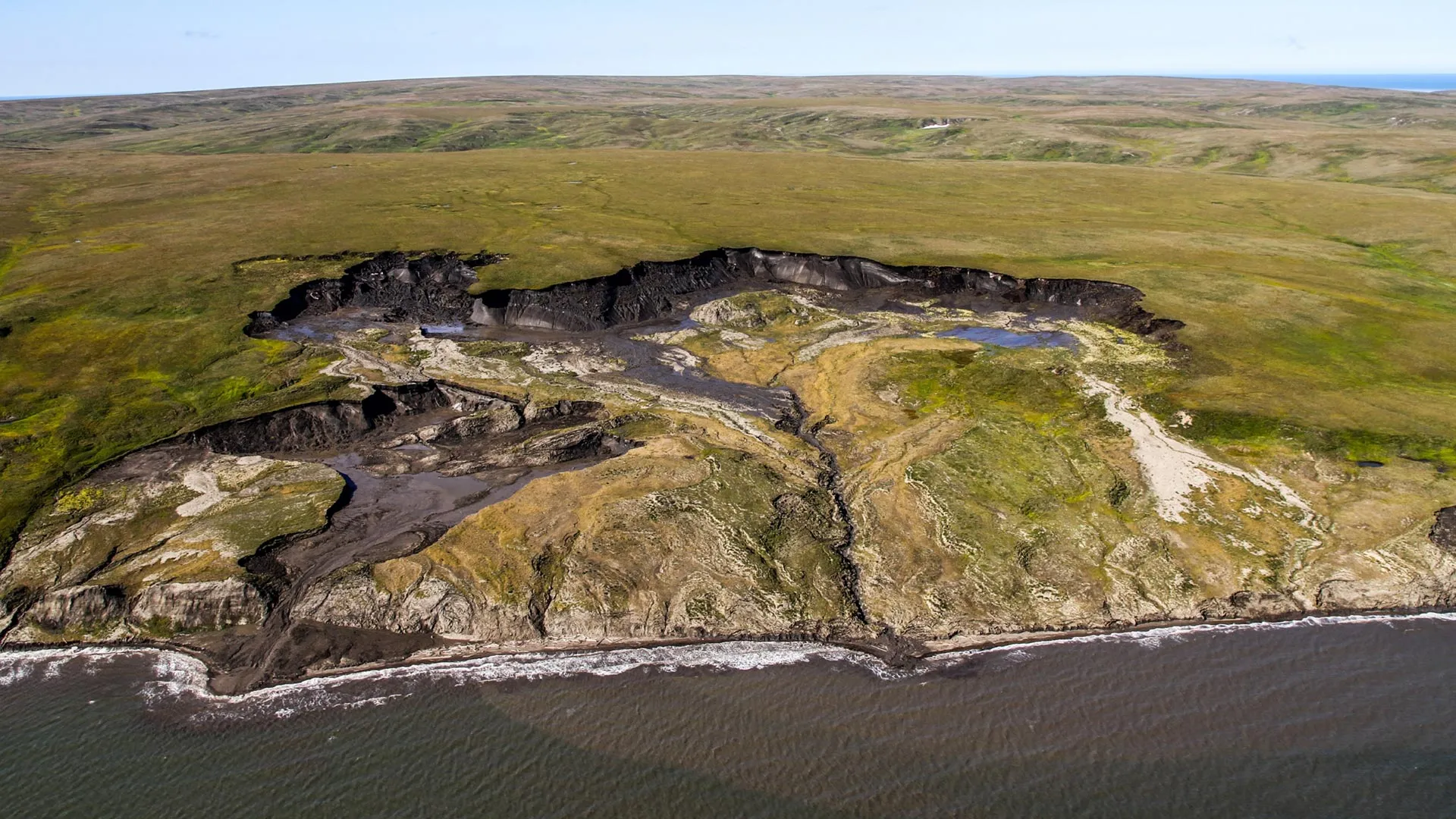
ARCTIC OCEAN — In the remote, windswept expanse of the Canadian Arctic, a silent transformation is unfolding along the eroding coastline of Qikiqtaruk, widely known as Herschel Island. Here, as global temperatures rise at an unprecedented pace, the frozen foundations of the earth are giving way. Vast stores of ancient organic carbon, locked away in permafrost for millennia, are sliding into the sea.
For climate scientists, this land-to-ocean migration has long represented a profound enigma. Once washed into the marine environment, how much of this organic carbon is broken down by microorganisms and released back into the atmosphere as potent greenhouse gases, and how much is safely sequestered in the dark, cold depths of the seabed?
Now, a groundbreaking study published in the prestigious journal Nature Geoscience provides unprecedented clarity. Led by researchers from the Alfred Wegener Institute (AWI) and MARUM – Centre for Marine Environmental Sciences at the University of Bremen, the new research reveals that marine microorganisms act as surprisingly selective eaters. Preferring the fresh, nutrient-rich remains of marine algae over the "old" carbon unleashed by thawing permafrost, these microbes leave the vast majority of terrestrial carbon securely buried in ocean sediments.
The findings offer a vital piece of the global climate puzzle, shedding light on the complex feedback loops governing the Earth’s rapidly warming polar regions and refining the predictive tools scientists rely on to model future climate change.
Main Facts: The Carbon Sink Beneath the Waves
At the heart of the discovery is a reassuring, if nuanced, reality about the fate of terrestrial carbon entering the Arctic Ocean. While climate models have long predicted that thawing permafrost would unleash massive carbon burps into the atmosphere, this new study demonstrates that the seabed acts as a remarkably efficient long-term vault.
Key takeaways from the research include:
- The Scale of the Store: Arctic terrestrial ecosystems harbor approximately 1,300 gigatonnes of organic carbon—predominantly composed of ancient plant material. An additional 400 gigatonnes are stored within ocean sediments and river deltas.
- The Coastal Leak: Driven by rapid warming and coastal erosion, roughly 0.02 gigatonnes of this organic carbon currently enter the Arctic sea each year. Projections indicate this outflow could surge by 70 to 150 percent by the year 2100.
- The Microbial Filter: Counter to fears that most of this eroded carbon would quickly convert to carbon dioxide or methane, analysis of sediment cores reveals that marine microorganisms convert only about ten percent of the organic carbon from these sediments into atmospheric gases.
- The "Gourmet" Diet: Microbes in the seabed exhibit a strong preference for fresh organic carbon derived from recent algal blooms rather than the ancient, degraded carbon streaming out of the thawing permafrost. Consequently, the bulk of the land-derived carbon remains buried safely in the seabed.
Chronology: Unraveling a Decades-Old Arctic Mystery
To understand how the team arrived at these conclusions, it is necessary to retrace the timeline of both the environmental changes threatening the Arctic and the meticulous scientific detective work required to study them.
1. The Accumulation of Ancient Stores
Over thousands of years, layers of dead vegetation, mosses, and animal remains accumulated across the Arctic landmass. As successive ice ages and changing climates swept the globe, these organic layers were sealed beneath freezing temperatures, creating the vast permafrost sheets that define the high north today.
2. The Acceleration of Arctic Warming
In recent decades, the Arctic has begun warming at roughly four times the rate of the rest of the planet. This amplified warming—known as Arctic amplification—has destabilized the frozen ground. Temperatures in the permafrost layers have climbed steadily, causing the ice within the soil to melt.
3. The Onset of Rapid Coastal Erosion
As the ice melts, the structural integrity of Arctic coastlines collapses. Storm surges, pounding waves, and thawing cliffs cause massive chunks of land to slump directly into the ocean. Rivers swollen by increased meltwater also scour the landscape, carrying immense loads of sediment and organic debris into coastal waters.
4. Fieldwork off Herschel Island (Recent Years)
To track where this mobilized carbon ultimately goes, researchers from AWI and MARUM traveled to the coastal waters surrounding Qikiqtaruk (Herschel Island) in the Canadian Yukon. Utilizing specialized coring equipment, the team extracted sediment cores from multiple marine locations. These cores captured layered stratigraphy representing approximately 50 years of continuous deposition, providing a historical archive of carbon accumulation on the seafloor.
5. Laboratory Analysis and Isotopic Fingerprinting
Back in the laboratory, the researchers subjected the sediment cores to rigorous biogeochemical analysis. By examining the chemical composition of pore water—the fluid trapped in the tiny spaces between sediment particles—they measured the quantity of dissolved inorganic carbon produced by microbial respiration. Using carbon isotopes ($^13textC$ and $^14textC$), the team successfully traced the precise origins of the organic material consumed by the microbes, culminating in the publication of their findings in Nature Geoscience.
Supporting Data: The Numbers Behind the Findings
The robustness of the study relies on high-resolution geochemical measurements. By dissecting the sediment cores layer by layer, the research team quantified accumulation rates and metabolic activity within the seabed.
- 1,300 Gigatonnes: The immense baseline of organic carbon currently locked within Arctic permafrost soils.
- 70 to 150 Percent: The projected increase in land-to-ocean carbon outflow expected by 2100 under current warming trajectories.
- ~10 Percent: The modest share of organic carbon from coastal sediments that marine microorganisms successfully convert into greenhouse gases.
- 50 Years: The temporal depth captured by the sediment cores, offering a reliable half-century window into modern coastal sedimentation and microbial dynamics.
Isotopic analysis proved especially critical. The stable carbon isotope ratio ($^13textC$) allowed scientists to differentiate between terrestrial and marine carbon sources. Meanwhile, the radioactive carbon isotope ($^14textC$) acted as an atomic clock, revealing the age of the organic matter. This dual approach demonstrated conclusively that microorganisms were selectively ignoring the radiocarbon-dating "old" permafrost carbon in favor of younger, more labile marine material.
Official Responses and Expert Perspectives
The implications of the study have reverberated throughout the international polar research community, offering both relief and a call for continued caution.
"Although the sea here carries away huge quantities of organic carbon from the coast, surprisingly little of it ends up in the ocean’s active carbon cycle," says Dr. Manuel Ruben, lead author of the study from the Alfred Wegener Institute, Helmholtz Centre for Polar and Marine Research (AWI). "Microorganisms convert around ten percent of the organic carbon from the sediments into gases, which rise into the water and can then enter our atmosphere."
Dr. Ruben emphasizes that quantifying this pathway has long been a missing link in global carbon budgeting.
"Our study shows, more precisely than ever before, how much carbon is safely stored in the seabed—and just how much of the decomposed material actually originates from the old permafrost. This provides an important foundation for climate models that can predict the consequences of permafrost thawing for the global climate."
Echoing these thoughts, Prof. Gesine Mollenhauer, a geochemist at AWI and co-spokesperson for the ‘The Ocean Floor – Earth’s Unexplored Interface’ Cluster of Excellence, highlights the fascinating behavioral patterns of marine microbes.
"Carbon isotopes represent our atomic indicators that can identify the food source of the microorganisms," Professor Mollenhauer explains. "The sediment is home to ‘gourmet’ bacteria that apparently prefer fresh carbon stemming from, for example, more recent algal remains over the ‘old’ carbon from permafrost deposits."
However, Mollenhauer urges the scientific community to maintain a measured perspective, noting that the research journey is far from complete.
"We do need further research here. This is because some of the organic carbon from the permafrost may already have been broken down before it reaches the seabed."
Implications: Ecological Disruptions and Future Horizons
While the finding that much of the eroded permafrost carbon remains safely buried in the seabed is good news for global atmospheric carbon budgets, the movement of terrestrial material into Arctic oceans carries profound ecological consequences for local marine ecosystems.
Altering Coastal Waters and Marine Food Webs
The massive influx of sediment and dissolved organic carbon from eroding coastlines fundamentally alters the physical characteristics of shallow Arctic seas.
- Light Deprivation: Suspended mineral particles make coastal waters turbid, while dissolved organic carbon stains the water a tea-like brown.
- Impact on Primary Producers: This dramatic reduction in light penetration severely hampers single-celled algae and phytoplankton, which rely on sunlight for photosynthesis.
- Ripple Effects: Because these microscopic algae form the foundation of the Arctic marine food web—supporting everything from zooplankton and fish to ringed seals and polar bears—disruptions to primary production can echo up the entire ecological ladder, threatening biodiversity and the subsistence livelihoods of northern indigenous communities.
Looking Ahead: The 2027 ‘Arctic Pulse’ Campaign
To capture the full scope of these cascading environmental changes, researchers are already preparing for the next major leap in polar observation: the international ‘Arctic Pulse’ campaign, scheduled for 2027.
This ambitious, multi-platform initiative will bring together coordinated observations from the state-of-the-art German research icebreaker Polarstern, specialized AWI research aircraft, and ground-based monitoring stations. By integrating oceanographic, atmospheric, and terrestrial data, scientists hope to gain a holistic understanding of how rapid climate change is reshaping the Arctic system in real-time.
Refining Global Climate Models
Ultimately, the work led by Ruben, Mollenhauer, and their colleagues bridges a critical knowledge gap. By mapping the precise fate of permafrost-derived carbon once it meets the sea, the researchers have given climate modelers the empirical data needed to replace generalized estimates with precise calculations.
As the Arctic continues to warm at a breakneck pace, these refined models will play an indispensable role in forecasting global climate trajectories—proving that even in the microscopic world of seabed bacteria, every detail matters in the planetary fight against climate change.
