

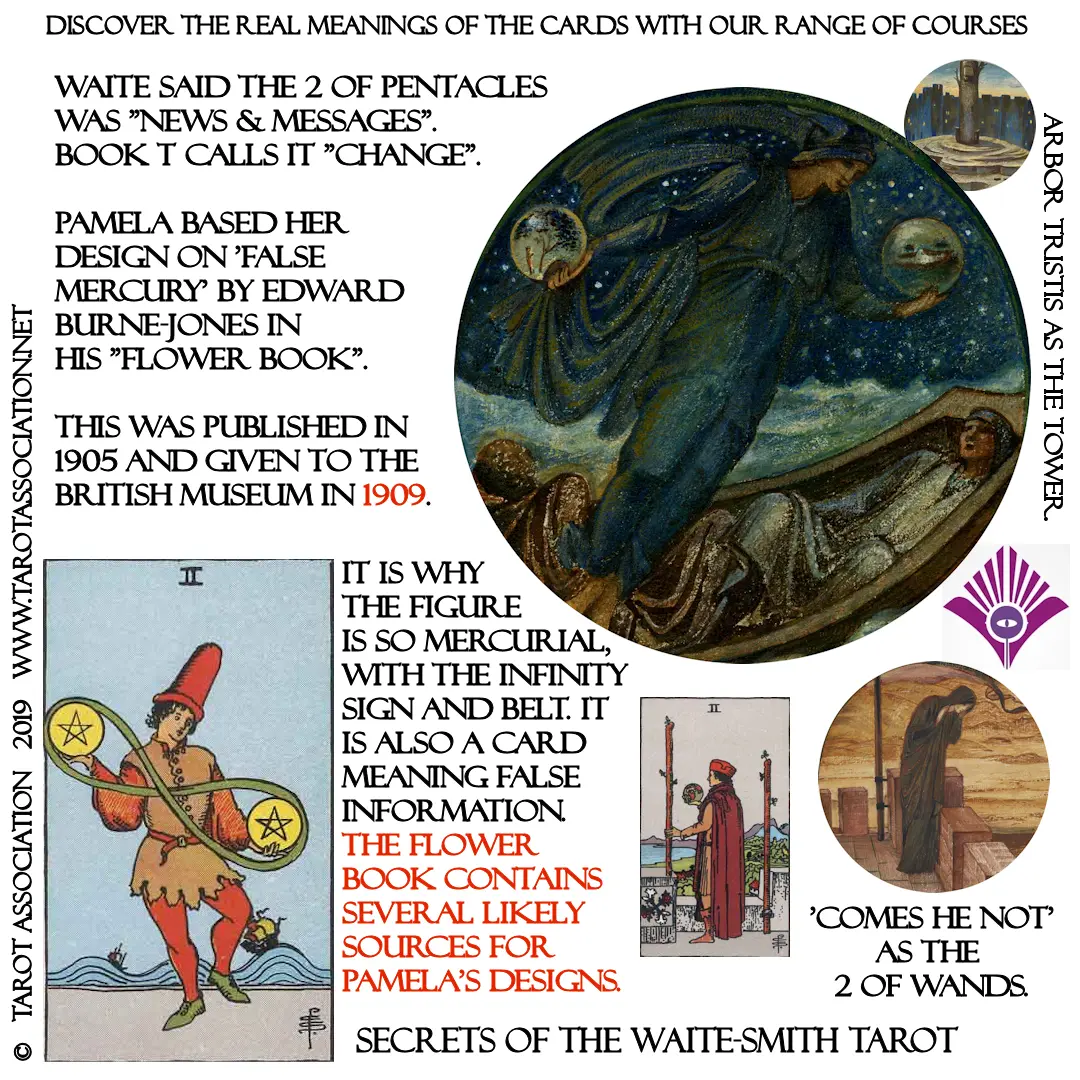
LONDON — For generations, modern tarot enthusiasts have looked at the Two of Pentacles and understood it as a straightforward emblem of time management, financial juggling, and the art of keeping multiple balls in the air. However, groundbreaking historical research reveals that this iconic card has become deeply disconnected from its true origins. Far from being a benign illustration of multitasking, historical analysis of the Golden Dawn, the personal notebooks of Pre-Raphaelite artist Edward Burne-Jones, and the creative process of Pamela Colman Smith indicates that the Two of Pentacles is, in fact, tarot’s original "gaslighting" card—a symbol of deliberate miscommunication, false promises, and psychological instability.
Main Facts: Re-evaluating the Two of Pentacles
At its core, the modern consensus treats the Two of Pentacles as a card of adaptability, urging readers to find equilibrium amid fluctuating circumstances, whether in personal finances, work schedules, or daily routines. Yet, a deeper dive into esoteric history paints a far more complex and cautionary picture.
According to foundational occult texts and newly resurfaced artistic influences, the card governs the duality of communication, hidden deception, and imaginary troubles. Rather than merely balancing a budget, the card exposes the presence of misleading information, manipulative behaviors, and structural unreliability.
The historical re-evaluation centers on three critical pillars:
- The Golden Dawn Tradition: The card’s root in Chockmah of Assiah (Wisdom of Action) and the decan of Jupiter in Capricorn, representing a rolling, unstable change alternating between gain and loss, elation and melancholy.
- The Waite-Smith Evolution: Arthur Edward Waite’s shift toward "conflicting communication" and imaginary troubles, as detailed in his Pictorial Key to the Tarot.
- The Burne-Jones Inspiration: Pamela Colman Smith’s direct visual borrowing from Edward Burne-Jones’s private botanical notebook, specifically his illustration of "False Mercury"—a plant known for its toxicity that symbolizes a misleading messenger offering false hopes of rescue.
Chronology: How the Meaning Evolved
To understand how the Two of Pentacles transformed from a symbol of mercurial deception into a mundane symbol of time management, one must trace its journey through the annals of occult history.
The Kabbalistic Roots and the Golden Dawn
The earliest formal framework for the card stems from the Hermetic Order of the Golden Dawn and its foundational Book T. In this tradition, the Two of Pentacles is mapped onto the Kabbalistic Tree of Life as Chockmah of Assiah (Wisdom of Action) and linked to Jupiter in Capricorn.
The Golden Dawn text describes the card’s energy as:
"The harmony of change, alternation of gain and loss; weakness and strength; everchanging occupation; wandering, discontented with any fixed condition of things; now elated, then melancholy; industrious, yet unreliable; fortunate through prudence of management, yet sometimes unaccountably foolish; alternatively talkative and suspicious."
Despite this tumultuous and contradictory description, the Golden Dawn also labeled the card "The Lord of Harmonious Change," interpreting it mundanely as "pleasant change, a visit to friends." This created an inherent tension in the card’s identity between deep, unstable duality and lighthearted movement.
The 1909 British Museum Discovery
The visual blueprint for the card was cemented in 1909, a pivotal year when artist Pamela Colman Smith and occultist A. E. Waite visited the British Museum to research historical imagery for their revolutionary tarot deck. During this period, the museum housed or provided access to a privately printed, illustrated botanical notebook by Pre-Raphaelite artist Edward Burne-Jones.
Burne-Jones’s notebook used traditional folklore translations of Latin plant names as the basis for whimsical, symbolic illustrations. Among them was Mercurialis perennis, commonly known as "Dog’s Mercury" but historically referred to as "False Mercury." Unlike other beneficial mercury plants, it is highly poisonous.
Burne-Jones illustrated "False Mercury" as a mercurial figure balancing two spheres while standing on a boat tossed by violent ocean waves, offering delirious sailors false visions of safety, home, and rescue. Captivated by this metaphor of the untrustworthy messenger, Pamela Colman Smith adapted the imagery for the Two of Pentacles.
A. E. Waite’s Interpretation
When A. E. Waite penned his Pictorial Key to the Tarot, he struggled to explicitly reveal the secret magical doctrines of Book T, yet his definitions reflected the card’s underlying volatility. He wrote that while the card represented gaiety and recreation, it was also read as "news and messages in writing, as obstacles, agitation, trouble, embroilment," adding the crucial caveat: "Troubles are more imaginary than real."
In the reversed position, Waite noted "enforced gaiety, simulated enjoyment… bad omen, ignorance, injustice." Thus, the card evolved away from pure physical change toward psychological manipulation and conflicting communication—the literal blueprint for modern gaslighting.
Supporting Data: The Dualistic Nature of the Card
Examining the card through various life domains reveals how this foundational theme of mercurial deception and unstable balance manifests in modern tarot readings.
- Romance and Relationships: While surface readings suggest navigating busy schedules together, a deeper look warns against deliberate gaslighting or emotional manipulation by a partner. It calls for testing the ground to ensure mutual honesty.
- Finance and Resources: Beyond simple budgeting, the card flags potential financial deceit, warning that someone may be misleading investors about the true potential of a project or asset.
- Career and Workplace: Juggling multiple responsibilities requires vigilance. The card serves as a warning to secure clear, written agreements to protect against shifting goalposts and workplace miscommunication.
- Home and Domestic Life: Balancing domestic duties requires establishing genuine routines rather than maintaining a superficial facade of domestic perfection.
- Spiritual and Esoteric Paths: Known in esoteric terms as the worker in the workshop accepting worldly duality, the card emphasizes grounding spiritual growth in everyday reality without falling victim to spiritual bypassing or self-deception.
When queried as a Yes/No question, the Two of Pentacles delivers a qualified YES. The overall trajectory is positive, but the path is marked by temporary setbacks, fluctuations, and approached hurdles before final resolution is achieved.
Official Perspectives and Esoteric Insights
Modern occult scholars have increasingly advocated for a return to these original, richer interpretations. Researchers such as T. Goodwin, M. Katz, and D. Bain have extensively documented the hidden lineage of the Waite-Smith deck in works like Secrets of the Waite-Smith Tarot and A New Dawn for Tarot: The Original Tarot of the Golden Dawn.
According to these scholars, stripping the tarot of its deep historical roots sanitizes the cards, reducing profound psychological and magical archetypes into superficial self-help tools. By recognizing the Two of Pentacles as an embodiment of Chockmah in Assiah—the dynamic, sometimes contradictory force of action in the material world—readers tap into a tool that speaks directly to the complexities of human deception, adaptability, and psychological resilience.
Implications for Modern Tarot Readers
The re-discovery of the Two of Pentacles as tarot’s original "gaslighting" card carries significant implications for both professional readers and everyday practitioners:
- Heightened Caution in Readings: When this card appears, readers should look beyond surface stress regarding time or money and probe deeper into potential interpersonal deception, unclear contracts, or self-sabotaging thought loops ("imaginary troubles").
- A Shift in Client Guidance: Practitioners can guide clients to ask tougher questions in relationships and business transactions, ensuring that communications are transparent and documented rather than relying on verbal assurances.
- Reconnecting with Artistic Heritage: Understanding the influence of Edward Burne-Jones and the British Museum archives enriches the appreciation of Pamela Colman Smith’s artistic genius, proving that every element of the iconic Rider-Waite-Smith deck was laden with intentional, esoteric meaning.
Ultimately, the Two of Pentacles reminds humanity to balance its resources, maintain grounding during periods of rapid change, and—above all—keep it real when navigating a world full of false messengers.
