

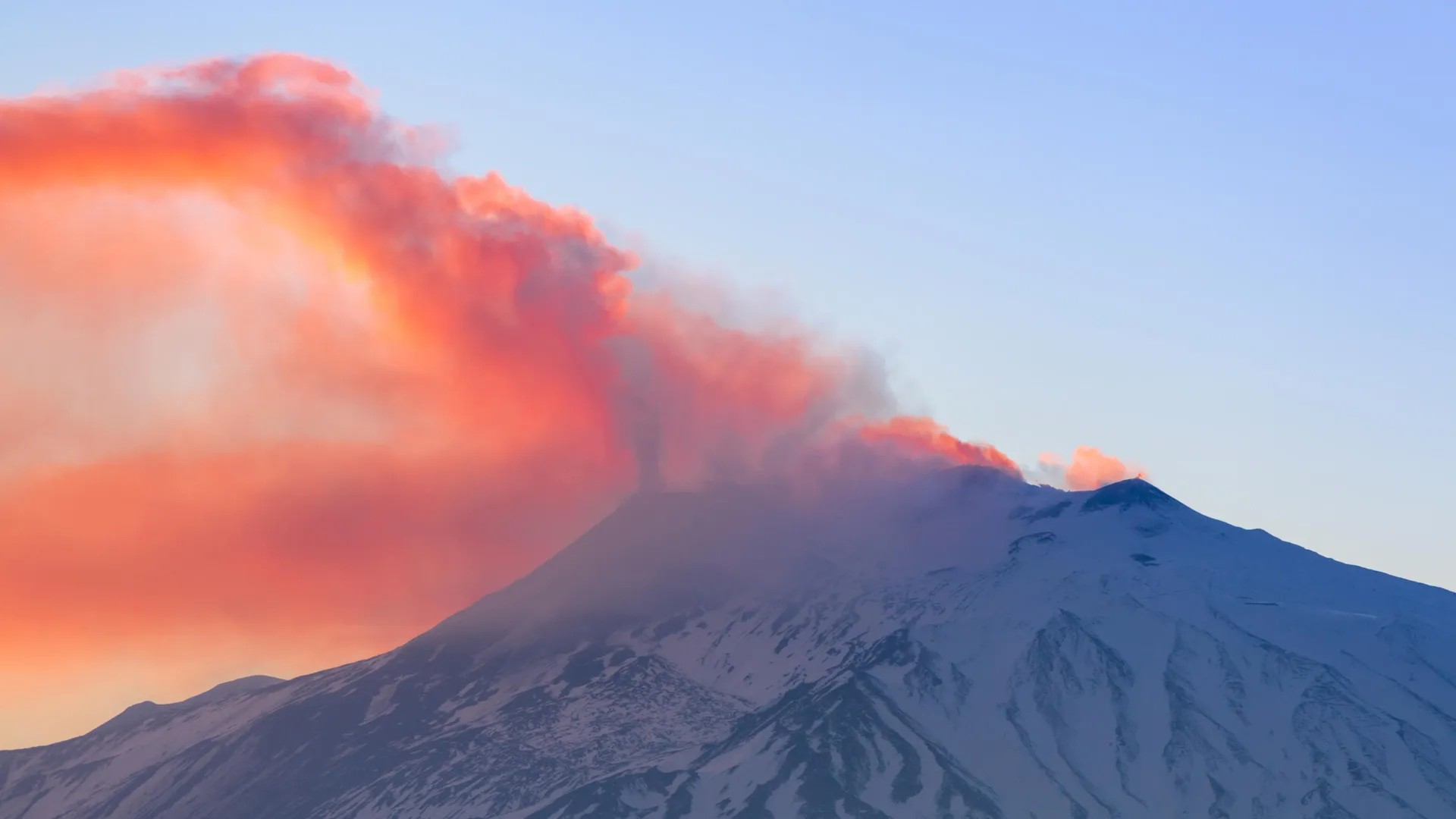
ROME — For centuries, the towering silhouette of Mount Etna has dominated the Sicilian landscape, a brooding sentinel standing more than 3,000 meters (9,800 feet) above the shimmering blue of the Mediterranean Sea. As Europe’s most active volcano, Etna erupts with striking regularity, spewing incandescent fountains of lava and billowing plumes of ash several times a year. It is a tourist magnet, a mythological forge of Hephaestus, and a persistent hazard to the millions of people living in its shadow.
Yet, beneath its fiery spectacle lies a profound scientific paradox. For decades, geologists have struggled to fit Mount Etna into the neat, established categories that explain how the rest of the Earth’s volcanoes form. It has stubbornly resisted traditional geological models, operating outside the standard rules of plate tectonics.
Now, a groundbreaking study led by researchers at the University of Lausanne (UNIL), in collaboration with volcanologists from the Istituto Nazionale di Geofisica e Vulcanologia (INGV) in Catania, has proposed a radical new explanation. According to their research, published in the Journal of Geophysical Research — Solid Earth, Mount Etna may have formed through a rare volcanic process unlike that of any other large volcano on Earth. If the hypothesis holds true, Etna could be entirely one of a kind—a giant manifestation of a geological process previously thought incapable of producing anything larger than a minor underwater bump.
Main Facts: Unraveling the Etna Enigma
To understand why Mount Etna has baffled scientists for generations, one must first understand the orthodox framework of volcanology. Traditionally, geologists group the Earth’s volcanoes into three primary categories based on how and where their underlying magma is generated:
- Divergent Boundaries (Rifts): Here, tectonic plates pull apart from one another, allowing molten rock from the mantle to passively rise and fill the gap. Examples include the Mid-Atlantic Ridge.
- Convergent Boundaries (Subduction Zones): In these regions, one tectonic plate is forced beneath another into the Earth’s mantle. The sinking plate releases water and other volatiles, melting the surrounding rock and feeding explosive volcanoes, such as those found along the Pacific "Ring of Fire."
- Hotspots: These are stationary plumes of hot magma originating deep within the Earth’s mantle, burning upward through the moving tectonic plates above to create chains of volcanoes, such as the Hawaiian Islands.
Mount Etna refuses to align with any of these standard classifications. Geographically, it sits near a complex convergent plate boundary where the African and Eurasian tectonic plates are colliding. Typically, this setting should produce volcanoes with the geochemical signatures characteristic of subduction zones. However, the chemical makeup of Etna’s lava tells a different story. Its elemental composition closely resembles that of hotspot volcanoes—yet seismological data confirms there is no deep mantle plume burning beneath Sicily.
For decades, this chemical mismatch remained an intractable puzzle. Etna was a geological square peg trying to fit into three round holes.
The new study bridges this gap by proposing that Etna is sustained by small, pre-existing pockets of magma trapped deep within the upper mantle, roughly 80 kilometers (50 miles) below the Earth’s surface. Unlike typical volcanoes, where magma is generated relatively quickly in the lead-up to an eruption, Etna’s magma appears to have resided in these mantle pockets for geological eons.
The collision of the African and Eurasian plates acts as a slow-moving compressor. As the tectonic plates bend and fracture near the subduction zone, these deep-seated pockets of melt are squeezed upward through the crust—functioning much like liquid being wrung out of a submerged sponge. This clever mechanical mechanism successfully accounts for both Etna’s baffling hotspot-like chemistry and its relentless, long-term eruptive schedule.
Chronology: A Half-Million-Year Geological Timeline
To trace the evolutionary history of this volcanic giant, it is necessary to look back across hundreds of thousands of years of geological time.
- 500,000+ Years Ago (The Submarine Origins): Long before it towered over Sicily, the region that would become Mount Etna was an underwater basin. Volcanic activity in the area began roughly half a million years ago, characterized initially by submarine eruptions beneath the ancient sea that covered the region.
- 170,000 to 100,000 Years Ago (Emergence and Migration): As tectonic pressures continued to warp and uplift the Sicilian crust, the locus of volcanic activity shifted inland and rose above sea level. Successive waves of basaltic and trachybasaltic lava began building the foundational edifice of the modern volcanic complex.
- The Last 100,000 Years (Stratovolcano Growth): Etna transitioned into a complex stratovolcano—a towering composite structure built of alternating layers of hardened lava, tephra, pumice, and volcanic ash. Through thousands of effusive and explosive cycles, it grew to its current majestic height of over 3,000 meters.
- The Modern Era (Decoding the Past): In recent decades, modern geochronology and geochemistry have allowed scientists to drill into and sample rocks spanning this entire 500,000-year timeline.
- The Breakthrough (Present Day): By analyzing the chemical evolution of these rock samples, the UNIL-led research team discovered a remarkable consistency. Despite dramatic shifts in the surrounding tectonic environment over the last half-million years, the chemical composition of Etna’s magma has remained astonishingly stable. This temporal stability provided the smoking gun researchers needed to confirm that the magma source was deep, isolated, and governed by mechanical plate compression rather than shifting mantle chemistry.
Supporting Data: The "Petit-Spot" Connection
The most startling revelation of the new study is not just where Etna’s magma comes from, but how that process scales up. The research team believes Mount Etna belongs to a little-known fourth category of volcanism: "petit-spot" volcanoes.
Petit-spot volcanism is a relatively young concept in geosciences. The phenomenon was first identified by Japanese geologists in 2006 when they discovered small, young submarine volcanoes off the coast of Japan. These tiny undersea mounds provided physical evidence supporting a theoretical model first proposed in the 1960s: that small pockets of melt naturally accumulate near the top of the Earth’s asthenosphere (the upper mantle).
Until now, however, petit-spot volcanism had exclusively been associated with micro-structures.
"Our study suggests that Etna may have formed through a mechanism similar to the one that generates petit-spot submarine volcanoes," explains Sébastien Pilet, Professor at the Faculty of Geosciences and Environment at the University of Lausanne and lead author of the study.
"This is unexpected, as such processes had previously only been observed in very small volcanic structures, typically rising no more than a few hundred meters. Mount Etna, by contrast, is a large stratovolcano, whose activity began around 500,000 years ago and which now towers more than 3,000 meters above sea level."
To test this bold hypothesis, Pilet and his colleagues undertook a rigorous analytical program. They examined rock samples spanning the entirety of Etna’s half-million-year lifespan. By reconstructing the chemical evolution of the lava and running advanced geochemical and thermal melting experiments, they tested whether a petit-spot-style mechanism could consistently reproduce the observed lavas.
The results were definitive: the math and chemistry aligned. The tectonic flexing of the African plate provides just enough extensional stress to tap into the upper mantle’s hidden melt pockets, driving magma upward along deep crustal faults. The sheer volume and longevity of Etna simply mean that this mechanical squeezing process has been operating on a massive, sustained scale over hundreds of thousands of years.
Official Responses and Collaborative Impact
The publication of the study in the Journal of Geophysical Research — Solid Earth has sent ripples through the international geological community. By bridging the gap between Japanese marine geology and Mediterranean subduction dynamics, the research offers a unifying theory for a geological outlier.
Crucially, the study was strengthened by a cross-border partnership with prominent Italian volcanologists, including Anna Rosa Corsaro of the Istituto Nazionale di Geofisica e Vulcanologia (INGV) in Catania. The inclusion of INGV researchers ensures that theoretical geochemistry is deeply grounded in empirical, real-world monitoring data collected daily on the flanks of the volcano.
For INGV, which operates the high-tech monitoring networks that keep watch over Etna’s frequent eruptions, understanding the deep plumbing system of the volcano is not merely an academic exercise—it is a matter of public safety.
"While this research fundamentally alters our theoretical understanding of how Etna works, it also provides vital context for our ongoing hazard assessments," notes institutional commentary surrounding the collaboration. By mapping the deep pathways through which magma travels from the upper mantle to the surface, volcanologists gain a clearer picture of the triggers behind sudden eruptive phases.
While the study does not predict specific future eruptions, knowing that the magma supply is governed by broad tectonic squeezing rather than ephemeral shallow melting chambers helps scientists interpret seismic tremors and ground deformation data with greater accuracy. This ultimately aids local civil protection authorities in safeguarding the densely populated towns and agricultural communities clustered around the base of the volcano.
Implications: Rewriting the Textbooks
If the University of Lausanne’s hypothesis withstands the rigorous scrutiny of peer review and further field testing, its implications for Earth sciences will be profound.
First and foremost, it shatters the long-held dogma that petit-spot volcanism is merely a geological curiosity restricted to minor, localized oceanic settings. If a titan like Mount Etna—a massive stratovolcano anchoring a major European landmass—can be generated by petit-spot mechanisms, geologists must reconsider the potential diversity of volcanic origins across the globe.
This realization opens the door for a wave of exploratory research. Geologists are now encouraged to re-examine other anomalous volcanoes around the world—peaks that, like Etna, refuse to fit neatly into divergent, convergent, or hotspot categories. Are there other sleeping giants sustained by the tectonic wringing of upper-mantle melt pockets? Could ancient petit-spot systems be hidden within the geological record of continental interiors?
Furthermore, the study highlights the interconnectedness of global geoscience. A discovery made in 2006 regarding tiny, fleeting submarine bumps off the coast of Japan has now been utilized to solve a riddle that has baffled European scientists since the days of classical antiquity.
As Mount Etna continues to rumble, vent steam, and send rivers of glowing orange lava down its snowy slopes, it does so with a newly revealed identity. No longer just a stubborn anomaly or a geological misfit, Etna stands poised to rewrite our textbooks, proving that beneath our feet, the Earth is capable of creative processes far more imaginative and diverse than we ever dared to imagine.
