

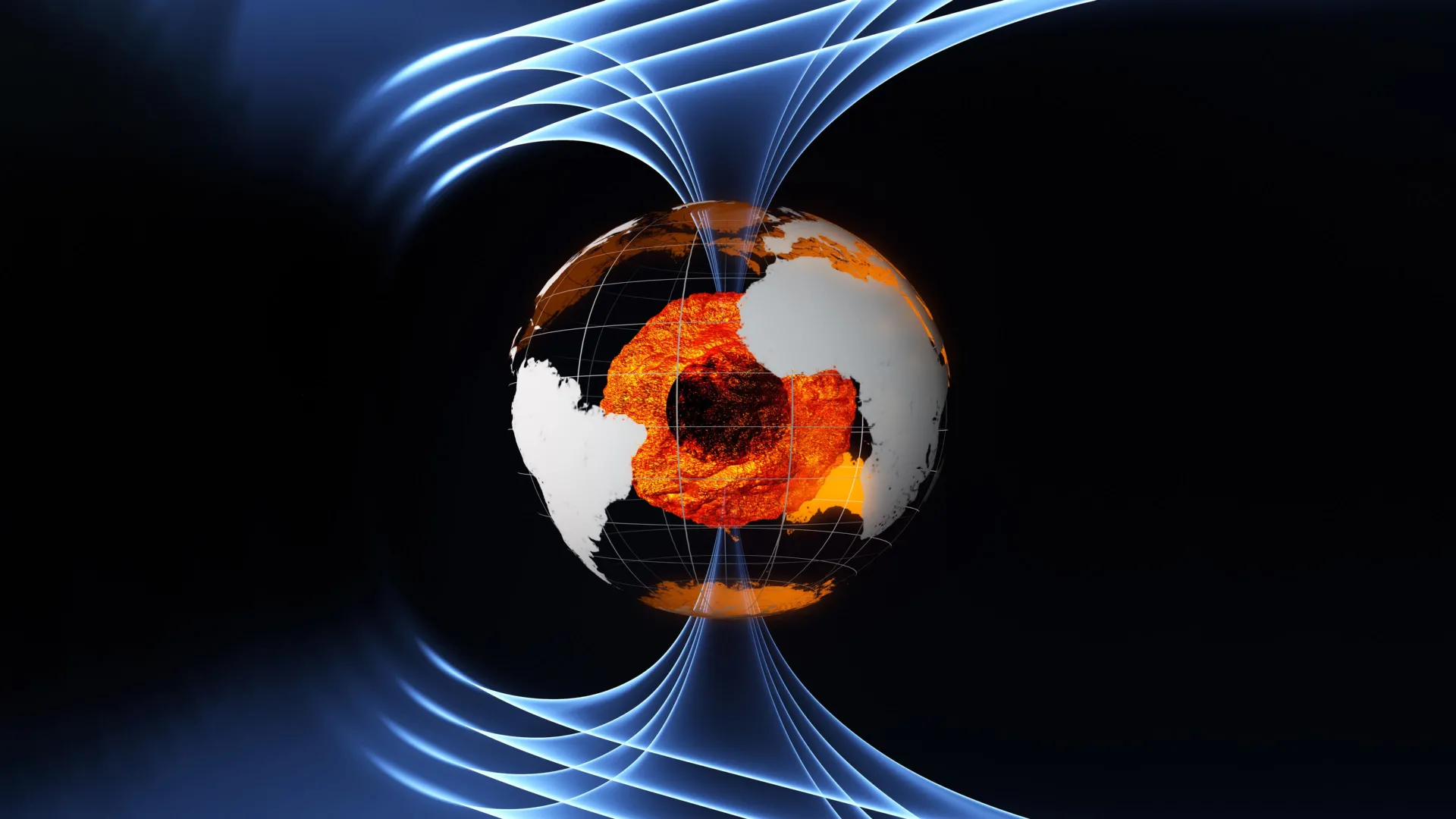
EDINBURGH & PARIS — Deep beneath the crust of our planet, hidden over 2,200 kilometers below the surface, a colossal river of liquid iron flows in near-total darkness. For generations, geophysicists operated under a comforting assumption: that the large-scale circulation patterns within Earth’s turbulent outer core were remarkably stable, grinding away in a predominantly westward direction over decades and centuries.
That consensus has now been dramatically upended.
In a landmark study published in the Journal of Studies of Earth’s Deep Interior, researchers have revealed that a massive plume of molten material beneath the equatorial Pacific Ocean underwent a shocking, abrupt reversal in 2010. Instead of maintaining its historically weak westward drift, this subterranean fluid highway abruptly shifted into a powerful eastward surge.
By synthesizing nearly three decades of ground-based observations with high-precision spaceborne data from the European Space Agency (ESA) and international partner missions spanning from 1997 through 2025, scientists have constructed the most detailed window into Earth’s geodynamo to date. The findings suggest that Earth’s deepest interior is far more dynamic, volatile, and complex than previously imagined, forcing researchers to completely rethink the fundamental mechanics driving our planet’s magnetic shield.
Main Facts: Unlocking the Mysteries of the Core-Mantle Boundary
The research, led by Frederik Dahl Madsen and a team of geoscientists at the University of Edinburgh’s School of Geosciences, centers on the blistering, electrically conducting fluid layer known as the outer core. Sitting just above the solid inner core and below the rocky mantle, this churning ocean of liquid iron is the engine of the geodynamo—the natural dynamo effect that generates Earth’s protective geomagnetic field.
For decades, scientists monitored this field using a sparse network of ground-based magnetic observatories. By tracking minute variations in the magnetic signals reaching the surface, researchers inferred that the fluid iron in the outer core was predominantly circulating westward. However, ground stations capture only a blurred, heavily filtered picture of these deep phenomena, as signals must pass through the electrically conductive mantle and crust, mingling with atmospheric and magnetospheric noise.
The new study shatters the illusion of core stability. The key takeaways from the research include:
- The 2010 Pacific Reversal: A broad region of iron-rich fluid situated below the equatorial Pacific abruptly flipped its trajectory, shifting from a weak westward flow to a strong eastward flow.
- Rapid System Variability: Rather than evolving over millennial timescales, large-scale core circulation can alter its behavior dramatically within the span of a single decade.
- Subsequent Slowdown: Data models indicate that this powerful eastward current has actually begun to lose momentum since 2020, pointing toward a possible transient fluctuation or a complex natural oscillation.
- Potential Inner Core Coupling: The sudden emergence of the Pacific flow reversal coincides temporally with distinct shifts in the behavior of Earth’s solid inner core, as detected through seismology and geodesy, hinting at deep-seated physical interactions across the core boundaries.
Chronology of Discovery: From Ground Observatories to Spaceborne Precision
To understand how scientists managed to "see" thousands of kilometers through solid rock, one must trace a technological evolution that transformed geophysics over the late 20th and early 21st centuries.
The Era of Ground-Based Inference (Pre-1999)
For most of the 20th century, scientists relied entirely on surface magnetometers. While these instruments were exceptionally good at recording global magnetic shifts over time, they suffered from a fundamental geographic limitation: the oceans cover over 70 percent of the Earth’s surface, leaving vast blind spots in places like the Pacific Basin. Consequently, global circulation models of the outer core were generalized, smoothing over regional anomalies and transient events.
The Dawn of Magnetic Satellites (1999–2013)
The paradigm shifted when space agencies began launching dedicated magnetometry missions designed to measure Earth’s magnetic field from orbit. The era began in earnest with Denmark’s Ørsted satellite in 1999, followed by Germany’s CHAMP mission in 2000. These spacecraft orbited high above the atmosphere, bypassing surface interference to measure the planet’s magnetic field lines with unprecedented clarity. Researchers suddenly had access to continuous, global datasets that could isolate core-generated magnetic fields from crustal and atmospheric anomalies.
The 2010 Reversal Event
Unknown to contemporary observers at the time, a monumental geological shift was unfolding quietly beneath the Pacific Ocean in 2010. A massive swath of molten iron abruptly halted its ancient westward creep and accelerated eastward. Because this event occurred deep below the oceanic crust, it initially went unnoticed in real-time, only revealing itself when researchers began stacking years of retrospective satellite and ground data.
The Swarm Constellation Era (2013–Present)
In November 2013, the European Space Agency launched its trio of Swarm satellites. Placed into carefully coordinated, near-polar orbits, the Swarm constellation was specifically engineered to untangle the complex web of magnetic sources surrounding the Earth. By flying at different altitudes and local times, the satellites could map the fine spatial and temporal details of the geomagnetic field.
The integration of Swarm data, alongside legacy missions like CryoSat, CHAMP, and Ørsted, enabled Madsen’s team to look backward and forward across a sweeping 28-year timeline (1997–2025). This prolonged baseline allowed them to spot the 2010 Pacific reversal, correlate it with the mysterious 2017 "geomagnetic jerk" (a sudden, sharp change in the secular acceleration of the magnetic field), and map the subsequent deceleration of the eastward flow observed post-2020.
Supporting Data & Methodology: Dissecting the Geodynamo
To untangle the magnetic signals originating from the core from those generated by the ionosphere or Earth’s crust, the research team relied on sophisticated inverse modeling techniques.
Electrically conducting fluids moving through a magnetic field generate their own magnetic fields through electromagnetic induction—a process described by magnetohydrodynamics. By analyzing the time-dependent changes in the magnetic field mapped by the Swarm constellation, scientists can solve the inverse problem: working backward from surface measurements to map the velocity fields of the liquid iron at the core-mantle boundary (located roughly 2,880 kilometers deep).
The data revealed wave-like accelerations and sharp flow structures that would have been entirely invisible in noisier, lower-resolution datasets. According to the analysis, the eastward jet beneath the Pacific reached its peak intensity several years ago before entering its current phase of deceleration.
This behavior provides crucial constraints for numerical geodynamo simulations. Standard computer models of the core often struggle to reproduce such rapid, localized velocity reversals. The new empirical data forces theorists to revise their models, suggesting that the fluid dynamics of the outer core involve complex waves, thermal plumes, and magnetic instabilities operating on much shorter timescales than previously thought.
Official Responses and Expert Analysis
The implications of the study have reverberated across the international geoscience community, drawing commentary from leading researchers and mission managers alike.
Frederik Dahl Madsen, lead author of the study from the University of Edinburgh, emphasized the profound questions raised by the discovery.
"The large-scale flow reversal beneath the Pacific raises new questions about the behavior of Earth’s deep interior," Madsen stated. "Scientists now want to understand whether the reversal represents a short-lived fluctuation, part of a repeating oscillation, or a new stable equilibrium for core circulation. Continued monitoring will be essential to determine how the flow evolves over the coming years."
Madsen also pointed to the intriguing synchronization between the core’s fluid dynamics and its solid center.
"The rise of the strong eastward flow in the Pacific is contemporary with a change in behavior in the inner core, as inferred from geodesy and seismology, and we hypothesize that these changes in the deep interior are associated with the changes in flow beneath the Pacific," he added.
From the operational perspective of the European Space Agency, the findings validate a decade of high-precision satellite monitoring. Anja Stromme, ESA’s Swarm Mission Manager, highlighted the irreplaceable value of continuous spaceborne observation.
"Although Swarm was launched after the dramatic reversal event of 2010, it has provided high-precision data that tell us about Earth’s inner core in the period that followed," Stromme noted. "Importantly, Swarm provides continuous global coverage over many years, allowing scientists to track how core dynamics evolve over time rather than relying only on ground-based magnetic observatories. Long-duration satellite magnetic measurements allow researchers to follow changes in the geodynamo in near-real-time and improve models of Earth’s magnetic field evolution."
Elisabetta Iorfida, ESA’s Swarm Mission Scientist, underscored how the findings challenge dogmatic views of deep-Earth stability.
"This study shows that regional changes can emerge rapidly within just a decade," Iorfida explained. "The findings may also help scientists investigate possible interactions between Earth’s outer core, inner core, lower mantle and, therefore, give more insights into the core-mantle boundary, which is a critical region for deep Earth dynamics."
Iorfida concluded that the research paints a picture of a planet far more complex than textbook diagrams suggest: "As the magnetic field continues to evolve, satellite missions are providing an increasingly detailed view of the dynamic processes unfolding deep inside our planet, revealing that Earth’s core may be far more variable and complex than once believed."
Implications: Why the Restless Core Matters to Life on Earth
While the violent churning of liquid iron 2,200 kilometers beneath our feet poses no direct, immediate physical threat to human populations or surface climate systems, it is intimately tied to the habitability of our world.
Protecting the Biosphere
The primary product of the geodynamo is Earth’s magnetic field, an invisible shield that extends thousands of kilometers into space. This magnetosphere traps and deflects charged particles streaming from the Sun in the solar wind, as well as hazardous cosmic rays from deep space. Without this magnetic armor, the solar wind would gradually strip away Earth’s atmosphere—much like what happened to Mars billions of years ago—and expose surface life and technological infrastructure to lethal doses of radiation.
Navigation and Space Weather
Because the magnetic field is generated by fluid motion within the outer core, any changes down below inevitably alter the field at the surface. These shifting magnetic parameters affect everything from civilian and military navigation systems (which rely on accurate geomagnetic models to calibrate compasses and GPS) to satellite operations in low-Earth orbit. Space weather forecasting models—crucial for protecting power grids, communication satellites, and astronauts—depend on understanding how the geodynamo behaves over time.
Probing the Deepest Frontiers
Finally, the discovery of the Pacific flow reversal opens up new avenues for understanding the thermodynamics of the deep Earth. The core-mantle boundary is the most extreme thermal and chemical interface on the planet, where scorching iron from the core meets the base of the silicate mantle. By tracking how fluid flows accelerate, decelerate, and reverse in response to conditions at this boundary, scientists hope to gain a unified understanding of plate tectonics, mantle plumes, and the long-term thermal evolution of the Earth.
As the Swarm satellites continue their vigilant orbits and future missions are planned, humanity’s view of the deep Earth is shifting from a static subterranean abyss into a living, breathing, and remarkably restless realm.
