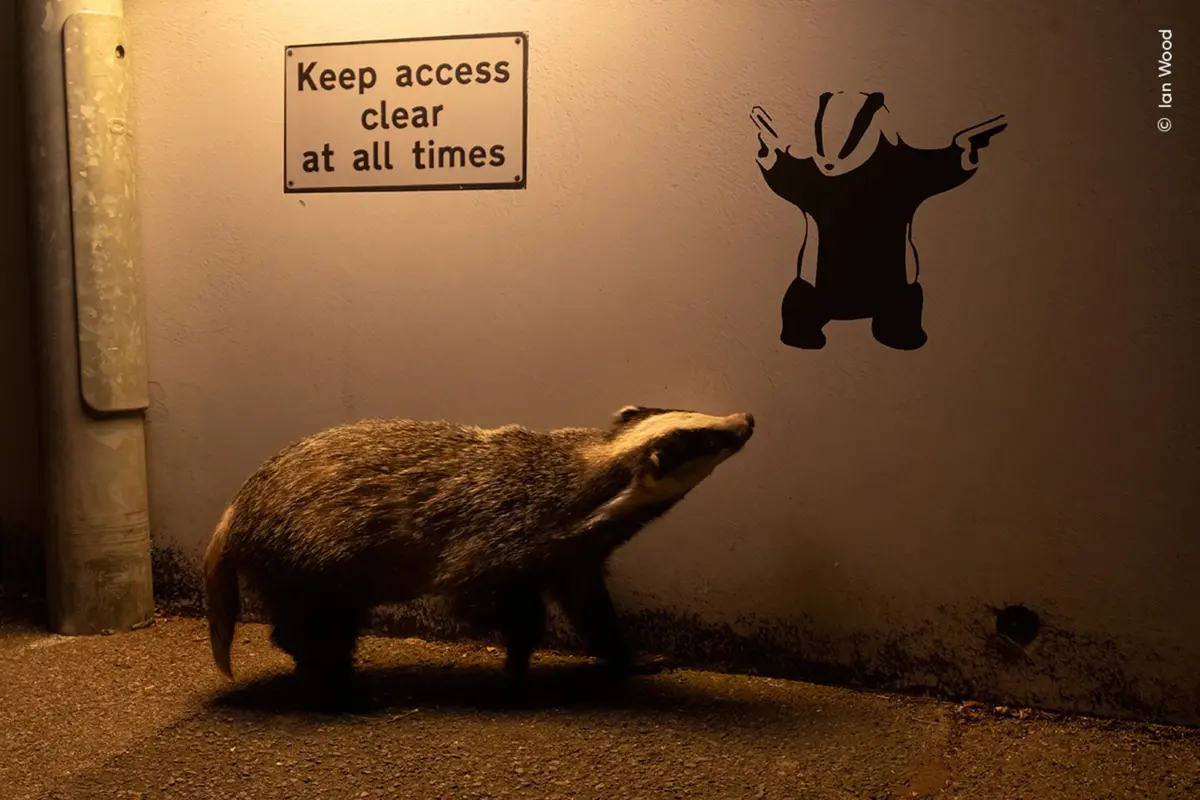
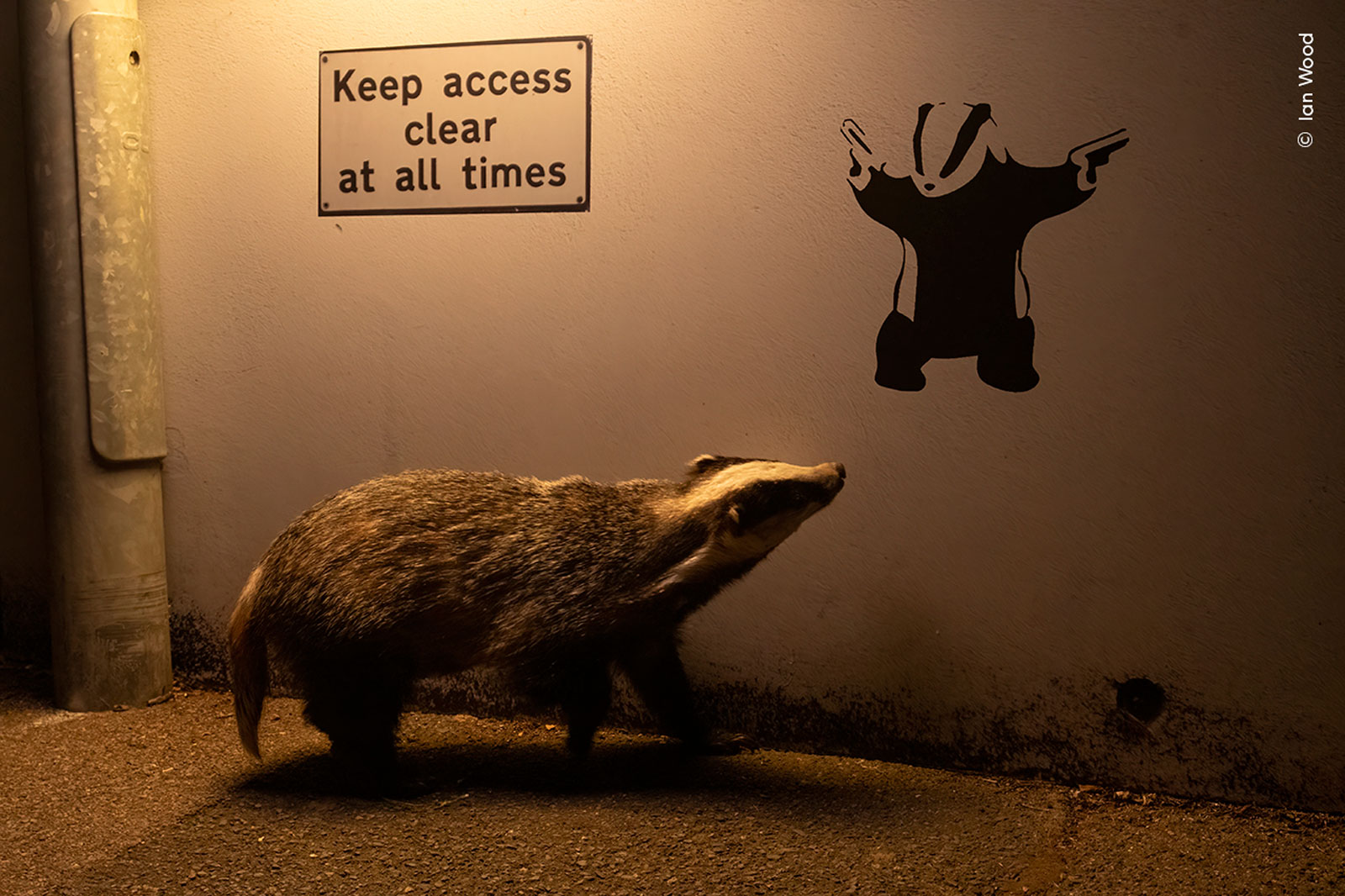
British photographer Ian Wood has claimed the prestigious title of the tenth annual Wildlife Photographer of the Year People’s Choice Award 2024 with his captivating and impeccably timed image, titled “No Access.” The winning photograph captures an ambling Eurasian badger glancing upward as it navigates a pavement in St Leonards-on-Sea, England, illuminated solely by the amber glow of a streetlamp against a backdrop of fittingly themed local graffiti.
Selected from a competitive shortlist of 25 extraordinary nature and wildlife images, “No Access” resonated deeply with the global public. A record-breaking turnout of over 76,000 nature enthusiasts and photography aficionados from across the globe cast their votes to decide the winner of the landmark competition, which is developed, produced, and hosted by the Natural History Museum in London.
While the image immediately charms viewers with its uncanny juxtaposition of urban decay and resilient wildlife, it also carries a profound conservation subtext. Beyond celebrating the quiet majesty of urban fauna, Wood’s victory has brought renewed public and political scrutiny to the controversial, ongoing badger cull in rural Britain, framing the urban migration of these animals not merely as a quaint novelty, but as a symptom of a broader ecological crisis.
Alongside Wood’s triumph, four other highly commended finalists captured the imaginations of voters worldwide:
“Earth and Sky” by Francisco Negroni (Chile): A fiery, nocturnal spectacle capturing a double lenticular cloud illuminated by glowing lava erupting from the Villarrica volcano.
“Edge of Night” by Jess Findlay: A dramatic, haunting action shot of a barn owl gliding out of a derelict hayloft window into the twilight to hunt.
“Whiteout” by Michel d’Oultremont: A minimalist, pristine composition depicting a stoat perfectly camouflaged against a sweeping snowy landscape in Belgium, peering intently across its territory.
“Spiked” by David Northall: A visceral, intense portrayal of a bloodied yet resolute honey badger returning to complete a hunt against a fiercely defensive Cape porcupine.
Chronology: From Pavement Foraging to Global Acclaim
The journey to “No Access” began in the coastal town of St Leonards-on-Sea in East Sussex. Local residents had established a routine of leaving food scraps on pavements to feed local urban foxes. Over time, however, this unintended feeding ground began attracting unexpected visitors: Eurasian badgers descending from nearby setts to forage in the urban sprawl.
Recognizing an extraordinary photographic opportunity, Ian Wood observed a badger regularly traversing a specific pedestrian route flanking a weathered wall late at night. Rather than relying on heavy studio lighting that might startle or disrupt the animal, Wood constructed a discrete, unobtrusive hide on the edge of the road. Working under the cover of darkness, he waited patiently for the precise intersection of wildlife movement and ambient municipal lighting. The resulting frame—snapped as the badger paused beneath the streetlamp—captured a moment of accidental symmetry between the creature’s path and the surrounding human environment.
The image was subsequently submitted to the sixtieth annual Wildlife Photographer of the Year competition. Out of nearly 60,000 entries submitted from amateur and professional photographers worldwide, an international panel of expert judges initially selected “No Access” as part of a competitive 25-image shortlist for the People’s Choice category.
Public voting opened globally, culminating in the announcement of Wood as the tenth People’s Choice Award winner in early 2025. The winning photograph, alongside the four other commended finalist works, is currently on display online and featured on interactive voting screens at the flagship Wildlife Photographer of the Year exhibition at the Natural History Museum in London, where it will remain open to visitors through June 29, 2025.
Supporting Data and Competition Metrics
The sheer scale of the 2024 Wildlife Photographer of the Year competition underscores its status as the premier global platform for nature photography. Key data points from this milestone tenth People’s Choice cycle include:
Global Engagement: Over 76,000 individual votes were cast by the public—setting a historic record for community participation in the award’s decade-long history.
Initial Pool: The final 25 shortlist contenders were culled from an immense pool of nearly 60,000 entries submitted to the primary sixtieth competition from photographers representing dozens of countries.
Exhibition Longevity: The exhibition showcasing the top five People’s Choice images is housed at the Natural History Museum in London and runs for an extended multi-month engagement ending June 29, 2025.
Future Timeline: While the 2024 cycle concludes with the public vote, the judging process for the sixty-first annual competition is already underway, with winners slated to be announced at a live ceremony in London in October 2025.
Official Responses and Perspectives
The announcement of “No Access” as the winner elicited strong praise from institutional leadership, alongside a deeply personal and sobering reflection from the photographer himself regarding the state of British wildlife.
Dr. Douglas Gurr, Director of the Natural History Museum, praised the photograph’s ability to bridge the gap between human infrastructure and the natural world. In an official statement, Dr. Gurr remarked:
“Ian’s flawlessly timed image offers a unique glimpse of nature’s interaction with the human world, underscoring the importance of understanding urban wildlife. His exceptional photograph serves as a powerful reminder that local nature and wildlife, often just outside our homes, can inspire and captivate us.”
For Ian Wood, the award represents a bittersweet validation of his photographic craft and a critical megaphone for environmental activism. Reflecting on his victory, Wood shared:
“The outpouring of badger love since my photo was nominated for the People’s Choice Award has been beautifully overwhelming. Finding out that it has won is truly humbling. However, there is a darker side to this image.”
Expounding upon the realities behind the urban scene, Wood contrasted his current residence in rural Dorset—where he actively engages in habitat restoration and re-wilding initiatives—with the grim ecological trajectory facing badgers across the UK.
“I live in rural Dorset where I’m on a re-wilding mission to enhance habitats for a huge array of wildlife. The badger cull—which is still ongoing—has decimated their numbers and I fear that unless the cull is stopped, we’ll only see badgers in urban settings in several parts of England. My hope is for this image to raise awareness of the damaging effect of the badger cull and help push for change.”
Implications: Urban Adaptation Versus Rural Eradication
While the surface narrative of “No Access” highlights the adaptability of urban wildlife, its deeper implications point toward a distressing ecological paradox in modern British conservation.
The Urbanization of Wildlife
As natural habitats face continuous fragmentation due to housing developments, infrastructure expansion, and intensive agriculture, many adaptable mammal species are forced to alter their foraging behaviors. Foxes, hedgepipes, and badgers increasingly occupy towns and cities, finding sustenance in discarded human food waste, domestic gardens, and paved verges. While urban environments offer a temporary refuge from rural pressures, they expose wildlife to entirely new hazards, including vehicular collisions, domestic pet interactions, and urban pollution.
The Badger Cull Controversy
Wood’s commentary shines a harsh spotlight on the systemic threats driving badgers toward these urban margins. The controversial badger cull—implemented primarily as a measure to curb bovine tuberculosis (bTB) in cattle—has faced intense criticism from conservationists, animal welfare organizations, and scientists who argue that the culling methodology is scientifically flawed, inhumane, and environmentally destructive.
By pushing rural populations to the brink, the cull risks driving displaced animals away from traditional woodlands and setts, leaving them vulnerable or forcing them to colonize suburban and urban sectors where they live in perpetual conflict with human infrastructure.
Photography as an Agent of Change
The Wildlife Photographer of the Year competition was founded not merely to aestheticize the natural world, but to forge empathetic connections between humanity and the environment. Ian Wood’s award-winning capture demonstrates the potent utility of visual storytelling. By transforming a simple nocturnal street scene into a viral symbol of resilience and vulnerability, “No Access” challenges policy complacency, proving that a single frame can spark vital national conversations on how society chooses to coexist—or fail to coexist—with its native wildlife.