

Main Facts: The Enigmatic Legacy and Burial of an Icon
More than a century after she forever changed the landscape of esoteric art and cartomancy, the final resting place of Pamela Colman Smith—affectionately known within artistic and occult circles as "Pixie"—continues to draw the curiosity, respect, and pilgrimage of tarot enthusiasts worldwide. Smith (1878–1951), whose brilliant, evocative illustrations breathe life into the world’s most popular and widely utilized tarot deck, was laid to rest on September 25, 1951. Her funeral service was conducted by Joseph Henry du Moulin-Browne, a well-regarded Roman Catholic priest whose presence underscored the quiet, dignified departure of an artist who spent her final decades largely in obscurity and financial modesty.
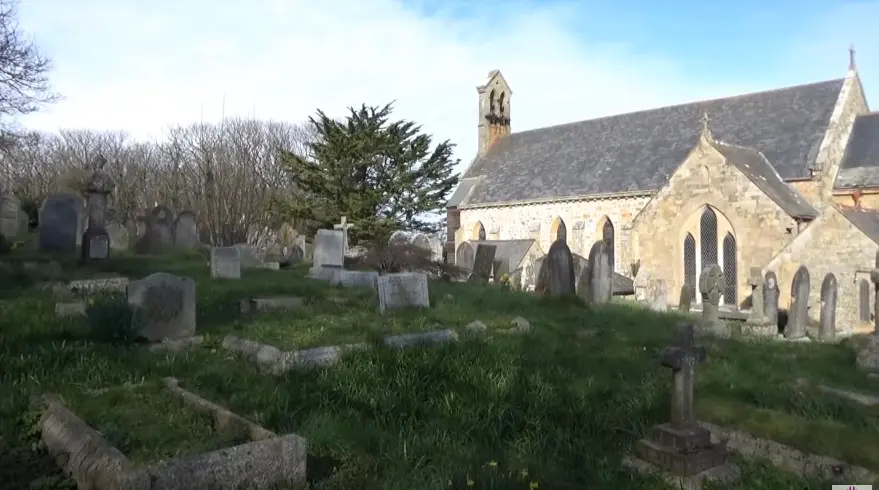
Today, Smith’s exact grave remains physically unmarked, its original wooden marker or stone long since surrendered to the elements and time. Furthermore, the official parchment records detailing the precise plot allocations of the era were tragically lost in a devastating fire. Despite these historical roadblocks, a dedicated collaborative effort involving modern researchers, site inspections, and independent historical validation has successfully pinpointed her most probable resting place within the churchyard of St. Michael & All Angels Church.
Nestled in a serene corner of the church grounds, flanked by whispering woodlands and within earshot of the sea, this location represents a poignant homecoming for an artist who held a deep, lifelong affinity for the coastline. While the lack of a headstone poses a challenge for traditional pilgrims, the convergence of surviving parish registers, chronological grave layouts, and expert corroboration offers a compelling closure to one of the lingering mysteries of modern esoteric history.
Chronology: Tracing the Life, Passing, and Rediscovery of "Pixie"
To understand the journey of Pamela Colman Smith’s final resting place, one must first retrace the timeline of her remarkable life, her quiet twilight years, and the decades of historical detective work that followed her death.
1878–1910: The Rise of an Artistic Visionary
- 1878: Pamela Colman Smith is born in Middlesex, England, to American parents. Her early life is marked by extensive travel between London, Jamaica, and the United States, instilling in her a vibrant, multicultural imagination.
- 1890s–Early 1900s: Smith establishes herself as a prolific illustrator, set designer, and writer. Associated with the avant-garde "Pagan Writers’ Club" and recognized by figures like William Butler Yeats, she earns the affectionate nickname "Pixie" for her whimsical nature and vivid folkloric artistic style.
- 1909: Commissioned by occultist Arthur Edward Waite, Smith creates the iconic 78-card tarot deck published by Rider & Company. Unlike previous decks that primarily focused detailed illustrated scenes solely on the Major Arcana, Smith revolutionizes the craft by instilling narrative artwork into all the Minor Arcana cards. This deck eventually becomes the undisputed global gold standard of tarot, known universally today as the Rider-Waite-Smith (or Waite-Smith) deck.
1911–1951: Obscurity, Conversion, and the Final Days
- 1911–1940s: Despite the monumental significance of her artistic output, Smith receives a flat fee for her work on the tarot deck and fails to secure ongoing royalties. As commissions dwindle, she converts to Roman Catholicism in 1911 and eventually relocates to Cornwall—a landscape of rugged shores and maritime beauty that deeply inspires her.
- September 18, 1951: Pamela Colman Smith passes away at her home in Cornwall at the age of 73, leaving behind an estate of minimal monetary value.
- September 25, 1951: Father Joseph Henry du Moulin-Browne presides over her Christian burial at St. Michael & All Angels Churchyard, committing her body to the earth in a quiet ceremony witnessed by few.
Post-1951 to Present: The Loss of Records and Modern Rediscovery
- Circa 1950s–1980s: During church renovation works, a temporary builders’ hut catches fire. Tragically, this blaze consumes the parish registers and plot maps that document burials from the mid-20th century, obscuring Smith’s exact coordinates.
- December 2023: Researchers and members of the Tarot Association conduct a meticulous site inspection at St. Michael & All Angels Churchyard. By cross-referencing surviving administrative records with the physical layout of the graveyard, they propose a highly probable location for Smith’s grave.
- Independent Validation: The following day, a local historian who originally researched the cemetery three decades prior independently verifies the researchers’ conclusions, solidifying the historical consensus regarding "Pixie’s" final plot.
Supporting Data: Methodology Behind the Identification
Because physical markers are absent and the primary ledger was lost to fire, proving the location of Pamela Colman Smith’s grave required forensic historical methodology. Researchers relied on several layers of corroborating data to deduce the exact plot.
1. Chronological Graveyard Mapping
St. Michael & All Angels Churchyard is organized with a strict adherence to chronological ordering. Graves from the post-World War II era were laid down sequentially, plot by plot, rather than being haphazardly assigned. By taking the date of Smith’s burial—September 25, 1951—researchers mapped out the expected trajectory of interments for that specific autumn.
2. Surrounding Markers and Parish Registers
While the master ledger was destroyed in the builders’ hut fire, surviving peripheral records and surviving headstones in the churchyard provide chronological anchors. The specific corner section identified contains three distinctly marked graves bearing dates from 1950 and 1951. Flanking these marked plots are at least three unmarked spaces. Given the continuous, orderly progression of burials during this two-year window, Smith’s burial naturally falls into one of these vacant slots.
3. Independent Historical Validation
No historical claim stands strong without peer review. During the on-site investigation, researchers documented the topography, layout, and surrounding headstones. The subsequent day, a consultation with a seasoned local historian—an expert who spent over thirty years archiving and researching the parish—yielded an independent confirmation. Without prompting, the historian pointed to the exact same cluster of plots in the far corner of the churchyard, validating the deduction made by the modern research team.
Official Responses and Perspectives from the Historical Community
The uncovering of Pamela Colman Smith’s most probable resting place has elicited profound emotional and intellectual responses from the international tarot and historical preservation communities. For decades, the narrative surrounding Smith’s final years was one of tragic erasure—an artist who gave the world its most beloved divination system, only to die in poverty and relative anonymity, her grave lost to history.
Historians and biographers, including Marcus Katz and Tali Goodwin (authors of Secrets of the Waite-Smith Tarot, Llewellyn 2015), have long championed the restoration of Smith’s legacy to its rightful prominence. The realization that her physical remains lie in such a poetic, peaceful environment—surrounded by nature, near the sea she cherished, and accompanied by the chime of church bells during recent site documentation—has brought a sense of spiritual closure to her modern admirers.
Furthermore, academic and institutional interest in Smith has surged. Scholars are increasingly decoupling the deck’s identity from Arthur Edward Waite alone, rightfully elevating Smith to co-creator status. The collaborative effort to locate her grave symbolizes a broader cultural movement: rectifying the historical oversights that marginalized female artists and visionaries at the turn of the 20th century.
Implications: Preserving the Heritage of Modern Tarot
The meticulous tracking of Pamela Colman Smith’s final resting place carries wide-ranging implications for historians, practitioners, and cultural heritage organizations alike.
1. Shifting the Narrative from Misfortune to Legacy
For years, the overarching biography of "Pixie" Smith was cast in melancholy tones: a brilliant artist who died penniless, forgotten, and unremembered. By locating her final resting place within a serene Cornish churchyard—and by actively memorializing her life through specialized research, digital archives, and physical pilgrimages—the global tarot community is actively rewriting her legacy. She is no longer remembered merely as a tragic footnote, but as a foundational pillar of modern esoteric art whose influence endures on millions of tables worldwide.
2. Advancing Rigorous Archival Standards
The loss of the St. Michael & All Angels parish records to a builders’ hut fire serves as a sobering reminder of the fragility of local history. It highlights the critical importance of digital preservation, redundancy, and meticulous archival practices in safeguarding cultural heritage. The success of independent researchers in piecing together fragmented data demonstrates that historical truth can often be recovered through interdisciplinary dedication, combining on-the-ground investigation with genealogical and topographical analysis.
3. Strengthening the Intellectual Foundation of Tarot Practice
As detailed by organizations such as the Tarot Association, understanding the true history of the Rider-Waite-Smith deck provides a comprehensive basis for new practical innovations in cartomancy. When practitioners understand the life, struggles, and artistic ethos of the woman who painted the cards, their relationship with the deck deepens from simple memorization to a profound appreciation of artistic lineage.
Moving Forward
Exclusive insights, rare photographs, and ongoing discoveries—such as the comprehensive feature “The Kiss of the Sun for Pardon: A Memory of Pamela Colman Smith”—continue to be published for members within specialized research portals. These efforts ensure that while her wooden marker may have weathered away into the Cornish soil, the light of Pamela Colman Smith’s brilliant imagination will never be lost to history again.
