

By Gayathri Narayanan
"Love isn’t a state of perfect caring. It is an active noun like struggle."
— Fred Rogers
Main Facts
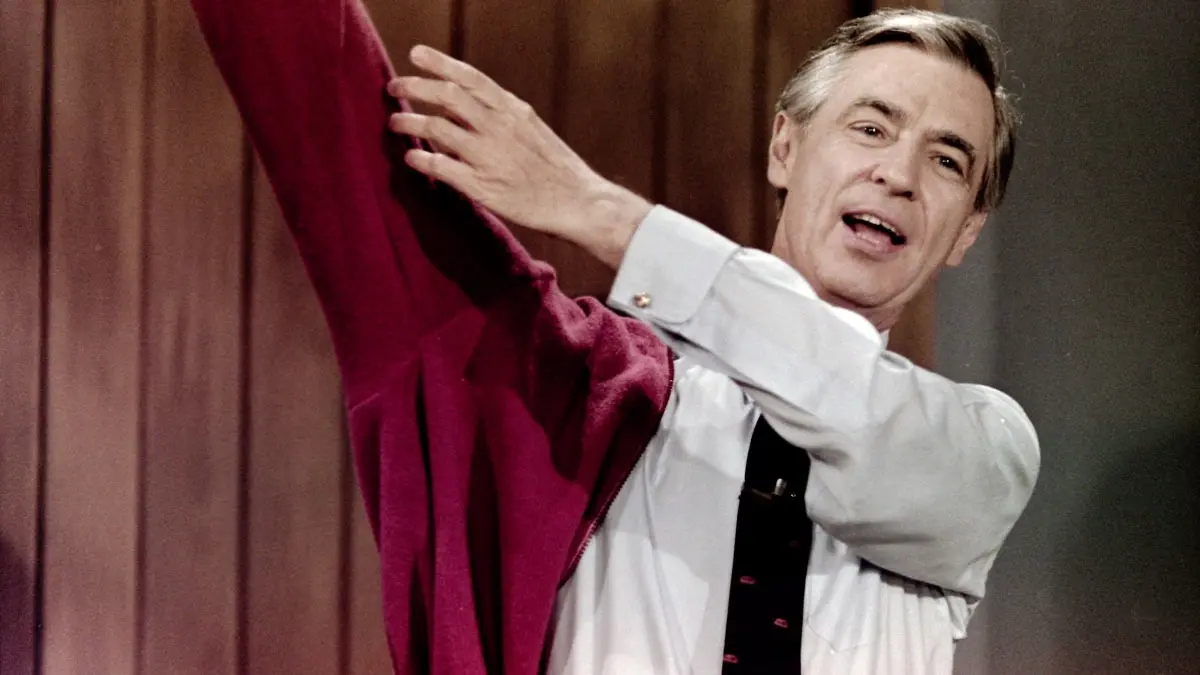
August 31 marks a quarter of a century since the final broadcast of Mister Rogers’ Neighborhood. For more than three decades, ordained Presbyterian minister Fred Rogers welcomed generations of children into his television living room, changing his shoes, zipping his sweater, and delivering a daily dose of foundational goodness into American households.
Though Rogers passed away in 2003, his cultural footprint has experienced a significant renaissance in recent years, propelled by the 2018 acclaimed documentary Won’t You Be My Neighbor? and the 2019 biographical drama A Beautiful Day in the Neighborhood, starring Tom Hanks. Today, a quarter-century after the cameras stopped rolling on new episodes, Rogers’ philosophy of radical acceptance is increasingly examined through the lenses of global contemplative traditions, comparative religion, and modern psychological frameworks. Far from a quaint relic of mid-century children’s television, his work offers a blueprint for navigating contemporary societal division through active, intentional presence.
Chronology: From Illness to Icon
The trajectory of Fred Rogers’ life reveals a man forged in vulnerability rather than effortless perfectionism:
- 1928: Fred McFeely Rogers is born in Latrobe, Pennsylvania. As a child, he suffers from severe childhood illnesses and is frequently targeted by bullies who dub him "fat Freddy," leaving emotional and physical scars.
- 1951–1968: Rogers attends Dartmouth College and Rollins College, earning a degree in music composition, before entering Pittsburgh Theological Seminary. Ordained as a Presbyterian minister in 1962, he initially enters television out of a desire to reform the medium, working on early children’s programming before launching the precursor to his defining show.
- 1969: Mister Rogers’ Neighborhood achieves a historic cultural milestone. Rogers invites François Clemmons, a Black cast member playing Officer Clemmons, to share a small wading pool and cool his feet—a potent, subversive statement during an era of deeply entrenched racial segregation in public swimming spaces. Later that year, Rogers delivers historic, unscripted testimony before a U.S. Senate subcommittee, single-handedly securing $20 million in federal funding for public broadcasting through the sheer power of quiet conviction.
- 2001: The final new episode of Mister Rogers’ Neighborhood airs on August 31, mere weeks before the tragic events of September 11. Pressured by producers a year later, a reluctant Rogers returns to the studio to record comforting messages for traumatized parents, framing the tragedy through the Jewish concept of tikkun olam—the call to be "repairers of creation."
- 2003: Fred Rogers passes away from stomach cancer at the age of 74, eliciting a nationwide outpouring of grief and remembrance.
- 2018–Present: The release of documentary and feature films introduces Rogers to global audiences raised outside the United States, cementing his status as a universal symbol of compassion.
Supporting Data and Cultural Impact
The cultural reach of Mister Rogers’ Neighborhood is backed by remarkable longevity and historical impact:
- Longevity: The series produced nearly 900 episodes across a span of 33 years on national public television.
- Legislative Triumph: Rogers’ 1969 appearance before the United States Senate Commerce Committee—presided over by a visibly skeptical Senator John Pastore—remains one of the most famous pieces of political testimony in American history. Armed with a simple poem about childhood feelings, Rogers turned the senator’s skepticism into visible admiration within six minutes, preserving critical funding for the Corporation for Public Broadcasting.
- Demographic Reach: While initially broadcast in the United States, streaming platforms and documentary retrospectives have exposed millions of international viewers—growing up outside the American media ecosystem—to Rogers’ distinctive style of televised ministry and psychological holding.
Official Responses and Critical Perspectives
While Fred Rogers is widely revered today, his legacy was not without contemporary controversy and complex internal contradictions:
Conservative Pushback and Psychological Skepticism
During the height of his show’s popularity, Rogers faced pointed criticism from certain conservative commentators and child-rearing experts. Detractors accused him of contributing to a rising tide of entitlement among American youth, arguing that his signature refrain—“I like you just the way you are”—instilled unearned self-esteem without requiring children to achieve milestones or earn validation.
Contemplative teachers and theologians, however, offer a vastly different interpretation. Rogers was not attempting to inflate young egos for the sake of empty praise; rather, he operated from a deep, spiritually grounded conviction regarding the inherent sacredness and basic goodness of every human being. His ministry was rooted in theological grace—the belief that human worth is an unalterable birthright, not a performance metric.
The Cost of Compromise
Despite his progressive stances on race—exemplified by sharing the wading pool with François Clemmons—Rogers’ worldview was shaped by the institutional constraints of his era. Clemmons, who was openly embraced on screen as a Black man, was simultaneously asked by Rogers to keep his identity as a gay man private, out of fear that societal prejudices of the period could cost the show its funding and platform. While driven by a desire to protect a program he believed served a greater good, this compromise exacted a painful psychological toll on Clemmons, illustrating that even Fred Rogers operated within the human limitations and moral compromises of his historical moment.
Implications: Bridging Contemplative Traditions and Modern Life
For those examining Rogers’ work from outside standard Western religious frameworks, his presence frequently invokes cross-cultural spiritual parallels.
Metta and the Practice of Unconditional Goodwill
In Buddhist traditions, the quality Rogers embodied so effortlessly is often referred to as metta—typically translated as loving-kindness or unconditional friendliness toward oneself and others. Every time Rogers looked directly into the camera lens, speaking slowly and deliberately to the child on the other side, he projected an energy of radical acceptance. He reminded audiences that they did not need to modify their appearance, excel academically, or acquire special status to be worthy of affection.
Advaita Vedanta and the Erasure of "Us Versus Them"
From the perspective of non-dualist philosophies such as Hindu Advaita Vedanta, the perceived separation between "me" and "you" is ultimately an illusion. The practice of unconditional love—whether understood through the lens of Christian grace, Buddhist metta, or non-dual awareness—seeks to soften the rigid psychological boundaries that divide societies into hostile camps of "us" and "them."
Rogers was no godlike figure detached from human suffering; he was a mortal man who swam a mile each morning, weighed himself daily to combat the haunting memories of childhood bullying, and relied on structured spiritual disciplines to maintain his equilibrium. His favorite puppet, Daniel Striped Tiger, served as an overt alter ego, a safe container through which Rogers could process his own fears, insecurities, and vulnerabilities.
The "Mud and the Lotus"
As the famed Vietnamese Zen master Thich Nhat Hanh observed, "No mud, no lotus." The difficult circumstances of Rogers’ early life—his physical frailties and social isolation—did not curdle into bitterness. Instead, they became the fertile soil from which a profound capacity for empathy grew.
Twenty-five years after the final episode of Mister Rogers’ Neighborhood, the world has grown increasingly polarized, hyper-digitalized, and fractured by rapid social change. Watching old clips of the show often evokes a sharp pang of grief—a mourning for the gentle world he modeled and the lingering question of what could be.
Yet, Rogers never asked individuals to fix the entire architecture of global geopolitical conflict. His call was intensely local and immediately accessible: to be present for the person standing directly in front of us, to slow down enough to truly see them, and to treat them as an essential part of our shared neighborhood. In an era starved of genuine attention, Fred Rogers’ enduring message remains a vital, revolutionary practice worth learning anew.
