

In the landscape of spiritual practice, some of the most profound paradigm shifts do not stem from the avoidance of hardship, but rather from cultivating an entirely new relationship with it. Obstacles that initially appear as impediments seamlessly merge with the path itself. Difficult, disorienting experiences yield unexpected wisdom, gradually replacing confusion with expansive clarity and ultimate freedom.
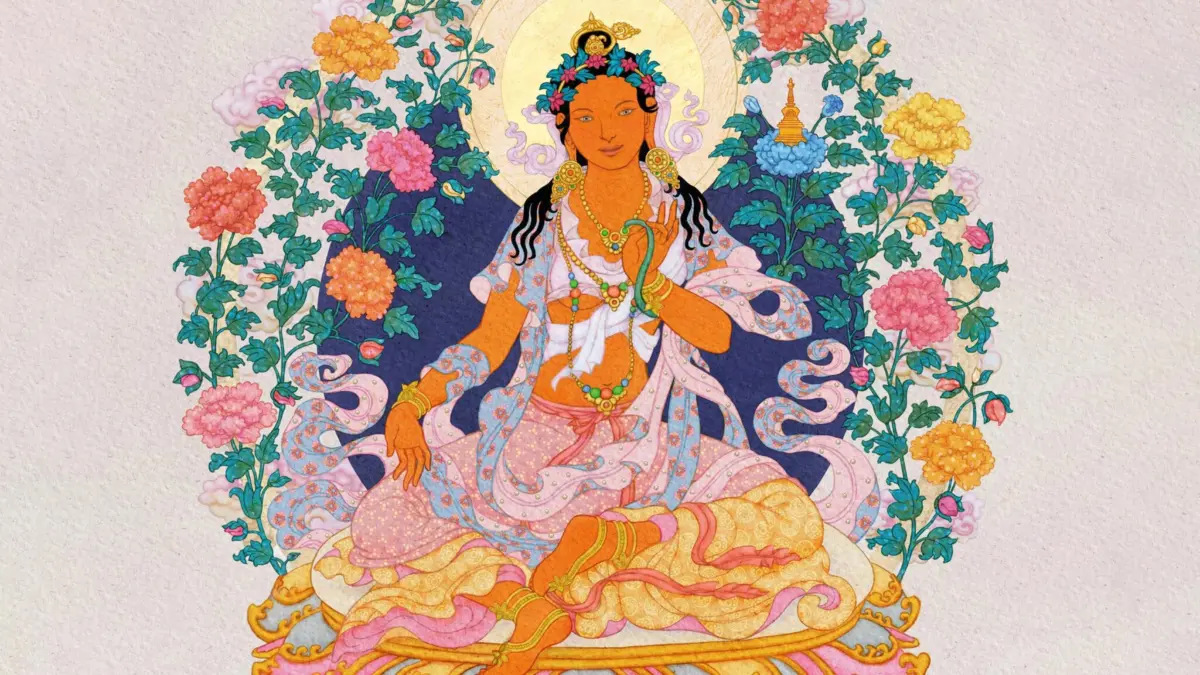
Within the Vajrayana Buddhist tradition, this transformative capacity to embrace adversity and recognize its deeper nature is personified by the female Buddha, Tara. As the final installment of a four-part series exploring the traditional liturgy Praises to the Twenty-One Taras, this article examines the final seven emanations—numbers fifteen through twenty-one. These powerful manifestations offer a structured blueprint for transmuting inner and outer turmoil into profound spiritual awakening.
Main Facts: The Tradition of the Twenty-One Taras
The Praises to the Twenty-One Taras is an ancient liturgical text and associated contemplative practice deeply embedded in Tibetan Buddhism. Traditionally, practitioners relate to Green Tara as the central archetype of awakened compassion, invoking her protection and blessings during times of crisis. However, advanced Vajrayana teachings invite practitioners to look inward, recognizing that Tara’s enlightened qualities are not external entities, but inherent dimensions of human consciousness.
Green Tara serves as the core matrix from which twenty-one distinct emanations arise. Each emanation acts as a living map of spiritual transformation, demonstrating how awakened attributes—such as discernment, courageous action, and healing—manifest and deepen within daily life.
While the first fourteen Taras, explored in previous installments, emphasize swift protection, courage, restoration, and realignment against immediate threats, the final seven Taras shift the focus toward deep pacification, the neutralization of internal and external poisons, and the ultimate realization of unconditioned freedom.
Chronology and Progression: A Roadmap of Spiritual Unfolding
The final seven Taras do not merely act as independent protectors; they form a sequential, progressive mandala of release and realization. Each emanation builds upon the last, guiding the practitioner systematically from the initial pacification of mental obscurations to the ultimate realization of the "suchness" of reality.
[15. Rabtu Shima: Pacification]
       ↓
[16. Rigngag Tobjom: Illumination / Exposure of Harm]
       ↓
[17. Pagmé Nönma: Subduing Violence & External Threats]
       ↓
[18. Maja Chenmo: Transmuting Poison & Trauma]
       ↓
[19. Mipam Gyalmo: Harmonizing Conflict & Restoring Joy]
       ↓
[20. Loma Gyönma: Healing Epidemics & Replenishing Depletion]
       ↓
[21. Özer Chenma: Ultimate Pacification & Unobstructed Freedom]
This sequence illustrates a precise psychological and spiritual trajectory: first, mental obstacles are quieted; then, hidden harms are exposed and neutralized; next, violent external forces are subdued; emotional and literal poisons are transformed; social and psychological harmony is restored; collective ailments are healed; and finally, the practitioner rests in the unobstructed freedom of awakened mind.
Supporting Data and Detailed Exploration of the Final Seven Taras
15. Jetsun Drölma Rabtu Shima: Tara Who Is Perfect Peace
Homage to Her who is happiness, virtue, and peace,
Who lives in the peace beyond suffering,
Who overcomes great negative deeds
With the purity of Svaha and OM.
Serving as the gateway into the final segment of the mandala, Jetsun Drölma Rabtu Shima initiates the process of pacifying the veils that obscure natural human clarity. Rendered in a soft, luminous white, Rabtu Shima radiates a deep, settling peace. She holds a vase brimming with wisdom-awareness nectar and a blossoming lotus, symbolizing the purification of negative karma and the revelation of an innate, ever-present peace.
Psychologically and spiritually, Rabtu Shima targets the core mechanisms of grasping, aversion, and conditioned reactivity. When these mental obscurations accumulate, they constrict human perception. By invoking Rabtu Shima, the practitioner allows old, rigid patterns to soften, creating mental spaciousness and allowing the mind to settle into stillness.
16. Jetsun Drölma Rigngag Tobjom: Tara Who Destroys the Power of Harmful Intentions
Homage to Her who completely delights her entourage,
Who destroys the bodies of enemies,
Who liberates with the light from the ten syllables
And with the mantra HUNG.
Embodying uncompromising clarity, Jetsun Drölma Rigngag Tobjom is depicted in a striking red hue, holding a double vajra that radiates the unshakeable light of awareness in all directions.
While her traditional verse speaks of "destroying the bodies of enemies"—language that can challenge modern readers—the Vajrayana tradition interprets the "enemy" not as a human adversary, but as the internal forces of harmful intent, conflicting emotions, and self-deception. Rigngag Tobjom utilizes the seed syllable HUNG to illuminate hidden corners of the psyche. When brought into the uncompromising light of awareness, fear, resentment, and reactivity rapidly lose their binding power.
17. Jetsun Drölma Pagmé Nönma: Tara Who Subdues Boundless Harm
Homage to Ture who stamps with her foot,
Whose seed syllable is HUNG,
Who shakes Mount Meru, Mandara,
Kailash, and the three worlds.
Jetsun Drölma Pagmé Nönma represents fierce, compassionate protection. Saffron in color and visually peaceful despite her immense energetic impact, her activity is symbolized by a golden stupa—the ultimate representation of the Buddha’s awakened mind.
Her verse employs dramatic imagery, describing her stamping her foot and shaking mountains. This cosmic disruption symbolizes the absolute power of wisdom and compassion to shatter systemic violence and the roots of collective suffering. Genuine protection, in this context, is not achieved through aggression, but through the uncompromising disruption of harmful cycles.
18. Jetsun Drölma Maja Chenmo: Tara Who Dispels All Poison
Homage to Her who holds in her hand
The rabbit-marked moon, like a celestial lake,
Who totally dispels poison
By reciting twice Tara and Pâ.
Known as the "Great Peacock" (Maja Chenmo), this luminous white Tara embodies the ultimate transmutation of suffering. Symbolized by the moon and a celestial lake, she offers profound healing for psychological residue—the lingering impacts of fear, grief, betrayal, and loss.
In Buddhist iconography, the peacock consumes deadly toxins and metabolizes them to nourish the brilliant colors of its plumage. Similarly, Maja Chenmo teaches practitioners not to avoid or suppress painful experiences, but to utilize them as the direct fuel for spiritual awakening.
19. Jetsun Drölma Mipam Gyalmo: The Invincible Queen
Homage to Her who is honored by hosts of Gods,
Kings, local deities, and spirits,
Who transforms conflicts and disturbing dreams
With the armor of resplendent joy.
Jetsun Drölma Mipam Gyalmo restores harmony, mitigating both external discord and internal anxiety. Clad in white and protected by an ancient white parasol—a traditional emblem of nobility and all-encompassing compassion—Mipam Gyalmo equips the practitioner with "the armor of resplendent joy."
Here, joy is neither a naive denial of reality nor a circumstantial emotion. Instead, it is an unshakeable confidence in one’s innate buddha-nature, serving as a resilient shield against the psychological contagion of fear and conflict.
20. Jetsun Drölma Ritö Loma Gyönma: Tara Clothed in Leaves
Homage to Her whose two eyes shine
With the luminosity of the sun and moon,
Who dispels virulent epidemics
With two Hara and with Tuttara.
Saffron-colored and associated with a sacred basket of medicinal herbs, Jetsun Drölma Ritö Loma Gyönma embodies holistic restoration. Her eyes—shining like the sun and moon—perform a dual function: the solar light destroys the root causes of illness and negativity, while the lunar light cools, heals, and replenishes what has been physically and emotionally depleted.
Beyond addressing physical contagion, Loma Gyönma’s practice targets the "epidemics" of collective panic, mass despair, and ideological polarization that rapidly infect human communities.
21. Jetsun Drölma Özer Chenma: Tara of Great Rays of Light
Homage to Her who through the suchness of ground, path, and fruition
Completely possesses the power to pacify,
Who quickly is victorious over yakshas and
Spirits who cause harm and sickness.
As the culmination of the mandala, Jetsun Drölma Özer Chenma represents absolute freedom. Rich white in color and symbolized by a pair of golden fishes moving effortlessly through water, Özer Chenma personifies a mind entirely unconstrained by fear, fixation, or conceptual limitations.
Her verse points directly to the "suchness of ground, path, and fruition"—the complete integration of ultimate reality. With all obscurations purified, illuminated, transformed, harmonized, and healed, the practitioner rests in a state of unobstructed, luminous freedom.
Official Perspectives and Teachings
Lama Döndrup Drölma, resident lama at the Sukhasiddhi Foundation in California, emphasizes that engaging with these advanced Vajrayana practices fundamentally alters how human beings navigate contemporary crises.
"Some of the most meaningful shifts in our lives don’t come from avoiding difficulty but from discovering a new relationship to it," Lama Döndrup Drölma notes. "What feels like an obstacle becomes part of the path. Difficult experiences reveal unexpected wisdom, and confusion begins to give way to greater clarity and freedom."
Rather than treating the twenty-one Taras as mere mythological deities, contemporary Buddhist scholarship and lineage holders stress that these liturgies are active technologies of consciousness. They provide modern practitioners with a structured framework to metabolize personal and collective trauma, transforming abstract philosophical concepts into visceral, embodied realities.
Implications for Modern Spiritual Practice
The journey through the final seven forms of Tara carries significant implications for individuals navigating the complexities of modern life. In an era marked by systemic uncertainty, psychological burnout, and pervasive social division, the Tara liturgy offers a radical counter-narrative:
- Embracing Adversity: Instead of seeking a sanitized existence free of friction, practitioners are encouraged to lean into difficulty, utilizing it as the primary catalyst for spiritual maturation.
- Systemic Psychological Hygiene: The progressive clearing modeled by Taras 15 through 21 provides a psychological roadmap for identifying hidden mental poisons, dismantling reactivity, and cultivating durable inner peace.
- Compassionate Action: True protection and healing, as embodied by these emanations, are never self-serving. They arise naturally from deep insight and are invariably directed toward alleviating the suffering of all sentient beings.
Ultimately, the twenty-one Taras stand as an enduring invitation to recognize that awakening is not a distant, unattainable ideal. It is an immediate, living potential waiting to be uncovered within the very fabric of human experience.
