

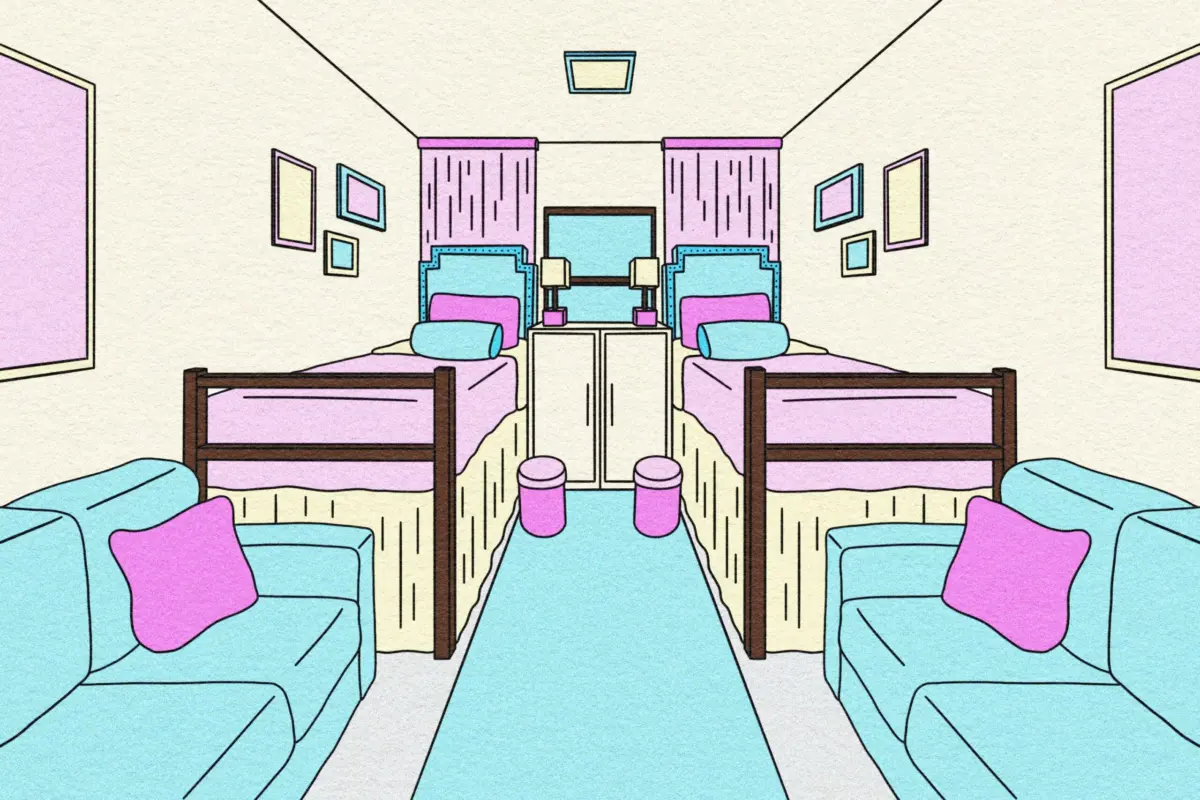
Pristine white monogrammed pillowcases stitched in pale blue sit neatly atop matching twin beds. That signature accent color echoes across the room: on plush throw pillows, woven into a patterned area rug, and framing chinoiserie-inspired artwork flanked by polished gold wall sconces. Designed to be photographed from every angle, this hyper-curated space looks more like a boutique hotel suite than a temporary college dorm room that will be inhabited for a mere nine months.
Created by designer MK Decker for two University of Mississippi freshmen, this over-the-top interior is no longer an isolated anomaly. Lavishly outfitted, professional-grade dorm rooms are rapidly becoming the cultural norm across American universities, particularly at institutions in the South and the Midwest. This visual excess aligns seamlessly with the long-standing aesthetics of Greek life, which has historically embraced pastel hues, custom monograms, and Lilly Pulitzer-inspired styling.
What was once a modest rite of passage—tackling cinderblock walls with a handful of posters and a cheap comforter—has evolved into a multi-million-dollar industry. Fueled by social media algorithms, sorority recruitment pressures, and a burgeoning class of professional dorm designers, the modern college student’s living space has transformed into a high-stakes status symbol.
Main Facts: The Rise of the Designer Dorm Room
The transformation of the traditional college dorm is driven by a convergence of consumerism, interior design services, and social media validation. Today’s incoming freshmen are not simply packing for college; they are curating environments designed for public consumption.
- Professionalization of Design: Interior designers and specialized entrepreneurs are cashing in on the back-to-school rush, offering services ranging from pre-packaged decor kits to fully bespoke, high-end room transformations.
- Astronomical Costs: While basic college packing lists used to total a few hundred dollars, modern designer dorm commissions can soar up to $20,000, with affluent parents readily footing the bill for custom furniture, layered lighting, and curated art.
- The Social Media Engine: Platforms like TikTok, Instagram, and Pinterest have weaponized comparison culture. Dorm rooms now serve as stylized backdrops for content creation, amplifying the pressure to establish a cohesive online "brand" before classes even begin.
- The Sorority Connection: Particularly prominent in schools with robust Greek life networks, room aesthetics have subtly woven themselves into the social and structural expectations of sorority recruitment, where rushees are frequently questioned about their interior design choices and color schemes.
Chronology: From Posterboards to Professional Consultations
To understand how a college bedroom became a professional design project, it is necessary to examine how the culture shifted over the past decade.
2015–2019: The Seed of a Trend
When MK Decker decorated her own freshman dorm room at Ole Miss in 2015, she recognized the emerging appetite for elevated campus spaces. At the time, it was the vanguard of serious dorm decorating. By the time Decker graduated in 2019, the market had expanded exponentially, prompting her to launch an enterprise designing and selling high-end campus products—such as duvet covers running up to $360, matching shower curtains at $145, and custom artwork priced at $475.
The Pandemic Era and RushTok (2020–2022)
As social media consumption surged during the COVID-19 pandemic, viral video subcultures like "RushTok" took off. Millions of viewers tuned in to watch sorority hopefuls document their rush season outfits, accessories, and social aspirations. Concurrently, online platforms popularized the concept of the hyper-aesthetic room, making meticulous interior design a baseline expectation rather than a luxury.
2023–Present: The Dorm Room Industrial Complex
By the mid-2020s, high-end residential designers recognized a lucrative new vertical. Designers began formalizing dorm packages, charging thousands of dollars to replicate the sophisticated processes used in multi-million-dollar residential homes. Companies like Dormie emerged, offering structured design kits that bridge the gap between expensive custom consultations and scattered retail shopping.
Supporting Data and Industry Insights
The financial investment pouring into temporary nine-month housing units highlights a significant shift in parental spending and entrepreneurial enterprise.
-
The Price Point Spectrum:
- DIY and Kit-Based Models: Entrepreneurs like Olivia Erwin Rosenthal, founder of Dormie, charge between $800 and $2,500 for curated kits containing bedding, furniture, wall decor, and bath items. Comprehensive custom packages—including 3D renderings and personal consultations—reach up to $4,000.
- Boutique Services: Independent designers like Jen Segall offer accessible professional packages starting around $3,500.
- High-End Customizations: At the apex of the market, elite designers command fees reaching up to $20,000 per room, implementing custom-built furniture tailored to specific architectural layouts and storage challenges.
-
The Gender Disparity:
The financial and social pressure to maintain an immaculate aesthetic falls disproportionately on young women. While male students frequently prioritize basic functional elements—such as sports memorabilia, flags, and standard bedding—female students navigate complex social expectations regarding color coordination, thematic consistency, and online presentation.
Official Responses and Perspectives from the Field
Industry professionals, parents, and students offer starkly contrasting viewpoints on this modern phenomenon, reflecting a tension between creative expression and socioeconomic excess.
The Designers’ View
Interior designers see their work as a natural extension of residential interior architecture, driven by genuine consumer demand. Shelly Gates of Mary Margaret Designs notes that custom furniture is often essential to optimize awkward layouts and restricted storage capacities in older campus buildings.
For designers like Jen Segall, keeping services accessible remains a priority. "I personally love seeing the creativity that a lot of these expensive dorm rooms show," Segall remarks. "But for me, that level of expense and excess doesn’t align with who I am as a designer."
Olivia Erwin Rosenthal recognized a logistical gap in the market. "Once I started poking around, I was amazed by how many great, affordable pieces were out there," she explains. "The problem was that they were scattered across so many different retailers, and there wasn’t an easy way to see how everything could come together into a room that actually felt designed."
The Parents’ View
Many parents view investing in a high-end dorm room as an act of maternal care and an investment in their child’s mental well-being. Kat Cook, a mother from West Point, Mississippi, enlisted professional help to build a Kentucky-themed space for her daughter Lucy, a collegiate golfer. "I knew her days would be busy and demanding, so it was important to me that her dorm room felt comfortable, peaceful, and like a place where she could truly relax and recharge," Cook says.
Similarly, Michele Gratch, an Atlanta-based interior designer who styled her daughter’s room at the University of Tennessee, highlights the omnipresence of social media. "Every post, video, and story is stylized and edited," Gratch observes. "Everyday girls who aren’t influencers still worry about their own brand. They are all hoping to go viral."
Philanthropic Intervention
Addressing the stark socioeconomic divide, North Carolina-based interior stylist Ebony Staten established The Vogue Foundation, a non-profit organization that decorates dorm rooms for first-generation college students entirely free of charge. As a first-generation graduate herself, Staten aims to alleviate the financial barriers that prevent disadvantaged students from participating in campus trends. "There’s something powerful about a student walking into that space and realizing, ‘Someone thought about me. Someone invested in me. This was created specifically for me,’" Staten shares.
Implications: Status, Mental Toll, and the Loss of Authenticity
While the luxury dorm trend is a boon for boutique designers and home-goods retailers, cultural critics and educators are increasingly raising alarms about its psychological and social fallout.
The Erosion of Personal Discovery
Historically, the college dorm room was envisioned as a blank canvas—a physical space where young adults transitioning out of their childhood bedrooms could experiment, make mistakes, and figure out who they are independently. Critics argue that pre-packaged aesthetic kits and thousands of dollars in professional styling rob students of this organic self-discovery process. When a room is meticulously engineered by an adult designer before the student even arrives, the space reflects parental aspiration rather than youthful identity.
Intensified Comparison Culture
The pressure to maintain appearances exacts a measurable emotional toll. Caroline DeRossette, whose daughter attends community college, worries about the psychological impact on students who cannot afford to compete. "When a young person walks into a dorm and immediately feels like theirs isn’t good enough, that’s a problem," DeRossette states. "When the room becomes another measure of status, money, popularity, or whether you fit in, we’ve missed the point."
Furthermore, as Auburn University freshman Sydney Riepe notes, room aesthetics have quietly bled into formal evaluations during sorority recruitment, where rushees are asked to describe and defend their interior design choices. What begins as interior decoration inadvertently hardens into an informal screening mechanism for social capital.
Conclusion: Redefining the Campus Experience
As the "dorm room industrial complex" continues to expand, it forces a broader cultural conversation about wealth disparity, social media saturation, and the commercialization of youth. Whether viewed as an elaborate expression of parental love or an over-the-top exercise in keeping up appearances, the designer dorm room has permanently altered the landscape of American higher education—turning the humble freshman bedroom into a battleground for modern status.
