

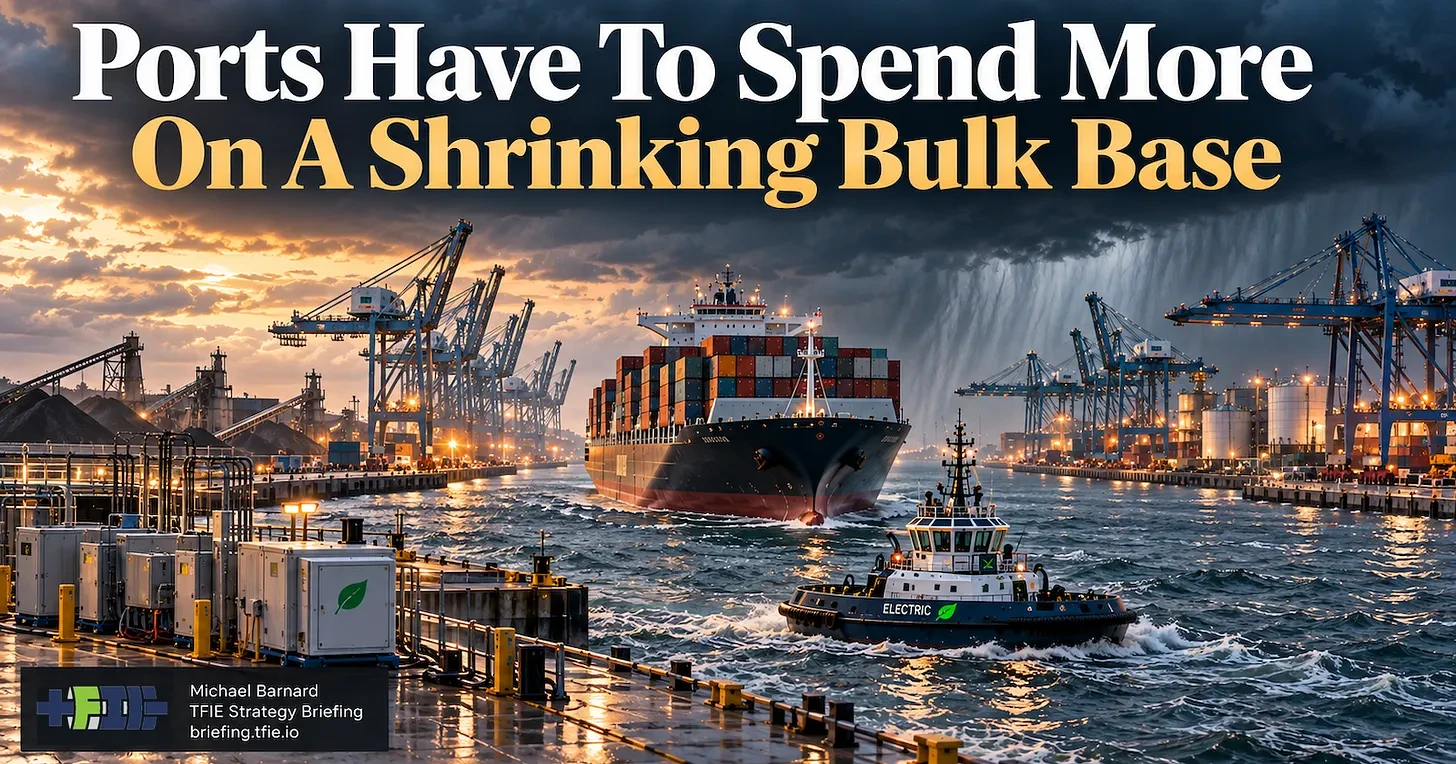
Global maritime trade is hurtling toward a historic crossroads. Port authorities around the world are being forced to make multi-decade infrastructure investments—locking in capital strategies designed to last thirty, forty, or even fifty years—just as the foundational assumptions that funded their historical growth begin to unravel.
According to recent strategic analyses from the TFIE Strategy Briefing, the maritime sector is caught in an unprecedented capital squeeze. Port operators must rapidly adapt to larger vessels, mounting climate change disruptions, and stringent decarbonization mandates. Yet, simultaneously, they are facing the structural decline of the very bulk commodities—coal, oil, and gas—that have historically generated the revenues required to pay for channels, berths, and shared hinterland connections.
Navigating this turbulence requires a delicate balancing act. Ports cannot simply build their way out of trouble by expanding capacity indefinitely, nor can they afford to stand still while the energy transition redrafts global shipping routes.
Main Facts: The Triple Threat Facing Modern Ports
The contemporary port authority faces a multi-front operational and financial crisis defined by three core pressures: physical scaling demands, climate vulnerability, and a shifting cargo landscape.
- Vessel Upgrades and Physical Constraints: Ships are growing rapidly in size and draft. To accommodate these mega-vessels, ports must continuously dredge deeper channels, install larger container and bulk cranes, and upgrade tugboat fleets for higher bollard-pull capacities.
- Climate Disruption: Extreme weather events, rising sea levels, and changing precipitation patterns are escalating the costs of maintaining reliable port operations and their inland transport connections. A terminal can harden its own quays and electrical grids, yet still experience catastrophic throughput losses if inland floods wash out rail links or droughts choke vital barge canals.
- The Fossil Fuel Phaseout: Roughly 40% of today’s global maritime freight tonnage consists of coal, crude oil, petroleum products, liquefied natural gas (LNG), and liquefied petroleum gas (LPG). Raw iron ore accounts for another 15%. Aggressive global electrification and clean-energy transitions directly threaten these volumes, shrinking the exact revenue streams that historically funded port expansions.
Chronology of the Transition: How Ports Got Here
To understand the current dilemma, it helps to examine how maritime infrastructure evolved and how the momentum of the green transition caught up with long-term capital planning.
Phase 1: The Era of Bulk-Funded Expansion (Late 20th Century)
For decades, port development operated on a predictable, linear model. Surging global demand for fossil fuels and raw materials created predictable, high-volume cargo streams. Coal terminals, oil jetties, and iron ore berths paid for themselves over decades, generating surplus capital that ports could use to cross-subsidize container handling facilities, shared rail links, and harbor services. Long-term loans were easily secured against decades of guaranteed throughput projections.
Phase 2: The Mega-Ship Era and Initial Climate Realities (2010s)
As global trade consolidated, shipping lines pursued economies of scale by commissioning increasingly massive container ships and bulk carriers. Ports entered a costly "arms race" to deepen harbors and expand handling infrastructure. Concurrently, early climate impacts began to manifest. Hurricane disruptions, coastal flooding, and river-level fluctuations started causing multi-million-dollar logjams, forcing ports to pivot from pure capacity expansion toward defensive engineering and resilience.
Phase 3: The Decarbonization Imperative and Cargo Peak (Present Day)
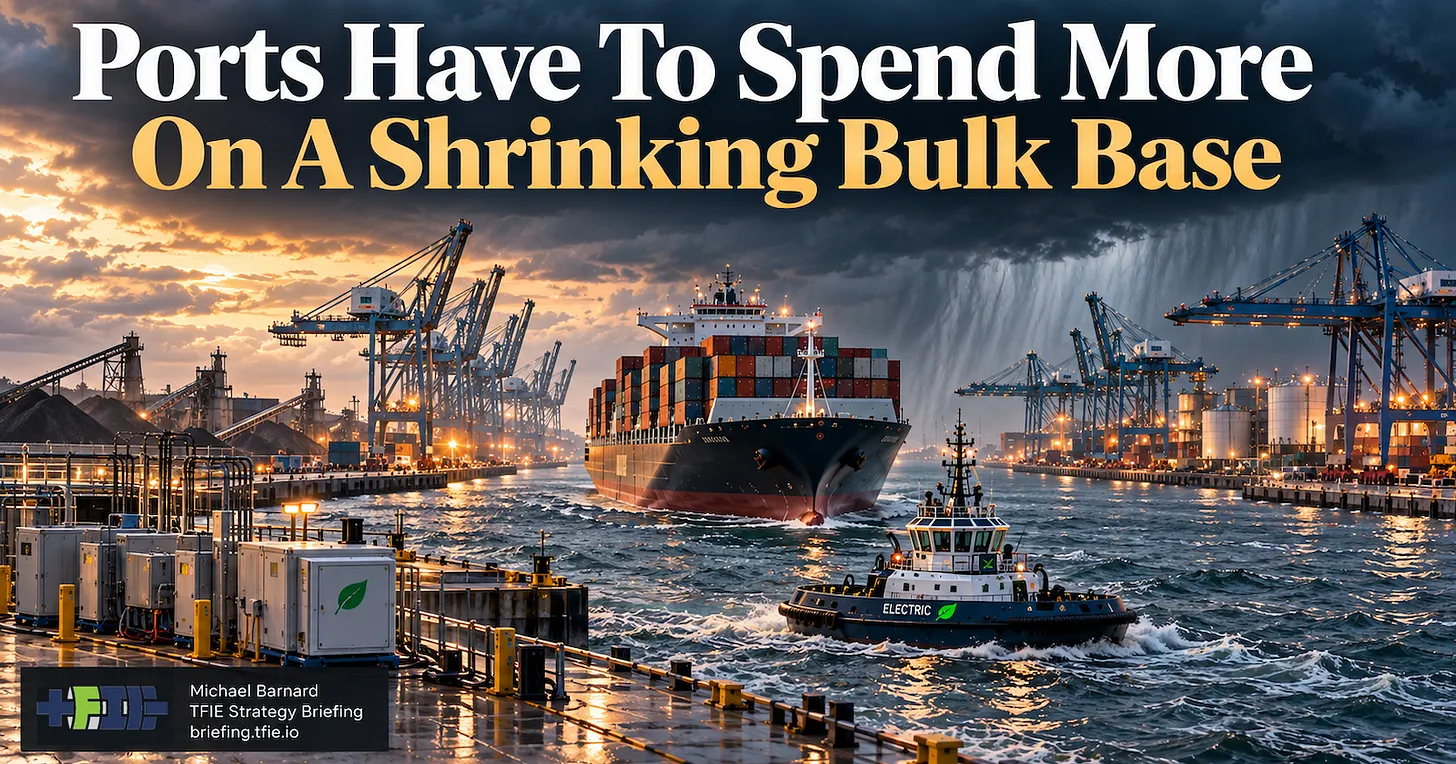
We have now entered an era where climate policies and energy transitions are biting into fossil fuel trade volumes. While containerized trade continues to grow, the foundational bulk cargoes that subsidized port development are reaching their peak and entering structural decline. Port planners are no longer looking at a straight-line future of compounding fossil fuel volumes; instead, they face a complex web of transition commodities—such as green hydrogen, ammonia, methanol, and biofuels—whose ultimate market shares remain highly speculative.
Supporting Data: The Arithmetic of Shrinking Fossil Streams
The numbers underlying the maritime transition reveal the magnitude of the capital problem facing port authorities.
- 40% of Tonnage at Risk: Fossil fuels—including coal, crude oil, petroleum products, LNG, and LPG—make up approximately four out of every ten tons of maritime freight moved globally today.
- 15% Iron Ore Exposure: Raw iron ore represents another 15% of global maritime tonnage. This stream faces growing pressure from scrap metal recycling, the rise of electric-arc steelmaking, and geographic shifts in where iron reduction processes take place.
- The Replacement Mismatch: A common misconception is that transition commodities will replace fossil fuel tonnages on a one-to-one basis. However, electrification drastically cuts primary energy demand rather than replacing every ton of burned fossil fuel with an equivalent traded molecule. For example, replacing thermal coal with domestic renewable energy eliminates the need to ship that coal entirely, leaving ports with a net loss in bulk throughput.
Furthermore, ports are caught in a zero-sum competitive trap. While individual port authorities frequently draft strategies to capture container market share from neighbors, or position themselves as hubs for green energy exports, every competing port cannot simultaneously capture market share from the others. When collective port strategies are aggregated, the math simply does not add up.
Official Responses and Strategic Perspectives
Port executives, logistics experts, and maritime economists are increasingly vocal about the need to rethink capital allocation strategies in the face of structural decline.
Industry analyses, such as those published in the TFIE Strategy Briefing, emphasize that traditional forecasting models are no longer fit for purpose. Many port authorities are attempting to hedge their bets by chasing multiple emerging transition sectors simultaneously—investing in specialized berths for ammonia, storage tanks for methanol, and terminals for hydrogen.
However, experts caution against "cargo-specific overbuilding." If a port invests heavily in specialized infrastructure for a fuel that ultimately loses out in the broader energy market (for instance, if green hydrogen dominates aviation and shipping bypasses ammonia), that capital becomes stranded.
Instead, a growing consensus points toward durable, fuel-agnostic shared infrastructure as the most resilient path forward.

Implications: Why Electrification Offers a Safe Harbor
Faced with an unpredictable cargo future, how should port authorities spend finite capital? The strategic answer lies in investments whose utility does not depend on a single, highly speculative commodity forecast.
The Broad Utility of Port Electrification
Electrification stands out as a uniquely robust investment case because electric assets remain valuable regardless of what goods are moving across the docks.
- Cranes and Yard Equipment: Electric rubber-tired gantry (RTG) cranes, automated guided vehicles (AGVs), and terminal tractors cut local emissions and operating costs whether the terminal is handling containers, steel products, perishable foods, or transition minerals.
- Battery-Electric Tugs: Harbor tugs equipped with modern battery-electric propulsion can maneuver ships safely regardless of whether those vessels are carrying manufactured goods or bulk commodities.
- Shore Power (Cold Ironing): Providing high-voltage shore power to docked vessels cuts local air pollution while forcing the expansion of vital local grid connections, substations, and energy management systems.
These upgraded grid pathways can later be leveraged to power everything from electric heavy-duty drayage trucks and harbor craft to inland vessels, stationary energy storage batteries, and nearby industrial customers.
Differentiating Shared Assets from Legacy Infrastructure
Adopting a resilience-first, electrified strategy does not mean pouring money into dying assets. A coal terminal nearing the end of its commercial life should not receive electrical upgrades sized for another forty years of operation, nor should it receive costly climate hardening intended to protect it into the 2070s.
Port directors must perform ruthless asset triage:
- Identify Terminal Lifespans: Determine which legacy facilities are economically viable and which declining cargoes can realistically continue paying their way.
- Evaluate Replacement Realism: Assess which new business lines can be genuinely won from competitors versus those that represent wishful thinking.
- Invest in Shared Resilience: Focus capital on durable, multimodal infrastructure—such as grid connections, substations, shared road and rail interfaces, and comprehensive shore power networks—that benefits the entire transport ecosystem.
Conclusion: Surviving the Shift
The structural transformation of global ports goes far beyond simply "decarbonizing" an industry that was once assumed to grow along familiar, predictable lines. Some ports will thrive, some will swallow their neighbors’ market share, some will successfully reinvent themselves as clean-energy hubs, and others will inevitably downsize.
While an electrification-led strategy cannot solve the brutal competitive realities of modern port economics, it offers a vital strategic advantage: it frees port authorities from the dangerous gamble of having to guess the exact winning cargo mix decades in advance. By building a resilient, flexible, and electrified foundation, the world’s ports can weather whatever economic and climatic storms lie ahead.
