

Main Facts
The global discourse surrounding the clean energy transition is currently shaped by a profound optical illusion. While hydrogen and direct electrification capture surprisingly similar shares of attention across trade publications, corporate press releases, and mainstream media reporting, the physical realities underlying these two pathways are separated by chasms of scale.
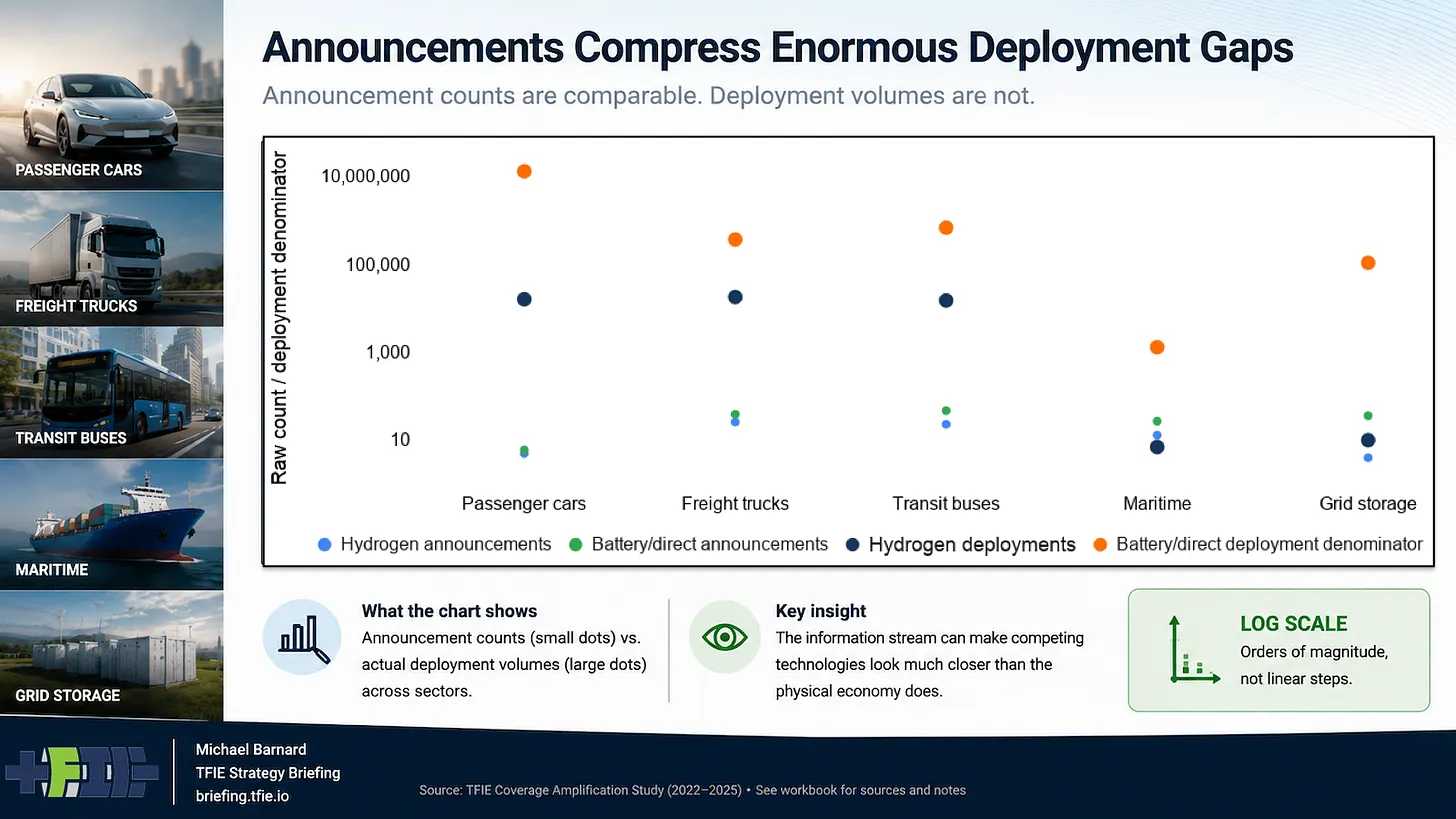
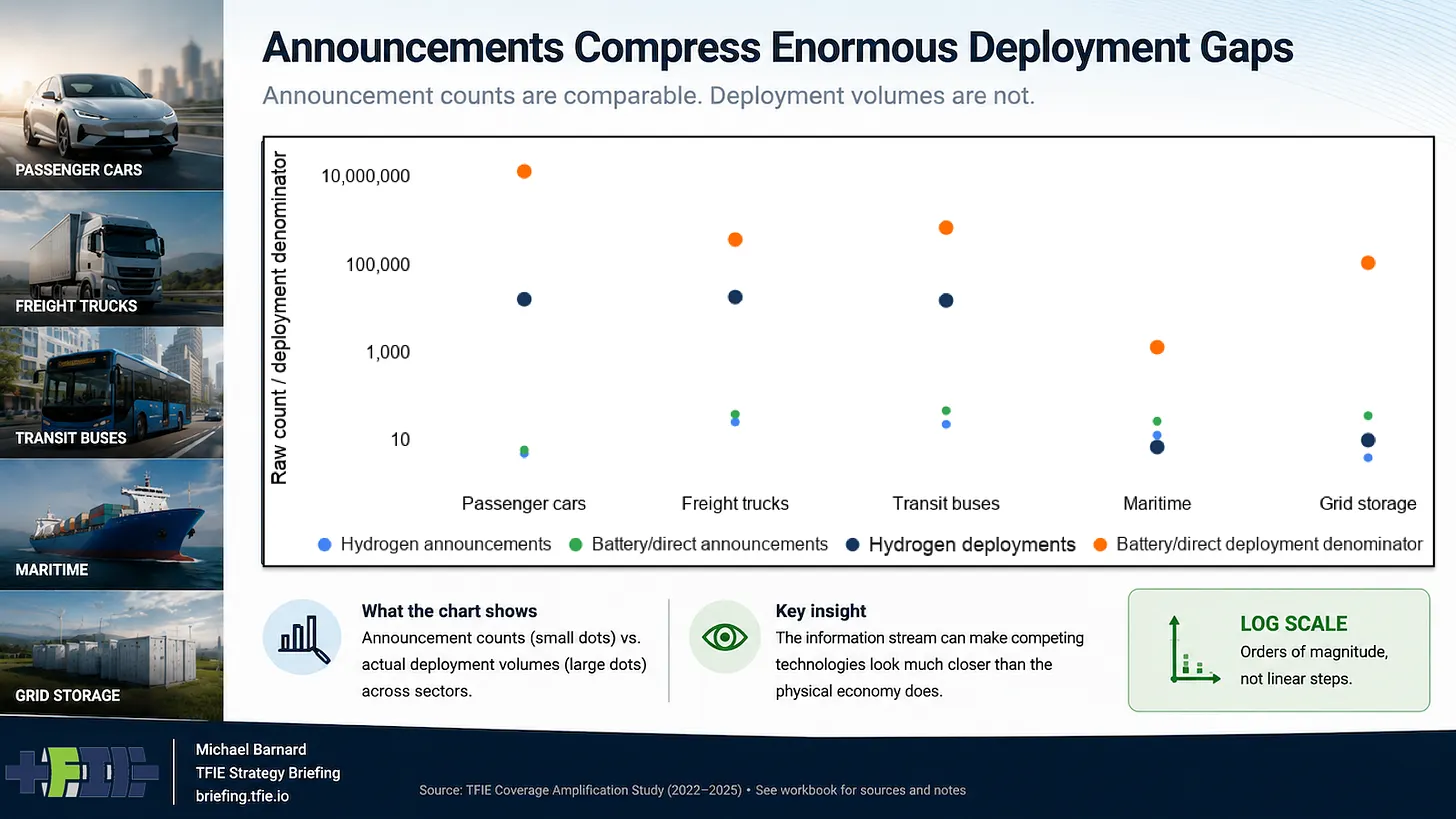
An extensive analysis of energy announcements and deployment milestones from 2022 through 2025 reveals that the media treats hydrogen as a robust parallel competitor to battery-electric technologies. In headline counts, the information divergence is remarkably modest. For instance, across a bounded register of positive milestones in this four-year period, batteries generated 206 announcements compared to hydrogen’s 114—a narrow 1.8-to-1 ratio.
However, this metric creates a deeply distorted impression of market momentum. When physical deployment denominators are restored—comparing actual vehicles on roads, ships on water, and megawatt-hours on the grid—the gap widens dramatically. Depending on the sector, hydrogen’s actual market footprint trails its media visibility by factors ranging from tens to more than 10,000 times.
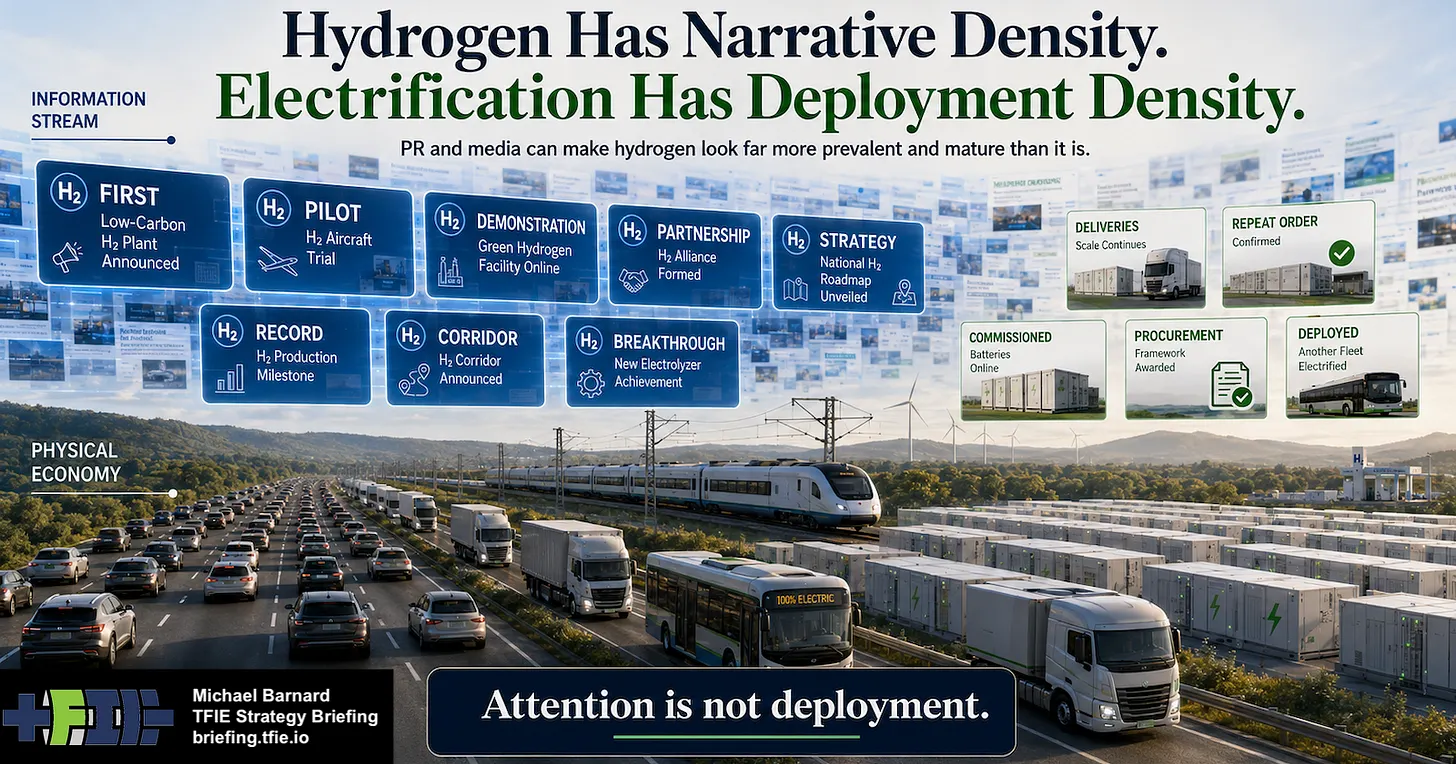
The core driver of this discrepancy is structural: the modern news ecosystem is organized around discrete, novel events, whereas mature markets grow through routine, uncelebrated commercial transactions. Because hydrogen remains a technology of pilots, prototypes, and first-of-a-kind deployments, virtually every incremental step generates fresh press coverage. Conversely, battery-electric vehicles (BEVs) and stationary energy storage have crossed the threshold into industrial-scale ubiquity, where massive quarterly deployment figures register as business-as-usual rather than headline news.
Chronology
To understand how this narrative density evolved, it is helpful to trace the timeline of key milestones and publicity cycles that defined the clean tech information stream between 2022 and 2025:
- Early 2022: As global supply chains rebound from pandemic disruptions, governments roll out aggressive green hydrogen subsidies under frameworks like the U.S. Inflation Reduction Act (IRA) and the European Union’s Important Projects of Common European Interest (IPCEI). Media coverage surges, framing hydrogen and batteries as co-equal pillars of deep decarbonization.
- Late 2022 to 2023: Early commercial deployments of fuel-cell buses and medium-duty trucks generate a steady hum of announcements. Meanwhile, battery-electric passenger vehicle sales cross major tipping points globally, led by rapid scaling in China, Europe, and North America. Despite batteries outpacing hydrogen in actual units sold by orders of magnitude, the announcement gap remains relatively narrow due to the novelty of early hydrogen trials.
- 2024: High-visibility engineering stunts capture global news cycles. For example, JCB’s hydrogen-combustion streamliner dominates headlines by completing FIA-observed runs at Bonneville, ultimately generating multi-source media clusters across hundreds of outlets. While technologically impressive, these projects represent isolated engineering prototypes rather than scalable commercial fleets.
- 2025: Physical deployment data for the year crystallizes the divergence. China alone records approximately 366,000 electric heavy trucks and over 680,000 electric buses by year’s end, compared to roughly 18,000 fuel-cell heavy trucks and 15,000 fuel-cell buses globally. In the stationary storage sector, global battery additions eclipse 108,000 MW, while hydrogen grid storage demonstrations stall at roughly 10 MW. Analysts begin questioning why the media landscape continues to treat the two technologies as neck-and-neck competitors.
Supporting Data
A granular examination of sectoral data exposes the stark disconnect between narrative presence and physical deployment. Across passenger vehicles, heavy freight, maritime shipping, and grid storage, the numbers tell an unambiguous story.
1. Heavy-Duty Freight Trucks
- Announcement Ratio: ~1.5 to 1 (in favor of batteries)
- Physical Deployment: China alone accounted for roughly 366,000 electric heavy-duty trucks by the close of 2025, compared to approximately 18,000 fuel-cell heavy trucks globally.
- Analysis: While every regional hydrogen truck trial or fueling station opening triggers localized or national news coverage, hundreds of thousands of electric freight trucks quietly enter commercial fleets without fanfare.
2. Transit Buses
- Announcement Ratio: 47 battery milestones vs. 23 hydrogen milestones (~2 to 1)
- Physical Deployment: More than 680,000 electric buses were operating in China alone by late 2025, contrasted with roughly 15,000 fuel-cell buses deployed globally.
- Analysis: Transit buses represent one of hydrogen’s more successful niches, featuring genuine repeat procurements in specific municipal markets. Yet, the physical deployment ratio remains overwhelmingly skewed toward battery electrification.
3. Maritime Shipping
- Announcement Ratio: ~2 to 1 in favor of battery announcements.
- Physical Deployment: Fleet data compiled by DNV reveals more than 1,300 battery-equipped vessels currently in operation, compared to a mere 7 hydrogen-fueled ships worldwide.
- Analysis: Maritime hydrogen announcements often center on conceptual designs, ammonia-readiness studies, or small-scale tugboat pilots, masking the reality that battery-hybrid and fully electric marine propulsion are already commercially operational across hundreds of ferries, workboats, and coastal vessels.
4. Passenger Cars
- Announcement Ratio: 6 battery milestone roots vs. 5 hydrogen milestone roots (near parity).
- Physical Deployment: Approximately 13 million battery-electric passenger cars were sold in 2025 alone, compared to a cumulative global total of roughly 16,000 fuel-cell passenger vehicles on the road.
- Analysis: This sector highlights the most extreme narrative compression. Information streams treat hydrogen fuel-cell cars as a viable alternative passenger path, despite the segment representing a statistical rounding error in global automotive sales.
5. Grid-Scale Energy Storage
- Announcement Ratio: 36 battery-storage roots vs. 4 genuine hydrogen-storage announcement roots (9 to 1).
- Physical Deployment: Approximately 108,000 MW of battery-storage capacity was added in 2025, compared to roughly 10 MW of operational hydrogen demonstration capacity.
- Analysis: Measured on a raw power scale, the deployment ratio stands at approximately 10,800 to 1. When accounting for duration and round-trip efficiency, the economic and physical dominance of batteries on the grid is absolute.
Commercial Maturity and Source Genealogy
Beyond raw deployment numbers, qualitative analysis of the announcement streams reveals differences in commercial maturity. When evaluated across a standardized seven-stage commercialization ladder, battery-related events averaged a score of 5.97 between 2022 and 2025, compared to 4.40 for hydrogen.
Crucially, roughly 82% of all tracked battery events represented scaled deployment, commercial expansion, or repeat procurement. In contrast, only 40% of hydrogen events reached those stages; the remaining 60% largely comprised early-stage research, memorandums of understanding (MoUs), feasibility studies, or isolated pilot projects.
Official Responses and Industry Perspectives
The persistent gap between hydrogen’s public profile and its industrial reality has sparked intense debate among industry stakeholders, policymakers, and market analysts.
Proponents of hydrogen technology argue that comparing deployment numbers directly against lithium-ion batteries is methodologically flawed. Industrial advocates emphasize that hydrogen is designed to tackle hard-to-abate sectors—such as steelmaking, long-duration energy storage, high-heat industrial processes, and heavy maritime transport—where chemical energy carriers are structurally superior to electrons alone. From this perspective, early-stage announcements and pilot projects are necessary precursors to build out the foundational supply chains, pipeline networks, and regulatory frameworks required for a future hydrogen economy.
Conversely, energy economists and market analysts caution against "narrative inflation." Observers point out that prolonged media attention on technologies that fail to scale can misallocate capital, divert public subsidies away from immediately deployable solutions, and create misplaced expectations among policymakers.
Furthermore, analysts highlight the mechanics of publicity cycles using case studies like JCB’s hydrogen-combustion streamliner. When the vehicle completed its FIA-observed runs at Bonneville, averaging over 406 mph, it generated a massive multi-source media cluster involving 127 reporting outlets. While the engineering achievement was undisputed, market analysts noted that its commercial denominator remained static: zero commercial fleets, zero customer utilization, and no operating economics. The multiplication was strictly confined to information exposure, not underlying market evidence.

Implications
The divergence between narrative density and physical deployment carries significant consequences for investors, policymakers, and corporate strategists navigating the energy transition.
1. For Investors
Capital allocation requires rigorous "denominator discipline." Investors who rely primarily on trade publications, press releases, or headline volume risk overestimating the commercial velocity of emerging technologies. Distinguishing between a publicity event (such as a prototype demonstration or an MoU) and market formation (such as repeat commercial procurement and multi-year supply contracts) is essential to avoiding stranded assets in lagging sectors.
2. For Policymakers
Government support schemes must look past the noise of high-visibility announcements when designing industrial policy and subsidy frameworks. While targeted funding for hard-to-abate sectors remains vital, policy targets should tie financial support to verifiable milestones in physical deployment, cost reduction, and efficiency gains rather than preliminary announcements or pilot phase declarations.
3. For the Broader Energy Transition
Ultimately, the concentration of media attention on hydrogen does not invalidate its long-term utility in specific, highly constrained industrial niches. However, it distorts public perception regarding the speed at which deep decarbonization is occurring. As direct electrification—anchored by batteries, solar, wind, and smart grids—continues its exponential growth, recognizing the difference between a dense stream of announcements and a mature industrial market will be critical for charting an effective and realistic course to a net-zero future.
