

Every November, major auction houses across the United States pivot their focus toward a specialized yet passionately contested sector of the fine art market: Western, California, and Native American art. As paddles rise, online feeds refresh, and telephone banks hum with international activity, the distinct cry of "Sold!" echoes across salesrooms. These genres, operating as vital sub-categories of the broader American art market, boast an exceptionally dedicated base of patrons whose enthusiastic collecting continues to drive new auction records and capture the imagination of the global art world.
Driven by strong institutional exhibitions, shifting demographic interest, and a growing appreciation for regional modernism, the market for art celebrating the American landscape and its Indigenous peoples has evolved from a niche collecting area into a major powerhouse. Prominent houses like Bonhams, Heritage Auctions, Santa Fe Art Auction, and John Moran Auctioneers are leading the charge, curating high-profile sales that reflect both deep-seated heritage and exciting contemporary directions.
Chronology of the Autumn Sales Circuit
The late-fall auction calendar provides a tightly packed, high-stakes schedule for collectors looking to acquire museum-quality works. The season unfolds across key regional hubs in rapid succession:

- November 5: Heritage Auctions launches its Western Art Signature Auction in Dallas, Texas, offering more than 100 fine paintings and sculptures.
- November 6–7: Santa Fe Art Auction hosts its comprehensive two-day Signature Sale in Santa Fe, New Mexico, featuring a heavy concentration of contemporary Indigenous works and modernist pieces.
- November 11: Bonhams presents its major California & Western Art auction in Los Angeles, California, showcasing over 125 curated lots.
- November 17: John Moran Auctioneers concludes the heavy-hitter circuit with its California & American Fine Art sale in Monrovia, California, highlighting approximately 250 lots drawn from prominent regional estates.
Supporting Data and Market Performance
Recent sales figures underscore the robust health and expanding boundaries of this market. Single-owner capsules and private collections have performed exceptionally well, regularly exceeding presale estimates.
At Bonhams, private collections featuring Western and Native American works have yielded stellar results. In a notable recent outing, The Gene Hackman Collection: A Life in Art featured Fritz Scholder’s (Luiseño) striking painting DANCER alongside Nicolai Fechin’s charcoal drawing CARMEN (HEAD OF A GIRL). Both pieces blew past their presale estimates, fetching $152,900 and $23,040, respectively.
This momentum carried into subsequent curated auctions. At the white-glove sale Diane Keaton: The Architecture of an Icon, Maynard Dixon’s 1941 nocturne painting TRAIN ON THE DESERT achieved $35,840, while Ed Mell’s 1992 landscape LIGHT IN THE VALLEY brought in $40,960.

The modernist Southwestern art of Ed Mell has experienced a particularly dramatic market surge following the artist’s passing in 2024. This trend points to a broader market phenomenon: collectors are increasingly willing to look beyond traditional blue-chip regional names to champion emerging talents or artists who previously enjoyed only localized recognition.
Official Responses and Expert Perspectives
Industry leaders attribute these market shifts to a combination of personal nostalgia, geographic connection, and a critical re-evaluation of art history that brings overlooked modernist voices to the forefront.
Aaron Bastian, Director of Fine Arts at Bonhams San Francisco, observes a persistent appetite among buyers. “Contemporary Western art continues to capture the attention of new and returning bidders, with works by Ed Mell exceeding their high estimates,” Bastian notes. Discussing historical highlights like Edgar Payne’s RIDERS ON THE MESA (INDIAN RIDERS)—estimated between $100,000 and $150,000—Bastian adds, “Along with his Sierra Nevada mountain scenes and Mediterranean boat paintings, [this work] is one of Payne’s most iconic subjects and continues to resonate with collectors as a quintessential expression of the American West.”

Alissa Ford, Vice President of American and Western art at Heritage Auctions, points out that the modern collector’s palate is expanding. “Collectors of Western art champion not only established artists but also emerging artists or those who are lesser known around the country,” Ford explains. “As a result, artists who once appealed primarily to regional audiences, such as Ed Mell, have achieved national recognition, reflecting the expanding reach, relevance, and appeal of Western art across the broader collecting landscape.”
When examining California art specifically, Katherine Halligan, Director of Fine Art at John Moran Auctioneers, highlights the emotional resonance driving buyers. “The collecting audience tends to have some sort of personal connection to the Golden State, whether they reside in California or in other states,” Halligan says. Interestingly, she has also noted that within the broader American paintings category, collectors “do look to our California artists’ non-California subjects with greater interest.”
Meanwhile, the Native American and Indigenous art sectors are experiencing a renaissance driven by contemporary creators working in painting, sculpture, pottery, and jewelry. Gillian Blitch, President and CEO of the Santa Fe Art Auction—where Indigenous works account for more than 50 percent of total sales—emphasizes the shifting tides of collector interest. “Contemporary Indigenous art has certainly become one of the most exciting collecting areas in recent times, particularly mid- to late-20th-century pieces that cross collecting categories into post-war modern art,” Blitch states.

Spotlight on Upcoming Highlights
The November sales feature a dazzling array of masterworks that embody the diverse aesthetic streams of the American West.
Bonhams (Los Angeles — November 11)
Bonhams’ upcoming catalog features more than 125 lots representing foundational artistic groups, including the Society of Six, the Taos Society of Artists, and the Cowboy Artists of America.
- Amédée Joullin (1862–1917), The Passing of the Wampum Belt (1897): An oil on canvas (36.5 x 57.25 inches) by the San Francisco-born painter, capturing Native American life in New Mexico. Estimate: $12,000–$18,000.
- Edgar Payne (1883–1947), Riders on the Mesa (Indian Riders): A quintessential expression of the American West utilizing Payne’s signature dynamic palette developed during his 1916 railway commissions. Estimate: $100,000–$150,000.
- The sale also features a dedicated capsule of Western art from the Estate of Ed and Bonnie Harvey of Little Rock, Arkansas, including works by G. Harvey and bronze sculptures by Harry Jackson.
Heritage Auctions (Dallas — November 5)
Heritage’s Western Art Signature Auction presents over 100 fine art lots focusing heavily on atmosphere, light, and narrative.

- Clark Hulings (1922–2011), Street Vendors (1993): A complex, vibrant 28 x 44-inch oil on canvas depicting a bustling market scene. Alissa Ford describes it as “dynamic and complex with its panoply of vibrant colors… and multitude of figures, each going about a different activity.” Estimate: $40,000–$60,000.
- G. Harvey (1933–2017), Raindrops and Puddles: Showcasing the artist’s mastery of light and reflection on rain-slicked city streets. Estimate: $30,000–$50,000.
- Additional highlights include Earl Biss’s Taking Shelter Before Crossing Pryor Gap (est. $20,000–$30,000), Charles Schreyvogel’s Haying Time (est. $25,000–$35,000), and E. Martin Hennings’ portrait Max Baca (est. $40,000–$60,000).
Santa Fe Art Auction (Santa Fe — November 6–7)
Spanning two days, this signature event bridges historical and contemporary Indigenous art, alongside an increased focus on overlooked modernists.
- Jaune Quick-to-See Smith (French-Cree/Shoshone/Salish, 1940–2025), What is an American? (2003): A lithograph with chine collé and acrylic highlights. Gillian Blitch notes that Smith’s market has strengthened significantly, bolstered by her recent retrospective at the Whitney Museum of American Art. Estimate: $8,000–$12,000.
- Rebecca Salsbury James (1891–1968), White Roses at Twilight (1941): A rare reverse-painted glass piece measuring 19.625 x 15.75 inches. Blitch notes a concerted effort to reposition James’s work, historically overshadowed by peers like Georgia O’Keeffe. Estimate: $200,000–$300,000.
- The auction will also feature works by Ed Mell, E. Martin Hennings, and a complete John B. Stetson set of Edward S. Curtis’s landmark publication, The North American Indian.
John Moran Auctioneers (Monrovia — November 17)
Featuring approximately 250 lots, John Moran’s sale leans heavily on local California estates, notably the Montecito collection of Sybil Rosen and Robert Fisher, and the Saperstein Collection of Oakland.
- Daniel Ridgway Knight (1839–1924), A Trysting Place: An idyllic oil on canvas featuring a young woman waiting by a river footbridge. Estimate: $20,000–$30,000.
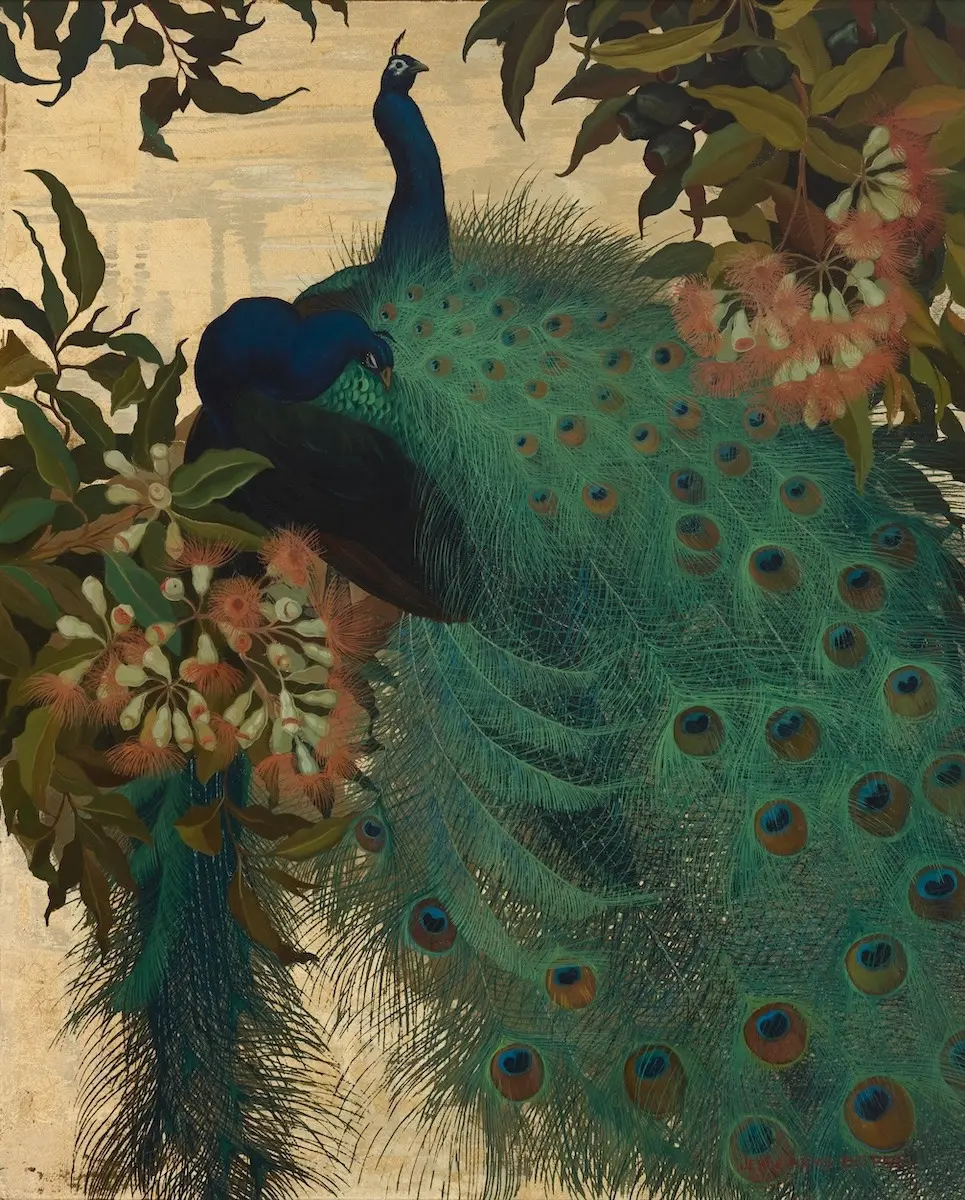
- Jessie Arms Botke (1883–1971), Black Peacocks: An oil and gold leaf on Masonite work (34 x 26 inches) that Katherine Halligan notes “showcases the artist’s ability to combine her extraordinary draftsmanship… within a highly decorated, elegant Asian-inspired gold leaf setting.” Estimate: $50,000–$70,000.
- Other notable offerings include pieces by Martin Lewis, Gifford Beal, Adam Emory Albright, and Eugene Higgins.
Implications for the Broader Art Market
The rising tide across Western, California, and Native American art sales signals a fundamental structural shift in how collectors value regionalism. No longer viewed as provincial or secondary to coastal metropolitan art centers, these works are increasingly recognized as central pillars of the American cultural narrative.

Furthermore, institutional corrections—such as museums offering long-overdue retrospectives to female modernists like Rebecca Salsbury James or cementing the contemporary legacies of Indigenous masters like Jaune Quick-to-See Smith—are directly influencing private collecting habits. As historical boundaries continue to dissolve, and as contemporary buyers seek deeper emotional and geographical connections to the art they acquire, the November auction block is proving that the spirit of the American West remains as vibrant, lucrative, and dynamic as ever.
