

Main Facts: The Core Philosophy of a Tarot Icon
In the modern landscape of esoteric studies, few figures loom as large, or as warmly remembered, as Rachel Pollack. An acclaimed science fiction author, comic book writer, and preeminent authority on the Tarot, Pollack left behind a profound intellectual and spiritual legacy when she passed away. Among her many writings is a seminal essay originally penned for World Tarot Day on May 25, 2015. In this piece, Pollack distilled decades of mystical exploration, creative output, and philosophical inquiry into a single, arresting realization: "Story. It’s all story."
Rather than viewing the Tarot as a rigid manual of fortune-telling or a dry esoteric science, Pollack championed the deck as a dynamic "machine for constructing stories"—a phrase she borrowed from the celebrated Italian writer Italo Calvino. For Pollack, the 78 cards of the Tarot were not merely mirrors of the future or fragments of ancient dogma; they were frozen moments in a continuous, unfolding narrative. When a reader lays out the cards, a tripartite collaboration takes place between the subject, the reader, and the imagery itself. Together, they conjure a narrative that bridges the gap between the mundane and the miraculous.
Pollack’s perspective challenges conventional views of truth and divination. By arguing that truth is not a static rock waiting to be discovered, but rather something we actively bring into being through narrative and engagement, she bridged the worlds of ancient mysticism and modern quantum philosophy. Her work continues to influence contemporary tarot practitioners, writers, and spiritual seekers who find themselves captivated by her ultimate guiding maxim: “The world is not what we think it is.”
Chronology: A Journey into the Cards and Creation
Spring 1970: The Awakening
Rachel Pollack’s lifelong romance with the Tarot began in the early spring of 1970. During a pivotal encounter, a friend offered to read her cards using Eden Gray’s traditional guidebook and the rare University Press edition of the Rider-Waite-Smith deck.
Rather than focusing on predictive futures or rote divinatory meanings, Pollack was instantly transfixed by the visual art of the cards. To her eyes, each piece of illustration represented a arrested moment in an ongoing narrative. Among the cards laid out that day, the melancholic and mysterious Six of Swords left a permanent imprint on her imagination, serving as a lifelong touchstone for her creative and spiritual journey.
July 2009: The Tarosophy Conference
Decades after cementing her reputation as a leading voice in tarot literature—notably through her groundbreaking 1980 book 78 Degrees of Wisdom—Pollack remained deeply engaged with the global tarot community.
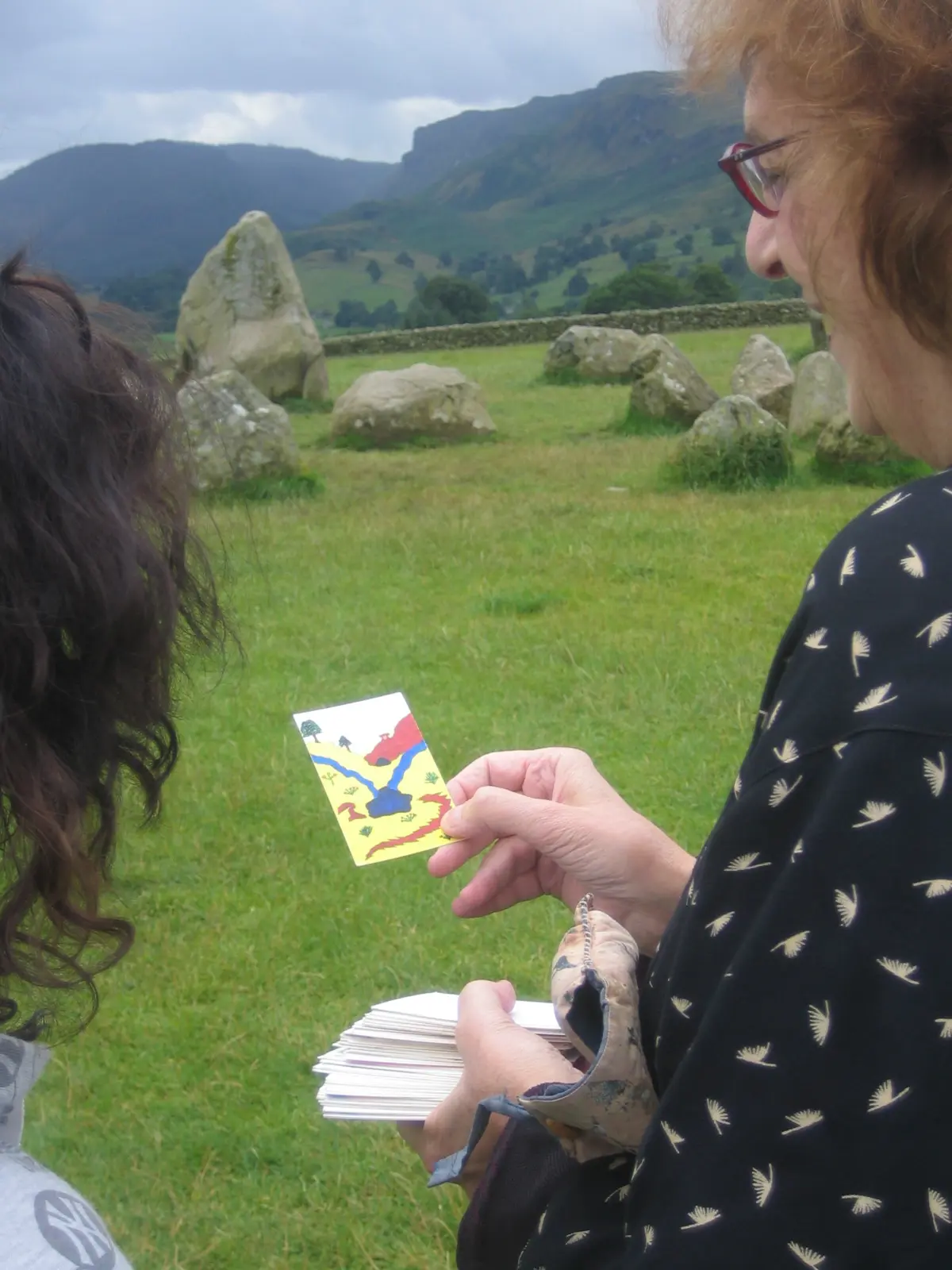
In July 2009, she attended the Tarosophy Tarot Conference held in England’s picturesque Lake District. Surrounded by ancient landscapes, including a visit to the historic Castlerigg Stone Circle, Pollack shared her insights with generations of modern practitioners. Photographs from this gathering capture her deep connection to both the historical roots of esoteric traditions and the living community of contemporary readers.
May 25, 2015: World Tarot Day Reflection
Marking World Tarot Day on May 25, 2015, Pollack published the reflective essay that encapsulates her mature philosophy. Turning her thoughts toward mortality, legacy, and the ultimate meaning of her life’s work, she weighed various potential epitaphs.
Discarding conventional consolation in favor of profound wonder, she settled on the deceptively simple declaration: "Story. It’s all story." This essay served not only as a personal meditation on her relationship with the Tarot, but also as a philosophical manifesto for how humans construct meaning across art, science, and spirituality.
Supporting Data: The Interlocking Narratives of Art, Science, and Mysticism
To understand Pollack’s perspective on the Tarot, one must examine how she dismantled the artificial boundaries separating divination, creative storytelling, and hard science. Her intellectual framework rested on the premise that human understanding is fundamentally narrative-driven.
-
The Literary and Cultural Framework:
Pollack frequently drew upon cross-cultural paradigms to validate her worldview. She noted the Gabon Pygmy song celebrating consciousness ("All lives, all dances, and all is loud") and Normandi Ellis’s poetic translation of the Egyptian Book of the Dead ("Give me not words of consolation. Give me magic"). Furthermore, she frequently cited the Hasidic teaching, "God made humans because God loves stories," aligning her perspective with ancient mystical traditions that view creation itself as a divine narrative. -
The Scientific Parallel:
In her 2015 essay, Pollack recounted a conversation with a physicist friend regarding subatomic particles. When she asked whether complex arrays of particles might not truly exist until scientists predicted and searched for them, her colleague confirmed that this was entirely plausible. For Pollack, this scientific uncertainty mirrored the mechanics of the Tarot: reality, whether quantum or personal, is brought into focus through the act of looking, questioning, and storytelling. -
The Mechanics of a Reading:
Pollack demystified the often-debated mechanics of tarot readings by framing them as collaborative storytelling events. She noted that a reading requires three active participants:
- The Subject: The seeker bringing their lived reality, questions, and vulnerabilities.
- The Reader: The facilitator navigating the symbolic landscape.
- The Cards: The visual stimuli acting as narrative catalysts.
While skeptics often demand to know "how the Tarot works," Pollack embraced the mystery, observing that while readings are sometimes broad, they possess an uncanny ability to deliver precise, life-altering clarity precisely when a seeker stands at a crucial crossroads.
Official Responses and Testimonials from the Tarot Community
Following her passing and the continued dissemination of her written works, leaders within the global tarot and esoteric communities have spoken extensively about Pollack’s monumental impact.
Johannes Fiebig, a prominent tarot author and publisher, noted:
"Rachel didn’t just write about the cards; she taught us how to inhabit them. She transformed the Rider-Waite-Smith tradition from a static system of fortune-telling into a living, breathing landscape of human psychology and spiritual growth. Her emphasis on story gave academic and artistic legitimacy to generations of readers who felt alienated by dogmatic approaches."
Tarot historian and author Mary K. Greer has frequently highlighted Pollack’s unique ability to blend rigorous scholarship with unbounded imagination:
"Rachel possessed a rare gift. She could take complex Kabbalistic or psychological concepts and weave them into a narrative that felt intimate and immediately accessible. When she said ‘It’s all story,’ she wasn’t diminishing truth—she was elevating our understanding of how profoundly human beings create their own destinies through the myths they choose to live by."
Organizers of international tarot conferences, reflecting on her appearances at venues like the Tarosophy gatherings in the Lake District, remember her not merely as a guest speaker, but as a generous mentor who treated every novice question with the same intellectual rigor and warmth as she did her bestselling books.
Implications: The Enduring Legacy of Rachel Pollack’s Worldview
The philosophical framework articulated by Rachel Pollack carries deep implications for how contemporary society approaches divination, psychology, and personal narrative. By stripping away the fear-based dogmas that historically plagued cartomancy, Pollack repositioned the Tarot as an empowering psychological and creative tool.
1. Redefining Personal Agency
If “It’s all story,” then individuals are not passive victims of a predetermined destiny dictated by a card spread. Instead, they are the co-authors of their own lives. When a difficult card appears—such as the Tower or the Three of Swords—it does not signal immutable doom; rather, it introduces a necessary plot twist, inviting the seeker to rewrite their narrative arc with courage and creativity.
2. Bridging Science and Spirituality
Pollack’s dialogue with quantum physics opens up exciting avenues for modern esoteric philosophy. By suggesting that truth is brought into being through engagement and observation, her work aligns with constructivist psychology and modern philosophical frameworks that view human consciousness as an active participant in shaping objective reality.
3. A Lasting Cultural Footprint
As the Tarot experiences a massive renaissance among younger generations seeking mindfulness, self-care, and spiritual connection, Pollack’s foundational texts—most notably 78 Degrees of Wisdom—remain standard reading. Her insistence that the world is far stranger and more magical than conventional materialism suggests offers an enduring antidote to cynicism.
Ultimately, Rachel Pollack’s life and writings remind us that whether we are reading a spread of cards, mapping the subatomic universe, or reflecting on our own mortality on a tombstone, we are all engaged in the same grand pursuit: making sense of existence through the power of narrative. As her timeless maxim asserts, the world may not be what we think it is, but so long as we have imagination, it’s all story.
