

Executive Summary: Severe Flooding Forces Closure of Arizona Wildlife Sanctuary
An unprecedented double-night flooding event has forced the indefinite closure of the Out of Africa Wildlife Park & Sanctuary in Camp Verde, Arizona. Over the nights of Monday, July 20, and Tuesday, July 21, 2026, torrents of floodwaters swept through approximately 50 acres of the facility, destroying critical containment fencing, eroding access roads, uprooting mature trees, and depositing thick layers of mud and debris across the property.
Despite the extensive physical destruction, park officials have confirmed that all 200 animals residing at the sanctuary, as well as the entire staff, are safe and accounted for. The park’s carnivore habitats remained entirely unaffected by the rising waters. However, the severe damage to roads and perimeter fences has rendered the park unsafe for public visitors, prompting an immediate suspension of operations.
General Manager Ashton Powell stated that the facility will remain closed at least through the upcoming Monday, with the potential for an extended closure depending on the pace of debris removal and fence reconstruction. The co-located Predator Zip Line, which shares access roads with the park, has also been forced to suspend operations. The sanctuary has initiated a comprehensive cleanup effort led entirely by internal staff to minimize stress on the animals, while simultaneously launching a public appeal for donations to fund the reconstruction of specialized, high-security containment barriers.
Chronology of the Disaster: Two Nights of Torrential Runoff
[Monday Night, July 20] ────────────────> [Tuesday Day, July 21] ───────────────> [Tuesday Night, July 21]
Prescott mountain runoff feeds            Staff conducts emergency repairs;         Local Camp Verde downpour
Cherry Wash, flooding Serengeti           clears debris and patches roads           triggers second flood, wiping
and Masai Mara areas.                     to stabilize containment.                 out all daytime progress.
The First Wave: Mountain Runoff via Cherry Wash
The disaster began on the night of Monday, July 20, 2026, under deceptive meteorological conditions. While the municipality of Camp Verde experienced no rainfall that evening, severe storms hit the high-altitude regions of Prescott and Prescott Valley, situated on the mountains above the Verde Valley.
The resulting precipitation funneled directly into Cherry Wash, a natural drainage channel that runs from the mountains down through the sanctuary’s property. The sudden volume of water transformed the wash into a fast-moving torrent that breached its banks and swept directly through the lower-lying areas of the park, specifically targeting the "Serengeti" and "Masai Mara" exhibits. These expansive, open-range habitats house the park’s diverse populations of African hoofstock.
The Intermission: Tuesday’s Race Against Time
On Tuesday, July 21, park staff mobilized immediately to assess the damage and begin recovery operations. Workers spent the daylight hours clearing heavy debris, grading washed-out roads, and reinforcing compromised fence lines to ensure the safety of the animals and prepare the park for a potential reopening. By late afternoon, substantial progress had been made toward stabilizing the primary access routes and animal enclosures.
The Second Wave: Localized Deluge Erases Progress
The recovery efforts were abruptly undone on Tuesday night. Unlike the remote storm of the previous evening, a severe localized weather system stalled directly over Camp Verde. The ensuing downpour saturated the already compromised terrain, triggering a second, more severe flash flood.
This second wave of water swept through the exact same corridors of the park, completely obliterating the newly repaired roads, washing away freshly laid gravel, and bringing down a fresh wave of mud, uprooted trees, and debris. The double-hit left the Serengeti and Masai Mara habitats buried under thick silt and rendered the park’s internal transportation network entirely impassable.
Infrastructure Damage Assessment and Supporting Data
Structural and Financial Metrics of the Destruction
The scope of the physical damage across the 50 affected acres is extensive, with the destruction of specialized fencing representing the most significant financial and logistical hurdle for the sanctuary.
- Acreage Impacted: Approximately 50 acres of the park’s active footprint sustained moderate to severe landscape and structural damage.
- Fencing Loss: Multiple sections of high-security containment fencing were flattened or structurally compromised by the weight of moving water and accumulated debris.
- The Grant-Funded Barrier: Among the destroyed structures was a recently completed 660-foot section of high-grade fencing. This specific barrier had been constructed using a $15,000 conservation grant.
- Engineering Specifications: Replacing the destroyed fencing is highly complex. The enclosures require custom-fabricated, welded steel panels set in deep concrete footings, standing between eight and nine feet tall. These barriers feature a reinforced top rail engineered specifically to withstand the physical pressure of large animals, such as giraffes, preventing them from bending or pushing over the barrier as they might with standard chain-link fencing.
- Road Network Integrity: The park’s unpaved access roads, which are vital for safari vehicles, emergency services, and the operation of the Predator Zip Line, were heavily eroded, leaving deep gullies and exposed bedrock.
+-----------------------------------------------------------------------------+
|                      ESTIMATED FLOOD DAMAGE SUMMARY                         |
+-----------------------------------------------------------------------------+
| Affected Area:            ~50 Acres                                         |
| Key Lost Asset:           660-foot Specialty Fence (Grant-funded)           |
| Lost Asset Value:         $15,000 (Excluding labor & auxiliary materials)   |
| Fencing Requirements:     8-9 ft tall, welded steel, concrete-set footings  |
| Impacted Businesses:      Out of Africa Wildlife Park, Predator Zip Line    |
| Operational Status:       Temporarily Closed (Target: Indefinite)           |
+-----------------------------------------------------------------------------+
Animal Safety and Containment Integrity
In a testament to both the design of the sanctuary and the natural instincts of the animals, all 200 residents survived the disaster without injury. Park officials emphasized that the animals did not panic or scatter haphazardly. Instead, as the waters rose, the hoofstock instinctively migrated to pre-established high-ground zones within their large-acreage habitats.
Importantly, the habitats housing the park’s carnivores—including lions, tigers, and hyenas—are located on higher topography and were completely untouched by the floodwaters. These high-security enclosures maintained total structural integrity throughout both nights, ensuring there was never any risk of predatory animals escaping or being exposed to hazardous conditions.
Official Responses: Management and Leadership Perspectives
Operational Decisions by General Manager Ashton Powell
General Manager Ashton Powell described the psychological and operational toll of watching the second night of flooding erase hours of hard work.
"Monday night, the water was running straight through the park, through the Serengeti and the Masai Mara area," Powell explained. "Then all the efforts and everything that we did to rebuild the road and to remove debris on Monday was killed, because Tuesday night it came right back through with all the rain that sat up here in Camp Verde."
Powell emphasized that the sanctuary is committed to a methodical, safe recovery process rather than a rushed reopening. "We’re not looking at being able to safely reopen through Monday of next week, but it could be longer. We have no intention of permanently closing this park. But we’re not the only one impacted. The Predator Zip Line, who shares our property, has also been impacted because they share our roads."
Minimizing Animal Stress During Remediation
A key operational constraint during the cleanup is the preservation of animal welfare. Powell noted that the sanctuary is deliberately avoiding the use of large, external construction crews or heavy, loud machinery near the animal habitats.
"We had, and still have, just an insane amount of debris in the habitat that’s pushing the fence down and preventing us from being able to fully erect a new fence," Powell said. "So we’ve got to move everything out of the way. It’s moving all the debris and tractoring it out into the parking lot, because we don’t have anywhere to place it, and we’re removing just big layers of thick mud that came through before we can even start fence work."
Because the animals have already experienced the stress of two consecutive nights of severe storms, the manual labor is being handled entirely by the park’s core staff to maintain a quiet, familiar environment.
Finding Hope in the Mud: President Prayeri Harrison
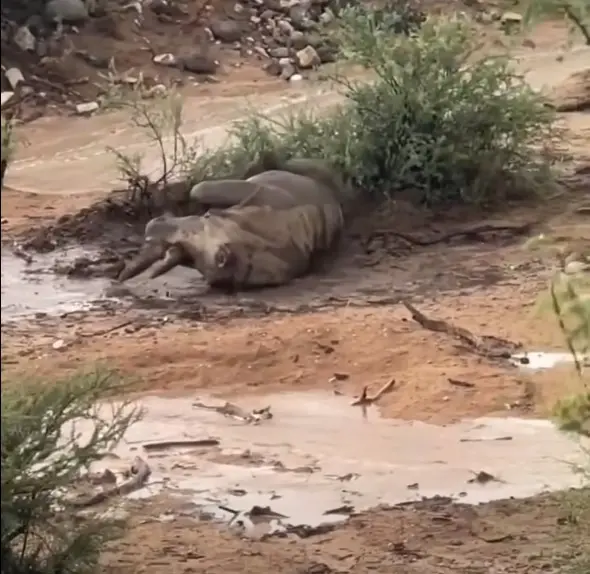
Despite the daunting cleanup process, park owner and President Prayeri Harrison found reasons for optimism, drawing inspiration from the resilience of the animals. She highlighted the behavior of Jericho, the sanctuary’s highly popular southern white rhino, who found immense joy in the aftermath of the storms.
"You look for the best things and the good things," Harrison reflected. "Our rhino, Jericho, who’s extremely popular and people pay to have safe encounters with him—he was enjoying the mud puddle, rolling over just like a warthog. It was a joy after everything we were going through, and then at the end of the day, seeing that, it was just a giggle."
Implications, Financial Impact, and the Path to Recovery
                             [Public Support Channels]
                                        │
                    ┌───────────────────┴───────────────────┐
                    ▼                                       ▼
     [Direct Financial Donations]               [Rhino Run 5K Participation]
     • Sent to OOASA (501c3)                    • Scheduled: Saturday, Sept. 26
     • Funds immediate fence procurement        • Supports global & local initiatives
     • Funds heavy debris removal               • Helps offset ticket refund losses
Financial Strain and Ticket Policies
The timing of the closure presents a significant financial challenge for the self-sustaining sanctuary. To accommodate displaced guests, the park has instituted a flexible ticketing policy:
- Refunds: Full refunds are being systematically issued to visitors who purchased date-sensitive packages, special encounters, or VIP tours.
- Ticket Extensions: General admission tickets purchased online remain valid for a full 365 days from the purchase date, with the park encouraging holders to retain their tickets for use once operations resume.
Community Mobilization and the Out of Africa Wildlife Sanctuary
Because the park operates in tandem with its non-profit arm, the Out of Africa Wildlife Sanctuary (a 501(c)(3) organization), management is directing community members who wish to assist toward tax-deductible financial contributions.
"Our priority and concern is for the safety of the staff, animals, and the public," the park shared in an official statement on Facebook. "Our small team is tirelessly working to repair the damage, but this is heavy manual labor, debris, and mud removal working in difficult conditions. If people could, and they’re willing and able, make donations to our nonprofit arm… we would greatly appreciate it."
Direct financial contributions are the most efficient form of aid, as they allow management to immediately purchase specialized steel piping, concrete, and heavy-duty hardware required to rebuild the perimeter fences.
Looking Ahead: The Annual Rhino Run 5K
Despite the current crisis, the park is moving forward with its plans to host the second annual Rhino Run 5K on Saturday, September 26, 2026, in honor of World Rhino Day. Supported by the Sedona Chamber of Commerce, the event serves a dual purpose: raising critical funds for global rhino conservation efforts and bringing visitors back to the Verde Valley to support the sanctuary’s long-term recovery.
The event is promoted as "a wild experience with a powerful purpose," where every registration helps protect endangered species. Park leadership hopes that by late September, the scars of the July floods will be fully healed, and the sanctuary will once again be fully operational, welcoming runners to race alongside the very habitats that staff are currently working so hard to rebuild.
For more information on how to donate to the emergency flood recovery fund, or to register for the upcoming Rhino Run 5K, community members are encouraged to visit the sanctuary’s official website at ooasanctuary.org.
