

DENVER, CO — Sixty years ago, inside the smoky confines of a Sedona, Arizona tavern, four visionary cowboy artists—Joe Beeler, Charlie Dye, John Wade Hampton, and George Phippen—laid the foundational bylaws for an organization that would permanently alter the landscape of American art. Little did they know that their casual gathering would spark a legendary institution: the Cowboy Artists of America (CAA).
Fast forward six decades, and the CAA is embarking on a monumental new chapter. On October 2–3, the organization will host its milestone 60th annual exhibition and sale at a brand-new home: The Legacy at the Stock Yards in Denver, Colorado. This high-profile event marks the official launch of an ambitious five-year partnership with the National Western, uniting two pillars of Western heritage in the heart of the Rocky Mountain West.
Main Facts: A Landmark Anniversary and New Home
The relocation to Denver’s Stock Yards signals more than just a change of venue; it represents a strategic evolution for an organization deeply committed to preserving the ethos, culture, and rugged beauty of the American West.
Running across two action-packed days, the 60th annual exhibition and sale will offer collectors, enthusiasts, and fine art aficionados unprecedented access to premier contemporary Western art. The marquee event of the gathering is a highly anticipated black-tie evening, where attending artists will debut their newest masterpieces. Beyond the gallery sales, ticket holders will have exclusive opportunities to mingle with CAA members, attend panel discussions, and participate in commemorative events honoring six decades of cultural stewardship.
The organization currently maintains a tightly curated roster consisting of 17 active members and 13 emeritus members, all of whom are eligible to submit new works to the annual exhibition. To inject fresh perspectives into the revered institution, the CAA also invites select guest artists each year. For the 2026 landmark show, the organization has extended invitations to acclaimed talents Shawn Cameron and Thomas Blackshear II. Cameron is widely celebrated for her exquisite depictions of cowboys and horses, blending meticulous draftsmanship with a mastery of atmospheric light and color. Meanwhile, Blackshear’s figurative works delve deep into the human element of the West, capturing internal emotional landscapes that transcend traditional portraiture.
Chronology: From a Sedona Tavern to the National Western
To fully appreciate the gravity of the CAA’s diamond anniversary, one must trace the trajectory of an organization born out of a desire for artistic integrity and camaraderie.
- 1965 (The Sedona Genesis): Frustrated by the contemporary art world’s tendency to overlook or misrepresent traditional Western subjects, Joe Beeler, Charlie Dye, John Wade Hampton, and George Phippen met in a Sedona tavern. They established the Cowboy Artists of America with a strict charter: to authentically portray the life, history, and people of the American West through uncompromising craftsmanship.
- The Decades That Followed: Over the next 50 years, the CAA grew from a regional collective into the gold standard of Western realism. Membership became one of the most fiercely contested and coveted honors in the American art market, demanding rigorous peer review and a lifelong dedication to technical mastery.
- 2026 (The Denver Transition): Marking its 60th year, the CAA severs ties with past venues to begin a transformative, five-year partnership with the National Western, establishing a permanent flagship presence at The Legacy at the Stock Yards in Denver. This move places the organization at the geographic and cultural crossroads of the modern West.
Supporting Data: The Art and Artists of the 60th Exhibition
The works featured in the 2026 exhibition read like a visual anthology of the American West, exploring themes of discovery, hardship, daily labor, and cultural evolution.

Landscapes of Discovery and Loss
In Dave Santillanes’s striking oil painting Still Waters (36 x 60 inches), the viewer is invited to share a quiet, profound moment with a lone rider and packhorse. They have seemingly stumbled upon a high mountain lake—a shadowed, pristine jewel that serves as a powerful metaphor for the American West itself as it first revealed itself to Native Americans, fur trappers, and pioneers.
Conversely, Albin Veselka’s monumental oil painting How the West Was Won confronts the darker, more turbulent realities of westward expansion. The canvas captures a makeshift raft tossed violently in roiling, treacherous whitewater, throwing two of its occupants into the merciless current. It is an unflinching meditation on the human cost exacted by progress.
Honoring the Labor of the Land
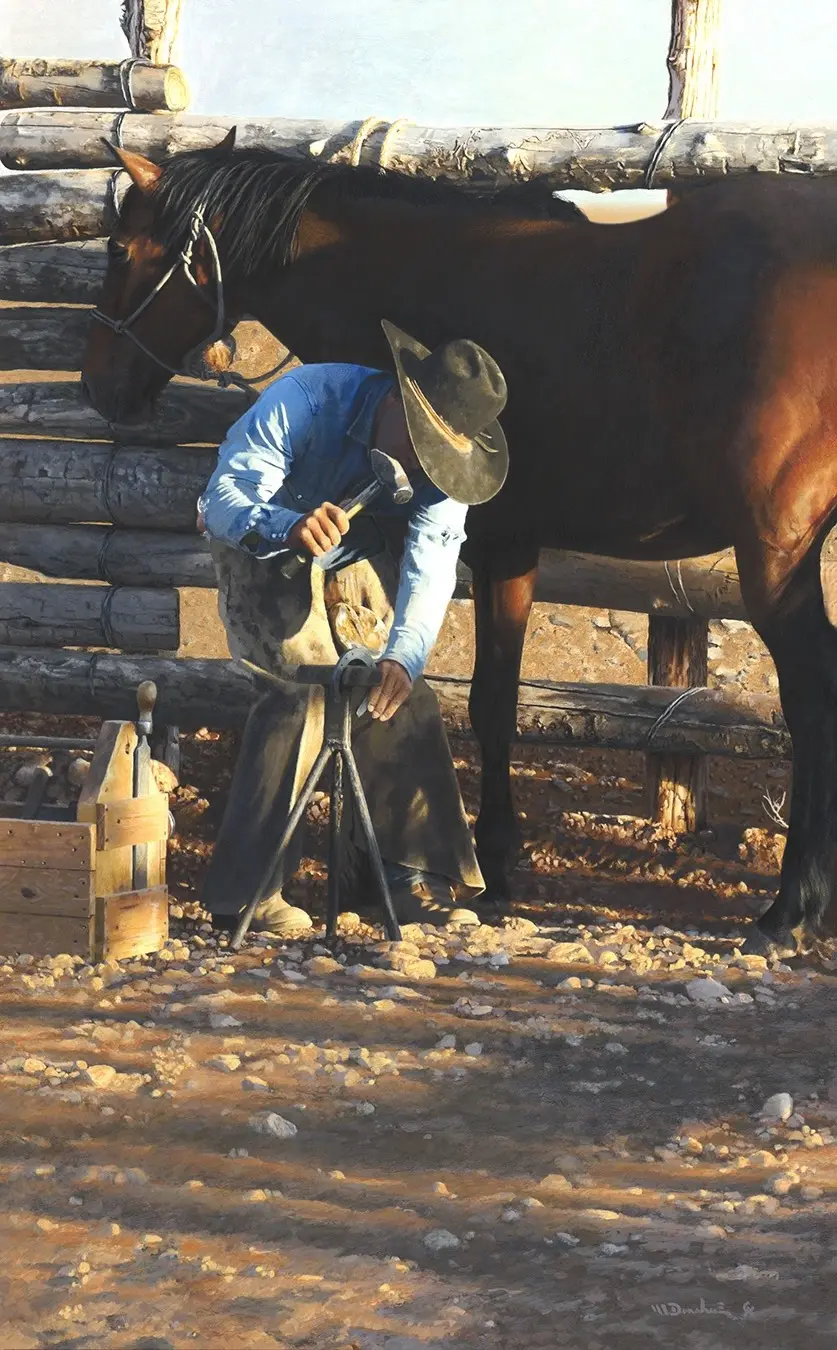
The daily grit and labor-intensive reality of ranch life take center stage in works like Mikel Donahue’s acrylic-on-board piece A Day in the Life (20 x 32 inches) and Grant Redden’s A Change of Seasons. Both paintings pay homage to the relentless cycles of cattle herding, trail riding, and animal husbandry.
Sculpture plays an equally vital role in the exhibition, most notably through Dustin Payne’s dynamic bronze, Trail Dust. Payne elevates the longhorn—perhaps the ultimate zoological symbol of the American West—beyond mere livestock, casting the animal in a heroic, almost mythical light that honors its resilience and historical importance.
Cultural Synthesis
Bridging the historical divides of the frontier, emeritus CAA member Martin Grelle contributes Blending Cultures. Grelle’s painting explores the harmonious possibility that historical conflict and friction could ultimately give birth to a vibrant, hybrid culture, drawing upon the diverse heritages that have found a home in the American West.
Official Responses: Perspectives on Tradition and Evolution
The move to Denver and the celebration of the 60-year milestone have drawn high praise from leadership across the Western cultural sphere.
Wes Allison, President and CEO of the National Western, emphasized the stringent criteria that continue to define the collective. Artists have long coveted an invitation to join the CAA, Allison notes, precisely because the organization’s admissions and exhibitions are rooted in an unyielding devotion to "authenticity, craftsmanship, and storytelling."

Art historian and critic James D. Balestrieri, writing in the October/November 2026 issue of Southwest Art magazine, reflected on the founders’ enduring legacy:
"One wonders what Beeler, Dye, Hampton and Phippen would make of their idea 60 years on. Given the strength of the institution they founded and its ability to seek out and find new sources of excellence even as the West itself changes and changes again, they would surely smile, not only at the endurance of the CAA, but at its capacity to adapt without compromising its mission or principles."
Implications: The Future of Western Art in a Changing Landscape
The partnership between the Cowboy Artists of America and the National Western at The Legacy in Denver carries profound implications for the fine art market and cultural preservation.
As the American West continues to face rapid demographic shifts, urban sprawl, and changing ecological pressures, the definition of what is "Western" is constantly being rewritten. By anchoring itself in Denver—a historic hub of commerce, agriculture, and culture—the CAA is positioning itself not merely as a nostalgic preservation society, but as a living, breathing archive of the contemporary Western experience.
The inclusion of diverse guest artists like Shawn Cameron and Thomas Blackshear II demonstrates that the CAA is actively expanding its visual vocabulary. By welcoming fresh interpretations while maintaining strict technical standards, the organization ensures that Western art remains relevant to modern collectors and younger generations.
Ultimately, the 60th Annual Exhibition and Sale at The Legacy is more than a retrospective. It is a bold declaration that the spirit of the American West—captured through canvas, bronze, and narrative—refuses to fade into the sunset.
Event Details
- Event: Cowboy Artists of America 60th Annual Exhibition and Sale
- Dates: October 2–3, 2026
- Location: The Legacy at the Stock Yards, Denver, CO
- Official Website: cowboyartistsofamerica.com
