

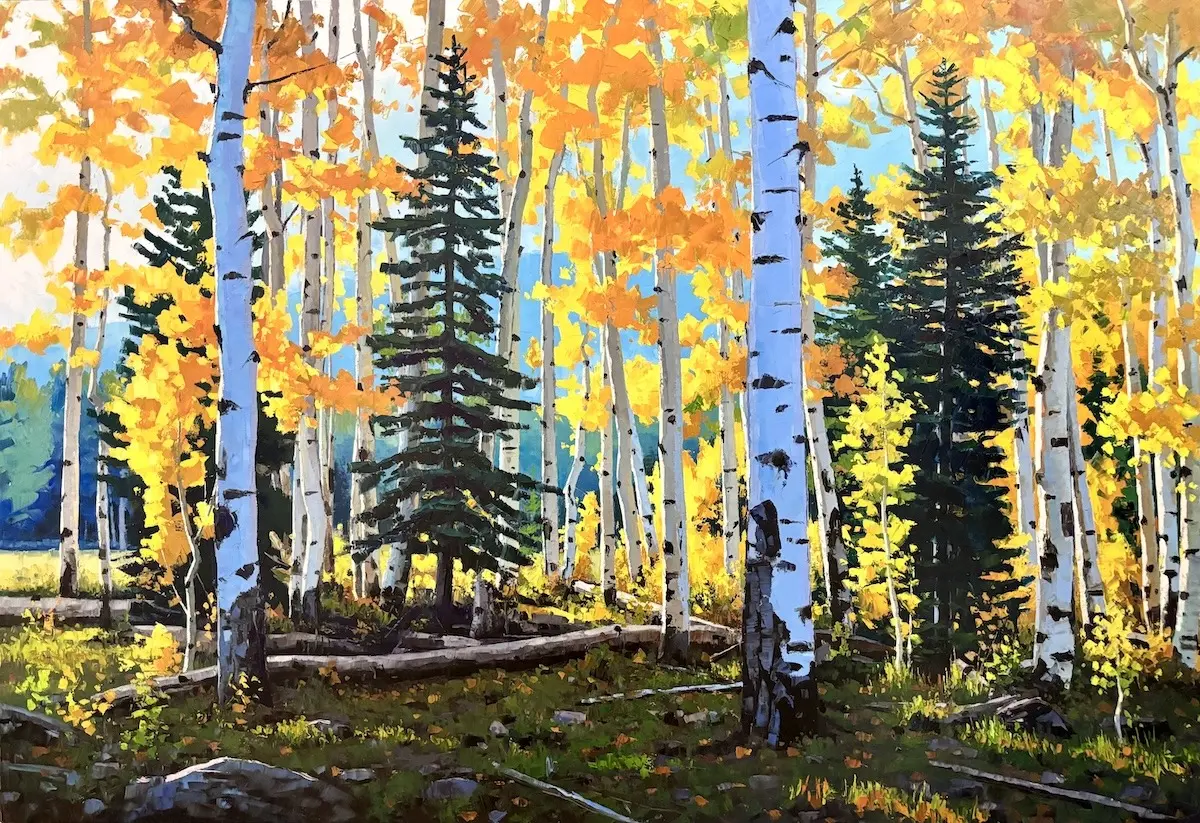
Main Facts: The Exhibition and Live Painting Event
This October, the historic art hub of Santa Fe, New Mexico, will play host to an immersive celebration of rural American tranquility. The prestigious Legacy Gallery is set to feature a major exhibition of 15 to 20 brand-new landscape paintings by acclaimed contemporary artist Douglas Aagard. Running through mid-October, the showcase brings together Aagard’s latest explorations of pastoral beauty, luminous atmospheric effects, and the enduring spirit of the American West.
The crown jewel of the exhibition will take place on October 9 and 10, when Aagard steps out of the studio and into the gallery space for a special live painting demonstration. From 11:00 a.m. to 4:00 p.m. on both days, collectors, art enthusiasts, and curious visitors will have a rare, behind-the-scenes look at the artist’s creative process in real time.
Working primarily in rich oils applied with a palette knife, Aagard will construct one of his signature textured landscapes directly before an audience. While painting with spectators watching closely can be daunting, the artist embraces the challenge. "It can be energizing," Aagard notes, reflecting on the upcoming live sessions. "I’m looking forward to it."
The exhibition highlights a major collection of large-scale and intimate works, including striking pieces such as Late Evening Light (36 x 48 inches), Preston Farm (36 x 48 inches), and the expansive Pleasant Creek Ridge (40 x 58 inches). Each canvas underscores Aagard’s mastery of light, mood, and composition, offering viewers a restorative escape into the quiet corners of the rural countryside.
Chronology: From Montana Canyons to the Santa Fe Gallery Stage
To understand the depth of Douglas Aagard’s art, one must trace a timeline rooted deeply in the rugged landscapes of the American West, tracing his evolution from an eager childhood explorer to a premier contemporary painter.

- Early Years in Western Montana and Utah: Aagard’s love for the outdoors began in his youth, spent hiking the steep canyons of Western Montana and working alongside his grandfather on a sheep ranch tucked high in the mountains of Utah. These formative experiences—walking quietly through stands of aspen trees and observing the interplay of light and shadow across pastoral valleys—planted the emotional seeds for his future career.
- The Watercolor Foundations: Aagard initially launched his artistic journey working as a watercolorist. This medium trained him in the importance of bold, decisive strokes and careful planning, disciplines that would later inform his handling of oils.
- The Pivot to Oils and the Palette Knife: Seeking greater textural depth and richer color saturation, Aagard experimented with oil paints and a palette knife for the first time. The transition proved revolutionary. Finding that the knife allowed him to manipulate thick applications of paint directly on the canvas without muddying his hues, he permanently adopted the technique as his primary mode of expression.
- Contemporary Success and Gallery Showcases: Over the years, Aagard has established himself as a fixture in Western art circles, culminating in major exhibitions at premier venues like the Legacy Gallery.
- October 9–10, Live Demonstration Events: The pinnacle of his current exhibition calendar, these live painting days at Legacy Gallery bridge the gap between solitary studio creation and public engagement, offering a transparent view into his mature artistic technique.
Supporting Data and Artistic Philosophy: Composition, Light, and Impasto
Aagard’s paintings defy simple categorization, though they clearly share a kinship with traditional impressionism. His artistic ethos is built upon two immutable pillars: composition and light.
1. Composition as the Indispensable Foundation
For Aagard, a successful painting begins long before the first stroke of paint touches the canvas. It starts with the structural arrangement of the scene.
"I always gravitate to nature, and to me, composition is number one. That’s where you need to start," Aagard explains. His works are expertly anchored by natural and architectural anchors—looming mountain ranges, rolling pastures dotted with grazing horses, cattle gathering near winding creeks, or the geometric shapes of rustic barns and stacked hay bales. "If you have good composition, you can almost mess it up with any color."
2. The Transcendent Power of Light
If composition provides the skeleton of Aagard’s work, light provides its soul. His landscapes are celebrated for an inner luminosity, capturing the fleeting moments when ordinary environments transform into extraordinary visual spectacles.
"Good light is paramount. Light is so, so important to me," he emphasizes. "You can see a drab scene 100 times and then the light changes and it becomes incredible, like someone put a frame around it and set it apart. And that doesn’t always mean bright light, but a good light source."
3. The Mechanics of the Palette Knife and Impasto
Aagard’s transition from watercolor brushes to oil-laden palette knives unlocked new dimensions in his work. Working on smaller boards for intimate scenes and expansive canvases for grand vistas, he utilizes a heavy impasto technique.
"As a watercolor artist, I liked bold strokes," he recalls. "When I tried my first painting with a palette knife, it was so much fun. It turned out so cool and I was really intrigued. There’s depth I can’t achieve with a brush that I can with a knife."
This method allows him to mix and blend pigments dynamically on the support surface itself. "Once I started painting with a knife, I was able to mix and blend paint right on the canvas," he shares. "It’s fantastic because I’m not muddying my paint as much."
Official Responses and Artist Perspectives: Capturing the Spirit of the Land
Douglas Aagard’s motivations extend far beyond technical execution or commercial success. At its core, his art is an emotional translation of peace, serenity, and a profound reverence for the natural world.

Discussing his stylistic evolution, Aagard notes a gradual shedding of rigid boundaries in favor of expressive freedom. "There are impressionistic leanings. You can pick out areas of my painting that look like impressionism," he says. "As I get older, I gravitate to a little more, a little more, a little more loose, but I’m still a representational painter."
Reflecting on the deeper purpose behind his creative output, Aagard connects his current canvases directly back to the memories of his childhood walks through the Utah aspen groves:
"As a young boy walking with my grandpa in the aspen trees, taking care of sheep—that feeling, that’s what it comes down to. The joy, the happiness, the feeling of well-being, the love of this great, beautiful world, speaks to me really deeply, and I want to show that to people. My job is to see that beauty and do my best to portray that."
These sentiments resonate deeply with collectors who seek an antidote to modern chaos through the quiet, bucolic landscapes he provides.
Implications: The Enduring Appeal of Western Pastoral Art in a Fast-Paced World
The upcoming October exhibition at Legacy Gallery carries broader implications for the regional art market and the appreciation of contemporary Western realism. In an era dominated by digital media and fast-paced urban living, exhibitions featuring traditional rural aesthetics serve as vital cultural touchstones, offering viewers a moment for contemplation and psychological restoration.

Furthermore, public demonstrations like those scheduled for October 9 and 10 play a crucial educational role. By opening the studio doors and inviting the public to watch the high-stakes, real-time application of thick impasto oils, artists like Aagard demystify the creative process. This transparency fosters a deeper appreciation among collectors, transforming the acquisition of art from a simple financial transaction into an intimate connection with the creator’s hand and mind.
As Santa Fe continues to draw art connoisseurs from across the globe, Douglas Aagard’s exhibition stands out as a testament to the enduring power of light, land, and memory—proving that the quiet majesty of a Montana canyon or a Utah sheep pasture can still captivate the modern imagination.
Event & Contact Information
- Exhibition Dates: October 9–10 (Live Painting from 11 a.m. to 4 p.m.), with works on display through mid-October.
- Venue: Legacy Gallery, Santa Fe, New Mexico
- Phone: (505) 986-9833
- Website: legacygallery.com
Note: This feature originally appeared in the October/November issue of Southwest Art magazine.
