

BOZEMAN, Mont. — In the vast, mythic landscape of the American West, tradition often casts a long shadow. For generations, the visual vocabulary of the region has been dominated by literalism: dust-choked cattle drives, snow-capped peaks rendered in precise photorealism, and bronzed cowboys caught in timeless moments of rugged heroism. But a new vanguard is staking its claim on the frontier, transforming the iconography of the Rocky Mountain West through the lens of modern abstraction, surrealism, and vibrant psychological depth.
At the forefront of this movement is 28-year-old Montana-based artist Maren Stubenvoll. Recognized in the prestigious 21 Under 31 | Young Artists to Watch, 2026 feature from the August/September issue of Southwest Art, Stubenvoll is capturing the attention of collectors, critics, and galleries alike. Her work bridges the familiar and the fantastical, creating a visual realm where cowgirls, local fauna, and undulating dreamscapes collide.
With a price range spanning from $250 to $10,000 and representation by the LeeAnn Ramsy Art Gallery in Bozeman, Stubenvoll is rapidly transitioning from an underground regional talent to a nationally watched name in contemporary Western art.
Main Facts: The Vision and Technique of Maren Stubenvoll
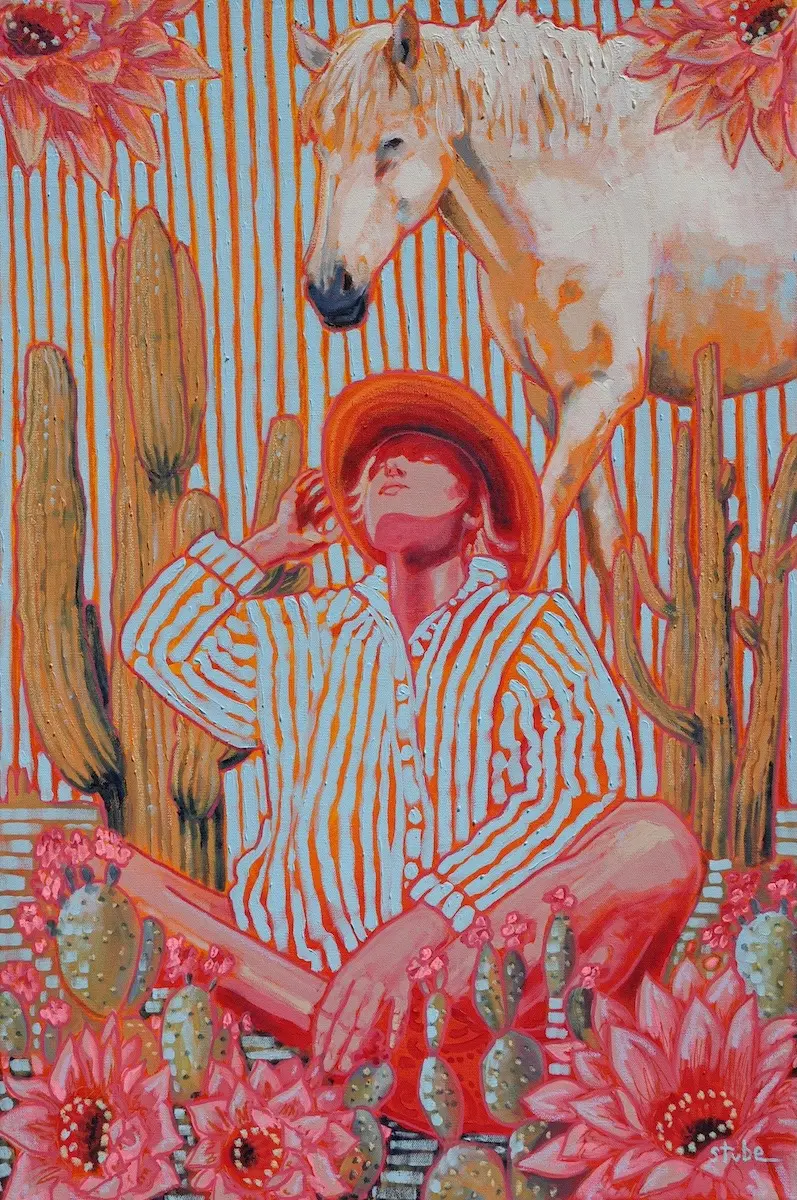
At first glance, a Stubenvoll composition is instantly arresting. Her signature pieces—such as her acrylic and oil pastel canvas, I Can and I Must Still Grow—defy traditional scale and perspective. Figures of cowgirls and regional wildlife are set against meticulously patterned, surrealist backgrounds that pulse with energy and saturated color.
Rather than aiming for historical documentation, Stubenvoll’s work explores an emotional terrain. Her style is an intentional collision of three distinct genres:
- Impressionism: Used to capture the fleeting, atmospheric light of the Montana sky and the kinetic energy of her subjects.
- Surrealism: Employed to distort scale and perspective, turning the physical West into an emotional landscape.
- Pattern Work: Integrating geometric and organic motifs that frame her subjects, lending a contemporary, graphic edge to traditional Western themes.
"My pieces often feature singular subjects set amongst surrealist landscapes, skewing perspectives and scale to create a colorful world that feels familiar to the Western genre and entirely otherworldly," Stubenvoll explains.
Her creative process is as tactile as her finished pieces. Working primarily in mixed media, she leverages the sharp, immediate texture of oil pastels against the fluid versatility of acrylics. This dual-medium approach allows her to build rich, layered surfaces that invite close inspection, echoing the complex ecosystems of the Rocky Mountain region she calls home.
Chronology: The Evolution of a Self-Taught Talent
Stubenvoll’s journey to the pages of Southwest Art is a testament to the power of relentless practice and a lifelong passion for image-making. Her artistic timeline reflects a modern path of creative development, forged outside the traditional corridors of elite academic institutions.
Childhood and Early Foundations
Art was a constant companion throughout Stubenvoll’s childhood in the Pacific Northwest and the Mountain West. From an early age, it was her favorite subject in school. While many young artists are discouraged by the lack of formal training, Stubenvoll embraced a DIY ethos, treating the world around her as an ongoing masterclass in observation.
Higher Education and the Pivot to Independence
Seeking to formalize her passion, Stubenvoll enrolled in an art program at an Oregon college. However, her formal academic tenure was brief, lasting only a single year. Finding that institutional instruction did not align with her instinctive, exploratory vision, she made the bold choice to leave formal schooling behind.
Instead of an MFA program, Stubenvoll embarked on a self-directed education. She honed her craft through decades of daily observation, hands-on experimentation, and—in a nod to the modern era of digital artistry—a healthy dose of instructional YouTube tutorials. This unconventional route allowed her to develop a distinct visual voice unburdened by academic dogma.
The Breakthrough and Commercial Recognition
By her late twenties, Stubenvoll’s unique synthesis of Western heritage and surrealist fantasy caught the eye of Bozeman gallerist LeeAnn Ramsy. Securing gallery representation marked a critical turning point, giving her work a physical home in one of Montana’s premier cultural hubs. Her inclusion in the 21 Under 31 cohort for 2026 has propelled her onto the national stage, validating years of solitary studio work and cementing her status as an artist to watch.
Supporting Data: Inside the Artist’s Studio and Mind
To understand Stubenvoll’s art, one must understand the ecosystem that feeds it—from the music playing in her studio to the outdoor adventures that fuel her imagination.

The Sound of Creation: Bon Iver and Layered Soundscapes
In the studio, Stubenvoll finds her creative rhythm through sound. She cites indie-folk innovator Bon Iver as a permanent fixture in her creative process. "I will forever be entranced by anything Bon Iver creates," she notes. "All the textures, layers of instruments and poetry in the lyrics feel like the sonic world I want to re-create through my art." This obsession with texture and layered narrative directly mirrors the visual depth of her canvases.
Influences and Colleagues
While carving out her own niche, Stubenvoll remains an active consumer and collector of contemporary art. Her home features a prized acquisition purchased from a local market in Bozeman: a piece by artist Shan Graf depicting a young girl in a bright orange sweater staring into an off-canvas mirror while cutting her white hair short. This fascination with introspective, narrative portraiture heavily influences how Stubenvoll handles the psychological interiority of her own subjects.
The Inseparable Bond of Art and Adventure
For Stubenvoll, creativity does not stop at the studio door. Her artistic practice is inextricably linked to her physical life in the Montana wilderness. Whether she is trail running through alpine passes, mountain biking down rugged single-tracks, or photographing the shifting light on the Continental Divide, these activities are part of the same creative engine.
"My passion for my art and for adventuring in the landscape around me truly feels inseparable—two different creative expressions drawn from the same well of inspiration," she says.
Official Responses and Professional Insights
Navigating the competitive world of contemporary Western art requires both resilience and wisdom. Stubenvoll credits her survival and growth in the industry to a piece of foundational advice she received early in her journey:
"The best way to make great art is to make A LOT of bad art first. Let go of the brakes, get out of your head and simply create constantly, and the good and even great art will emerge."
This philosophy has liberated her from the paralysis of perfectionism. By prioritizing volume, momentum, and experimentation over immediate perfection, she has cultivated a prolific output that continually pushes her stylistic boundaries.
Her gallerist, LeeAnn Ramsy, notes that collectors are increasingly drawn to this fearless approach. "Maren possesses a rare combination of technical intuition and bold imagination," Ramsy observes. "In a genre that can sometimes feel overly reverential of the past, she brings a fresh, vital energy that collectors are eager to bring into their homes."
Implications: Building a Legacy on the Modern Frontier
As Stubenvoll looks toward the future, her ambitions extend far beyond commercial success or critical acclaim. She is thinking in terms of generations.
"My goal for my art is to continue to create original work that people adore and put into their homes to become family heirlooms," Stubenvoll reflects. "When I’m long gone, I hope that someone’s great-great-granddaughter sees one of my pieces and feels the same joy I felt when I created it decades before."
This long-term vision has significant implications for the broader genre of Western art. For decades, the market has heavily favored historical accuracy and nostalgic depictions of the 19th-century frontier. However, as a new generation of buyers—millennials and Gen Z collectors who value emotional resonance, surrealism, and diverse perspectives—enters the market, artists like Stubenvoll are expanding the definition of what "Western art" can be.
By injecting her own contemporary reality—her love for the outdoors, her introspective psychology, and her playful subversion of scale—into the traditional motifs of cowgirls and western landscapes, Stubenvoll is not just painting the West; she is rewriting its visual mythology.
With her prices currently ranging from an accessible $250 for smaller works to $10,000 for major canvases, she offers an entry point for emerging collectors while commanding the respect of seasoned connoisseurs. As her career unfolds through her representation at LeeAnn Ramsy Art Gallery and her spotlight in Southwest Art, Maren Stubenvoll is proving that the spirit of the American frontier is as malleable, wild, and expansive as the imaginations of the artists who dare to paint it.
To view more of her portfolio, visit her official website at stubecreative.com.
