

The clean energy transition has prompted a wave of innovation, leading engineers and entrepreneurs to revisit fundamental physical principles in search of grid-scale energy storage solutions. Among these, solid-mass gravity storage—the concept of moving massive weights up and down slopes or towers to store and discharge electricity—has captured the imagination of investors, public agencies, and media outlets alike.
However, recent real-world operational data from ARES North America’s GravityLine demonstration project at the Gamebird Pit in Nevada exposes profound limitations in this technology. While the system successfully demonstrates mechanical movement, a rigorous examination of the underlying physics, capital requirements, and lifecycle emissions reveals that solid-mass gravity storage struggles to compete with established alternatives like closed-loop pumped hydro and modern lithium-ion battery systems.
Main Facts
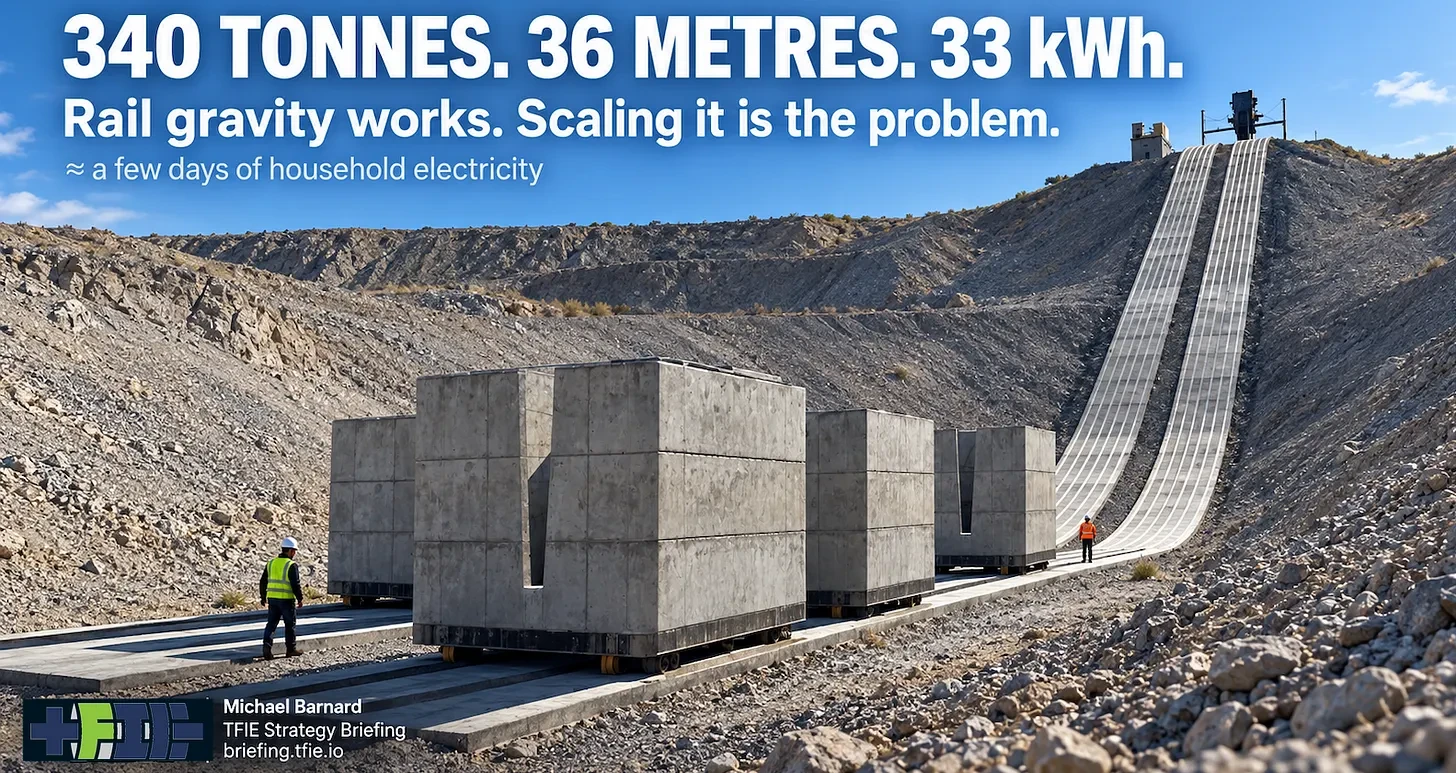
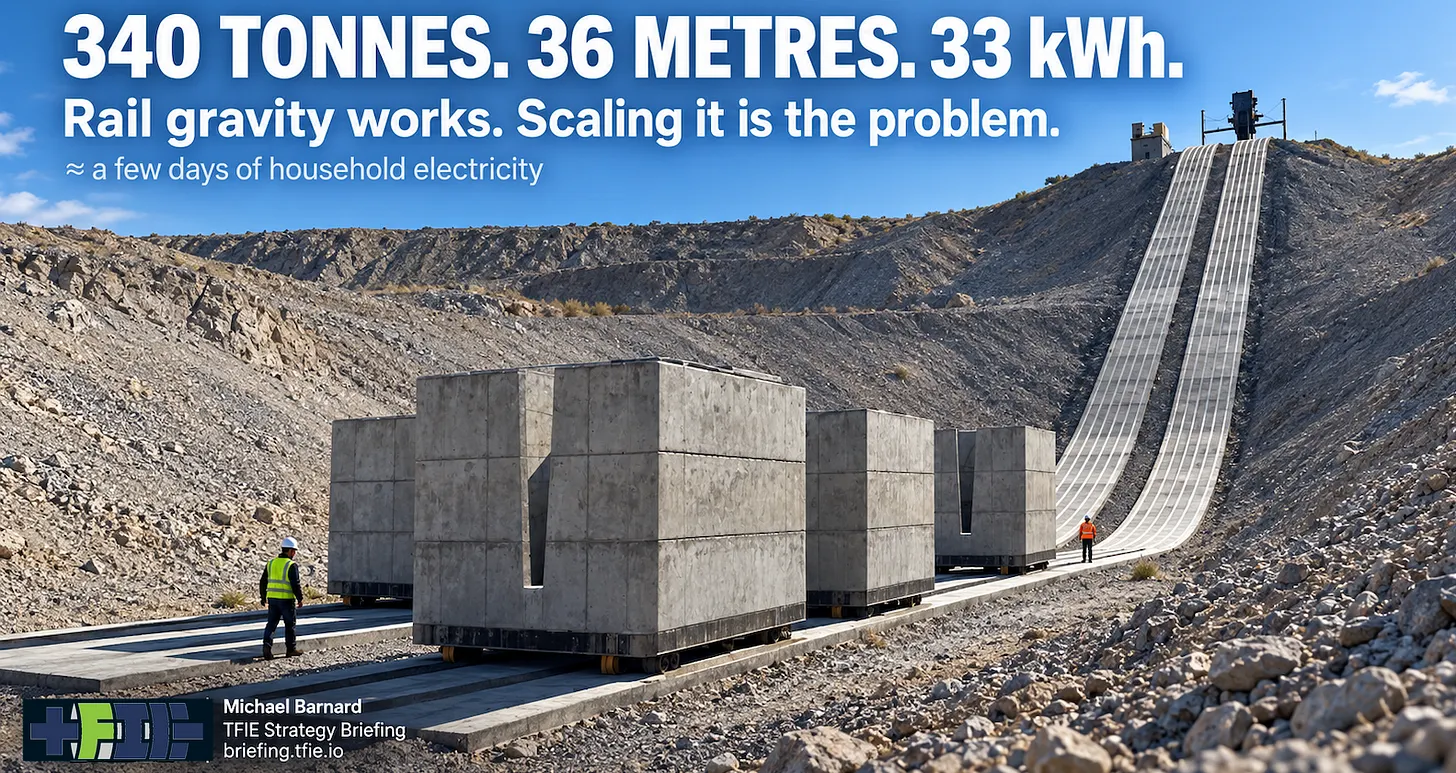
At the core of the debate is a recent operational milestone achieved by ARES North America at the Gamebird Pit site in Nevada. According to documentation from Sandia National Laboratories, the company operated a pair of heavy mass cars—weighing a combined total of roughly 340 tonnes—climbing a 55% grade slope driven by a stationary motor and chain system. The cars traversed approximately 36 metres of elevation.
Despite the immense visual scale of moving hundreds of tonnes of material, the resulting output was remarkably modest: roughly 33 kWh of gross stored energy.
This outcome aligns precisely with fundamental gravitational physics. Stored gravitational energy is calculated as a direct product of mass, gravity, and vertical elevation ($textEnergy = textmass times textgravity times textheight$). While a system moving hundreds of tonnes can generate several megawatts of power briefly on a descent—because power is defined as energy delivered rapidly—the actual energy inventory remains constrained by the minimal vertical displacement.
For a gravity storage project to deliver meaningful long-duration grid services (such as hundreds of megawatt-hours), the physical infrastructure required to move and manage the necessary mass becomes staggeringly complex.
Chronology and Project Evolution
- Pre-2024: Conceptual development of rail-based gravity storage gains traction, with proponents arguing that mechanical systems can bypass the geographic constraints of traditional pumped hydro.
- June 2024: Early industry analyses highlight foundational flaws in solid-mass gravity concepts, predicting that conventional funicular cable limits would severely restrict practical moving masses. ARES responds by integrating a chain-drive configuration that avoids some cable-tension bottlenecks.
- Late 2025 / Early 2026: Sandia National Laboratories documents testing phases for the ARES GravityLine system at the Gamebird Pit in Nevada, providing concrete empirical data on mass, elevation, and energy yield.
- 2026: Recent long-duration battery procurement data—such as utility-scale storage deployments in Britain stretching well into the teens of hours—demonstrates that lithium-ion technology is rapidly capturing the multi-hour duration market once claimed exclusively by mechanical storage concepts. Concurrently, strategic assessments (such as TFIE Strategy Briefings) model the capital and material requirements of scaling ARES-style systems to commercial utility scales.
Supporting Data and Comparative Analysis
To evaluate how ARES’s technology translates from a small-scale demonstration to a commercial-grade utility asset, energy analysts have modeled scaled-up hypothetical deployments.
If we look past the 36-metre elevation of the Gamebird Pit—which offers convenience due to pre-existing aggregate roads and industrial infrastructure, but lacks vertical drop—and instead assume a more favorable 400-metre effective elevation difference, the engineering requirements shift dramatically.
To deliver a modest 20 MW of power over twenty hours (yielding a 400 MWh storage facility), the system cannot rely merely on "cheap rock" moving up and down a hill. The math is unyielding:
- Mass Scaling: Because gravity remains constant, reducing elevation or scaling up energy requires a proportional increase in mass. To achieve competitive energy inventories at lower heights, thousands of concrete-filled steel rail cars must be manufactured, marshaled, and maintained.
- Machinery Overhead: Unlike water in a pumped hydro reservoir—which flows freely through common conduits without needing a chassis, wheel bearings, or dedicated parking infrastructure—solid mass must be divided among hundreds of thousands of purpose-built mechanical carriers.
- Capital Intensity: Each installation requires a heavy rail, rock-crushing, concrete-forming, and machinery manufacturing plant custom-built on-site. The infrastructure demands extensive storage tracks at both upper and lower elevations, stationary winches, transfer systems, and high-redundancy controls.
Comparative Matrix: Storage Architectures
| Metric / Feature | Rail Gravity Storage (ARES) | Closed-Loop Pumped Hydro | Lithium-Ion Batteries |
|---|---|---|---|
| Primary Medium | Solid mass (concrete/steel cars) | Water | Chemical cells |
| Material Handling | High mechanical complexity (chassis, bearings, chains) | Simple fluid dynamics (pipes, turbines) | Standardized factory-built modules |
| Geographic Constraints | Requires steep slopes, rock/aggregate access, and rail corridors | Requires dual reservoirs with significant head and water rights | Minimal geographic constraints |
| Embodied Carbon | High (massive steel and Portland cement infrastructure) | Low-to-moderate (civil works) | Moderate (factory production, diminishing over time) |
| Maintenance Risk | High (mechanical wear across thousands of moving cars) | Low (centralized turbine and valve maintenance) | Low (modular replacement) |
Official Responses and Industry Perspectives
Proponents of solid-mass storage, including representatives from ARES North America, have positioned the GravityLine system as a viable, long-duration alternative to chemical batteries, particularly for durations exceeding standard lithium-ion capacities. They argue that utilizing industrial sites like gravel quarries—such as the Gamebird Pit—allows developers to bypass permitting hurdles and utilize disturbed land with existing access roads.

Conversely, independent energy analysts and research entities have raised serious concerns regarding the economic and environmental viability of these systems:
- The Thermodynamic and Carbon Critique: Analysts point out that while the rock or ballast material is ostensibly low-carbon, the industrial machinery required to handle it is not. The extensive use of high-quality steel for rail cars and winches, alongside massive quantities of Portland cement for civil foundations, incurs a heavy upfront embodied carbon debt. Some researchers estimate that this carbon footprint rivals or exceeds the per-kWh emissions profile of high-efficiency natural gas peaker plants over the facility’s lifecycle.
- The Battery Competitiveness Shift: Assumptions that chemical storage cannot compete in long-duration brackets (such as 10 to 20 hours) are increasingly outdated. Recent procurements in international markets demonstrate that lithium-ion systems are scaling efficiently into longer discharge windows, narrowing the market niche that mechanical gravity storage once hoped to occupy.
- Institutional Scrutiny: Observers have questioned why public research institutions, such as the U.S. Department of Energy’s Sandia National Laboratories, allocate resources to validate technologies whose basic thermodynamic limits can be calculated using middle-school science equations.
Implications for the Future of Energy Storage
The demonstration at the Gamebird Pit answers a specific mechanical question: Can heavy carriers be reliably moved on a steep alignment using a chain-drive system? The answer is yes.
However, answering that mechanical question highlights the deeper, unresolved commercial hurdle that follows. Once the engineering mechanics are settled, solid-mass gravity storage faces an unforgiving economic reality. To build a functional energy inventory, developers must deploy massive amounts of complex machinery that must compete directly against two vastly superior material-handling architectures:
- Water in Pumped Hydro: Utilizing fluid mechanics to move mass without the parasitic overhead of thousands of individual rolling chassis.
- Factory-Produced Batteries: Leveraging global manufacturing scale to deliver standardized, modular storage units directly to project sites without requiring custom heavy-rail manufacturing plants on fragile hillsides.
Ultimately, physics dictates that solid-mass gravity storage possesses inherently low energy density. Unless a project can magically alter the acceleration of gravity or bypass the necessity of building thousands of heavy-duty mechanical carriers, rail gravity storage risks remaining a solution in search of a problem—surpassed by technologies that are cleaner, cheaper, and vastly more scalable.
