


As Massachusetts lawmakers race to finalize comprehensive energy legislation aimed at reining in ballooning utility bills, a quiet yet fierce debate is brewing behind closed doors. At the heart of the controversy is a single policy proposal: mandating new fixed monthly charges on residential and commercial electric bills. While state leaders champion sweeping reforms to modernize the grid and lower energy costs, clean energy advocates warn that fixed charges could inadvertently punish low-usage customers, undermine investments in rooftop solar, and sabotage the state’s broader climate and affordability goals.
With the legislative conference committee working feverishly to reconcile competing bills from the House and Senate before sending a final package to Governor Maura Healey, stakeholders across the Commonwealth are urging lawmakers to hit the brakes on mandated fixed fee structures and let regulatory experts finish their work.
Main Facts: The Legislative Push and the Fixed-Charge Controversy
The legislative battle centers on two primary energy bills passed earlier this year: Senate Bill 3166 (S.3166) and House Bill 5175 (H.5175). Both measures share a common, commendable objective—making electricity more affordable and reliable for Massachusetts residents and businesses.

To achieve this, the bills introduce several forward-thinking mechanisms:
- Flexible Interconnection: Easing the integration of distributed energy resources (DERs) onto the grid.
- Retail Storage Programs: Expanding the deployment of local battery storage to enhance grid stability.
- Modernized Residential Solar Permitting: Streamlining bureaucratic red tape to make it faster and cheaper for homes and businesses to install rooftop solar arrays.
However, a late-emerging proposal threatens to derail these positive reforms. Lawmakers are weighing provisions that would mandate new, mandatory fixed utility charges. Under this proposed rate design, utilities would shift a portion of their cost recovery away from volumetric charges—which scale directly with how much electricity a customer consumes—and toward fixed monthly fees that must be paid regardless of energy usage.
Critics, led prominently by the Solar Energy Industries Association (SEIA) and a broad coalition of consumer, environmental, and low-income advocates, argue that this shift turns the concept of energy affordability on its head. By decoupling utility revenue from consumption, fixed charges force low-usage customers—often lower-income families, renters, and seniors living in smaller spaces—to disproportionately subsidize large energy consumers. Furthermore, it blunts the financial incentive to conserve energy or invest in efficiency, solar, and battery storage.

Chronology of Events: How the Debate Unfolded
The path toward the current legislative showdown has evolved rapidly over the past year through a series of administrative and legislative milestones:
- Late 2025: Recognizing widespread public frustration over soaring utility bills, the Massachusetts Department of Public Utilities (DPU) opened a comprehensive, statewide review of all delivery charges on electric and gas utility bills. The regulatory proceeding was designed to deeply evaluate rate structures and ensure equitable cost distribution.
- Early 2026: As the legislative session progressed, both the Massachusetts House and Senate advanced their respective energy bills (H.5175 and S.3166). While both packages contained robust measures for grid modernization and clean energy deployment, provisions regarding fixed utility charges surfaced during committee negotiations.
- Mid-2026: A diverse coalition of consumer advocates, low-income organizations, business groups, environmental nonprofits, and clean energy firms flooded the DPU with public comments. The unified message: any sweeping changes to fixed charges require rigorous data analysis and should not be rushed through a legislative mandate.
- Present: The Massachusetts Legislature established a conference committee tasked with merging the House and Senate bills into a single compromise package. With Governor Maura Healey’s executive order on affordable, reliable clean energy serving as a backdrop, the committee now holds the fate of Massachusetts rate design in its hands.
Supporting Data: What the Numbers Reveal About Fixed Charges
The argument against fixed charges is not merely philosophical; it is heavily backed by empirical data from the state’s largest investor-owned utilities. Analyses conducted by SEIA using operational data from Eversource and National Grid paint a stark picture of financial redistribution.
Eversource Territory (Serving 1.4+ Million Customers)
In Eversource’s service area, data demonstrates that shifting costs from volumetric to fixed charges inherently penalizes conservation. Customers who pull the lowest amounts of electricity from the grid—whether due to energy-efficient habits, smaller home sizes, or existing solar installations—will see their overall monthly bills increase significantly. Conversely, the largest corporate and residential energy consumers stand to experience bill reductions, effectively transferring a portion of their overhead costs onto more frugal or vulnerable ratepayers.
National Grid Territory (Serving 1.3 Million Customers)
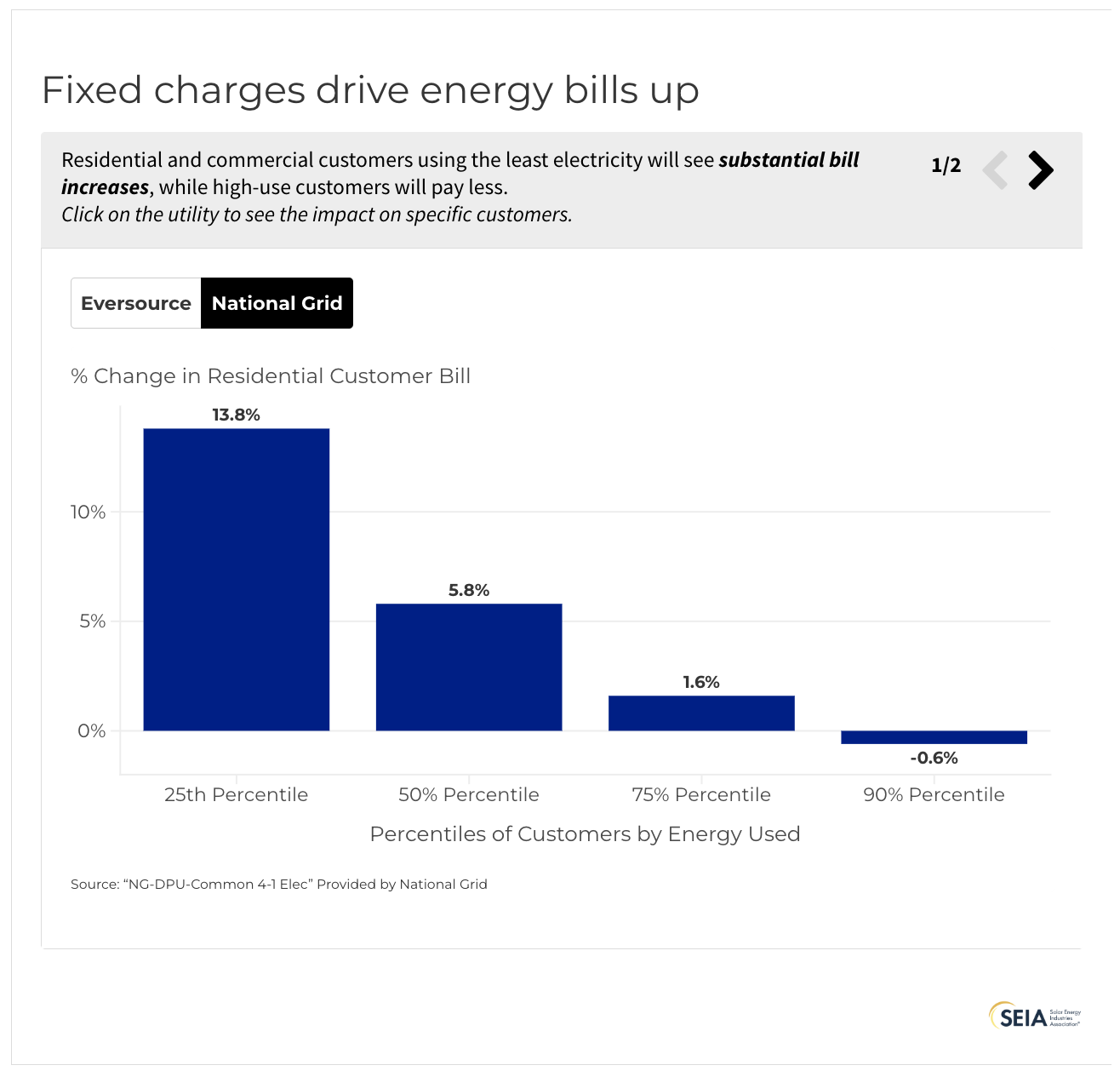
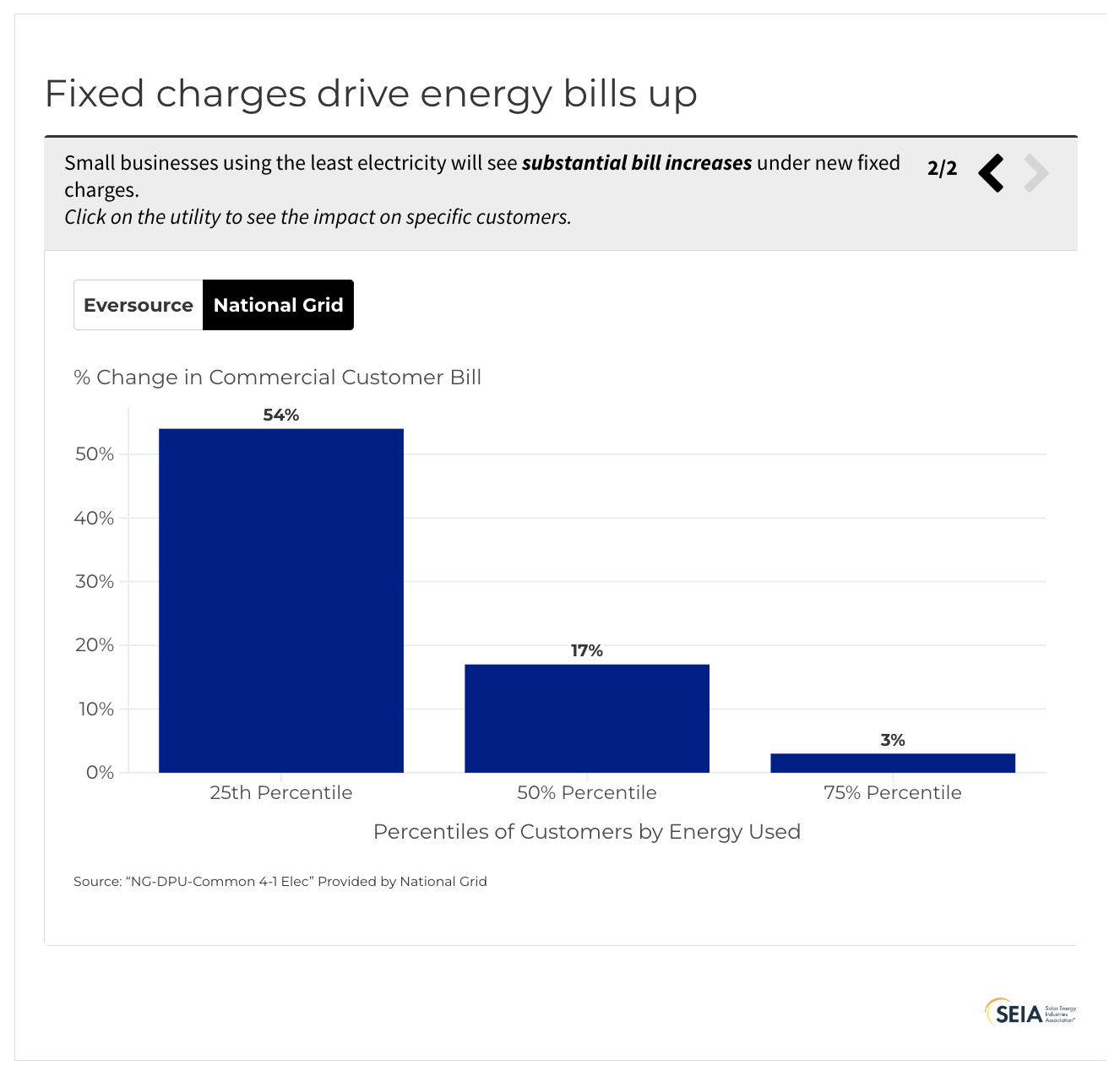
The trends in National Grid’s service footprint mirror those of Eversource. According to SEIA’s review, residential customers using the least amount of electricity will see their monthly utility bills spike by an average of 13.8% under a fixed-charge regime. Meanwhile, high-volume energy users will see their financial burdens eased.
This dynamic exposes a severe equity flaw in mandatory fixed charges. Rather than protecting consumers from high energy costs, the policy shifts financial weight onto those least equipped to absorb additional baseline expenses, while rewarding consumption-heavy users who have less financial incentive to curb their usage.
Official Responses and Stakeholder Perspectives
The debate has catalyzed an unusual and powerful alliance across the political and economic spectrum in Massachusetts.

The Clean Energy and Consumer Coalition
A broad coalition representing clean energy companies, environmental justice advocates, and low-income consumer protection groups has pushed back aggressively against the fixed-charge proposals. They emphasize that when a greater percentage of an electric bill is locked into a fixed monthly fee, the financial return on investment (ROI) for energy-saving measures plummets.
If a customer installs rooftop solar or home battery storage, their primary financial relief comes from reducing the volume of grid electricity they purchase. When fixed charges swallow up a larger slice of the bill, the savings generated by self-generation shrink, lengthening the payback period for clean energy tech and stalling adoption rates.
The Regulatory Stance: Department of Public Utilities (DPU)
The DPU has taken a measured approach, acknowledging that utility rate design is inherently intricate. The department formally stated its intent to "carefully evaluate this issue" through its ongoing review process before making any determinations on whether or not delivery charges should be partially or fully fixed.
Advocates point out that the DPU possesses the specialized expertise, economic modeling tools, and administrative oversight required to untangle complex rate structures. Bypassing this regulatory agency via a hasty legislative mandate, critics argue, undermines due process and risks unintended economic consequences.
Implications for the Future of Massachusetts Energy
The decisions made by the Massachusetts legislative conference committee will ripple across the state’s economy and its environmental future for decades to come.
1. Threat to Climate and Decarbonization Goals
Massachusetts has set ambitious statutory targets to slash greenhouse gas emissions and transition toward an electrified economy powered by renewables. Achieving these goals requires widespread adoption of heat pumps, electric vehicles (EVs), and distributed energy systems. Mandating fixed charges dampens the economic signals that encourage consumers to adopt these technologies and manage their energy loads intelligently.

2. Energy Burden on Vulnerable Populations
Affordability is the stated catalyst for the current energy bills. However, fixed charges achieve the exact opposite for low- and fixed-income residents. For a senior citizen living alone in an apartment who consumes very little electricity, a high fixed monthly charge represents a regressive tax that cannot be avoided through conservation.
3. A Path Forward: Trusting the Regulatory Process
Stakeholders are not calling for a complete prohibition on evaluating rate design; rather, they are advocating for procedural integrity. The consensus recommendation for Governor Healey’s administration and the conference committee is straightforward: amend the pending legislation to permit the DPU to evaluate fixed charges through its deliberate administrative process, rather than forcing a mandate into law.
By removing mandatory fixed charges from the final bill, Massachusetts can preserve the transformative benefits of its grid modernization, protect its smallest energy users from undue financial strain, and ensure that clean energy remains accessible and affordable for every resident in the Commonwealth.
