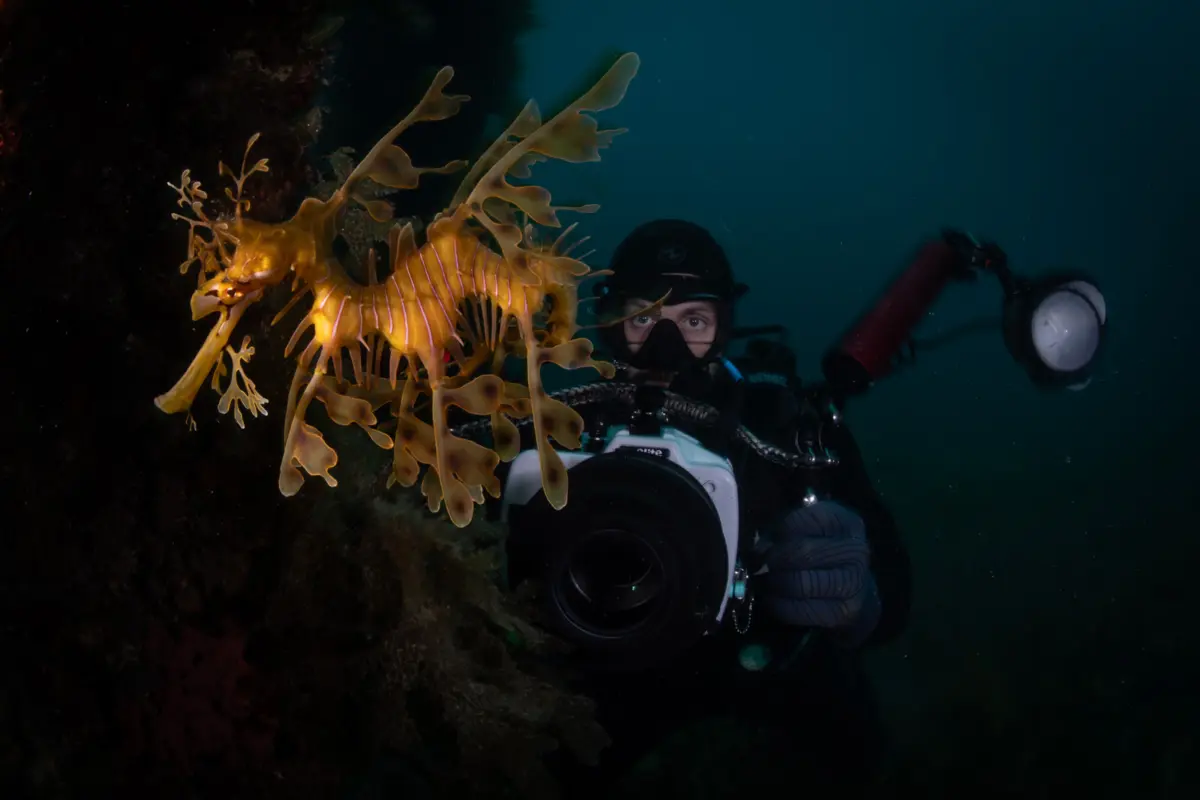
In the quiet, rolling hills of rural Wales, a young boy spent his days chasing a fascination with the natural world. Growing up on a traditional farm, Rowan Dear spent his childhood running through fields, tracking badgers, foxes, hedgehogs, and the rich birdlife native to the British countryside. Like countless children of his generation, his imagination was fueled by the BBC’s iconic nature documentaries presented by David Attenborough. Yet, while most kids dreamed of far-flung terrestrial safaris, Dear harbored a deeper, more elusive fascination: the hidden, alien realm beneath the ocean’s surface.
Today, Rowan Dear is an acclaimed, award-winning professional underwater photographer. His journey—highlighted as part of Nature TTL’s interview series, "From Amateur to Professional"—is a testament to overcoming personal boundaries, mastering technical discipline, and allowing a lifelong passion for the ocean to organically shape a thriving creative career.
Main Facts: The Transition from Land to Sea
Rowan Dear’s ascent in the photography world is defined by a sharp pivot into an unforgiving and technically demanding medium.
The Breakthrough: Though Dear toyed with disposable cameras as a child, photographing pets and attempting to capture local wildlife with limited success, he did not embrace underwater photography in earnest until 2020.
Overcoming Adversity: His entry into the marine world began years prior. Facing a deep-seated fear of water, Dear confronted his phobia head-on in 2017 by enrolling in professional scuba diving courses in Sydney, Australia.
Recognition: By combining his scuba proficiency with high-end camera equipment, Dear quickly transitioned from a hobbyist posting images to social media to an award-winning professional, capturing prestigious competition wins and international acclaim.
Signature Subjects: He is best known for his dynamic, vibrant imagery of marine life, specializing in cephalopods (particularly the giant cuttlefish aggregations in South Australia), sharks, marine mammals, and delicate macro subjects like the leafy seadragon.
Chronology: A Decade of Growth and Discovery
To understand Dear’s success, one must trace his trajectory from an intimidated amateur to a seasoned professional navigating the unpredictable conditions of the global ocean.
1. Childhood and Early Ambitions (1990s–2000s)
Growing up in Wales, wildlife photography felt entirely out of reach. To a young Dear, the industry appeared elitist—an endeavor reserved for those with substantial financial privilege and specialized gear. Armed only with a cheap disposable camera, his attempts to photograph wild animals yielded minimal results, though the underlying ambition remained firmly planted.
2. Facing the Deep: Sydney, Australia (2017)
The turning point in Dear’s relationship with water occurred in 2017. Recognizing that his fear of the ocean was gating him from his true passions, he moved past his anxieties and undertook rigorous dive training in Sydney. This foundational step transformed the ocean from a space of apprehension into his primary office.
3. The Digital Awakening and First Steps (2020)
By 2020, Dear fully invested in dedicated underwater camera systems, moving beyond basic action cameras like GoPros. Reflecting on his earliest professional attempts—such as a heavily anticipated shot of a giant cuttlefish outside Sydney—Dear acknowledges the stark contrast between expectation and reality.
"Unfortunately, it didn’t quite work out how I had pictured it, and I landed with a quite flat, uninteresting, and not very colorful image," Dear recalls. "At the time I was pretty happy, and posted it on my social media… but when I looked at professional or even semi-pro images, it definitely was not comparable."
4. Establishing a Professional Footing (2021–Present)
As Dear refined his technique, he began entering and winning major international photography competitions. These accolades served as external validation, confirming that his work matched the high standards of his peers in the professional underwater imaging community.
Supporting Data & Field Practice: Mastering the Elements
Underwater photography is vastly different from terrestrial shooting; it requires an intimate understanding of physics, marine biology, behavior, and fluid dynamics. Dear’s methodology relies on rigorous preparation and environmental adaptation.
Key Locations and Behavioral Focus
Whyalla, South Australia: Dear frequently returns to this shallow, 5-meter-deep marine sanctuary where over 10,000 giant cuttlefish gather annually to mate. The accessibility of the shore entry allows him to spend hours immersed in the behavior of these intelligent, colorful creatures.
Byron Bay, New South Wales: Known for its summer aggregations of leopard sharks, this location allows Dear to shift fluidly between shallow, sun-dappled close-ups and dramatic top-down wide-angle compositions.
Heron Island, Great Barrier Reef: A prime destination for freediving during turtle hatching season (February to April), where Dear captures the fragile moments of newborn turtles entering the ocean alongside resident lemon sharks and rays.
Technical Evolution and Workflow
Dear’s post-processing philosophy has evolved inversely to his technical skill. Early in his career, he spent hours trying to salvage poorly lit, flat, or backscatter-heavy images using editing software. Today, he spends mere minutes on each photo.
"I now believe that if a photo takes too long to edit, you just need to go back out and take a better one," Dear explains. Utilizing a bright, natural lighting style, he avoids heavy manipulations, preferring his images to reflect the authentic vibrancy of the underwater world.
Official Insights: The Reality of Working with Nature
When asked about the defining challenges of his career, Dear emphasizes that nature rarely adheres to human timelines or carefully laid travel itineraries.
"With wildlife photography, the biggest challenge is being in the right place at the right time to get the images you want," says Dear. "I have been on trips to photograph minke whales where we had bad weather and zero sightings. Sometimes, it doesn’t matter how well you have planned, as nature has other ideas."
He notes that while underwater photographers dream of pristine visibility and flawless lighting, those conditions are anomalies. True professional competence is demonstrated when a photographer is forced to adapt to adverse weather—such as the heavy winds and murky visibility he encountered while legally permitted to photograph southern right whales in Argentina—and still extract compelling, emotionally resonant imagery from the experience.
Implications: Lessons for Aspiring Conservation Photographers
Rowan Dear’s journey offers profound takeaways for the next generation of visual storytellers, particularly those intimidated by the financial and technical barriers of entry into professional photography.
Combating Imposter Syndrome: Dear admits that self-doubt occasionally held him back from pursuing commercial opportunities he was already qualified for. He stresses the importance of balancing healthy self-criticism with trust in one’s personal creative process.
Organic Career Progression: Rather than aggressively chasing a "professional title," Dear’s career grew out of a continuous loop of personal exploration, skill acquisition, and a desire to share intimate ocean narratives with land-bound audiences.
The Danger of Social Media Metrics: In an era dominated by algorithmic validation, Dear warns against using "likes" and follower counts as true metrics of artistic merit. True growth stems from peer-reviewed competitions, mentorship, and an uncompromising dedication to craft.
For those looking to follow in his footsteps, Dear’s ultimate advice is simple yet demanding: "Work out where you want to get to, follow the people who inspire you and follow your instincts, create your own style, hone your craft, and always try to improve. Never be content with where you are at."