

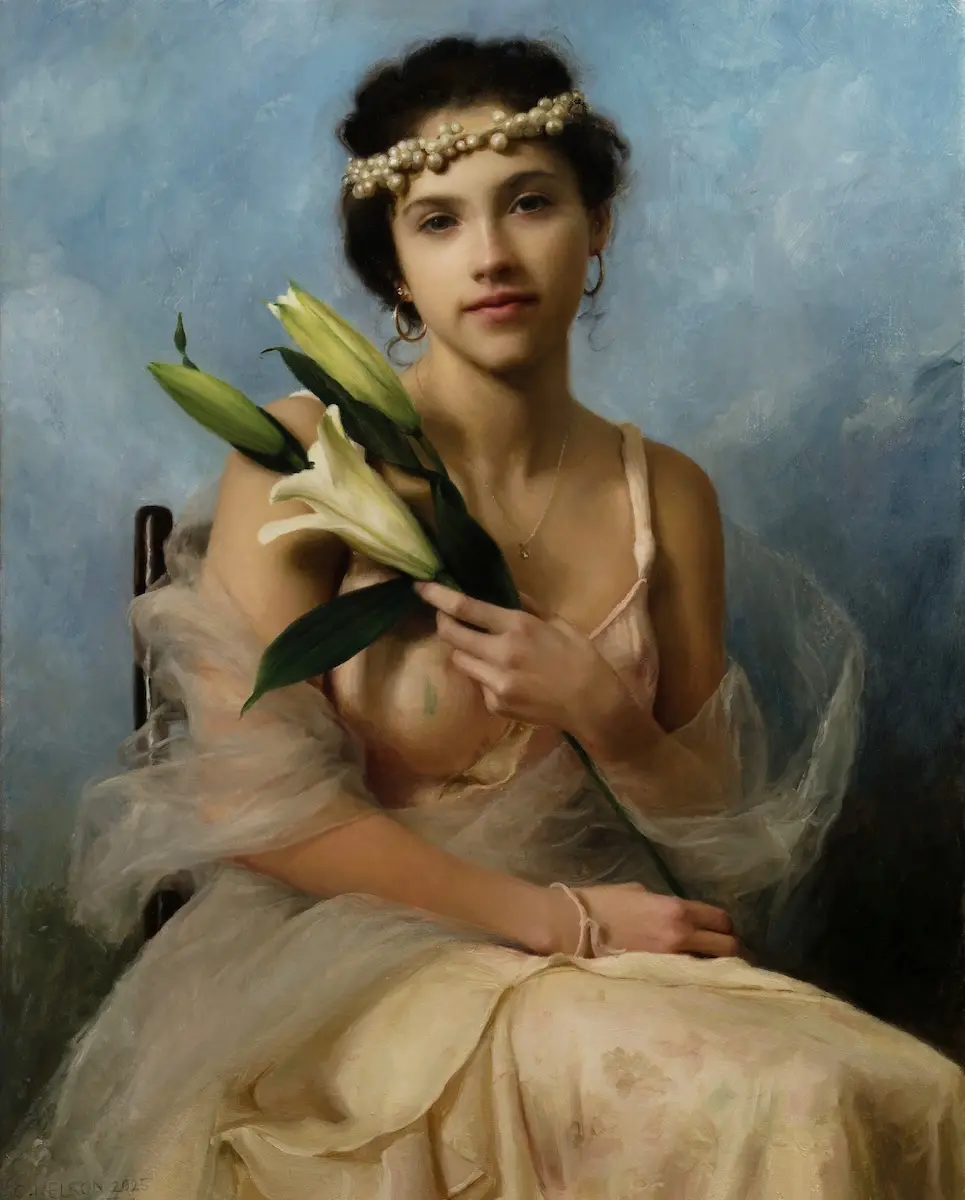
VIRGINIA — In the contemporary art market, where conceptual installations and digital mediums frequently dominate the cultural conversation, a quiet renaissance of classical realism is taking place. At the vanguard of this movement is 28-year-old Virginia-based painter Caroline Nelson. Recognized as one of the standout talents in the August/September 2026 issue of Southwest Art magazine as part of their prestigious "21 Under 31 | Young Artists to Watch" feature, Nelson has cultivated a distinctive aesthetic that bridges the timeless techniques of the 19th-century academic masters with romantic literary sensibilities.
Represented by Arcadia Contemporary in New York City, Nelson’s oils on linen—such as her striking 20-by-16-inch piece Lilies of the Field—command prices ranging from $3,000 to $20,000. Her work offers viewers an immersive escape into pastoral grace, emotional resonance, and rigorous technical draftsmanship.
Main Facts: The Art and Philosophy of Caroline Nelson
At just 28 years old, Caroline Nelson has established herself as a formidable force in the realm of contemporary representational art. Her technical execution relies heavily on painting from life, a disciplined practice that separates true realists from those who rely solely on photography.
- Medium and Dimensions: Primarily working in oil on linen, Nelson’s compositions are celebrated for their luminous skin tones, delicate fabric rendering, and harmonious color palettes.
- Aesthetic Influences: Nelson’s visual vocabulary is deeply rooted in 19th-century academic realism. She draws immense inspiration from French master William-Adolphe Bouguereau—specifically citing his masterwork The Song of the Angels as a perennial source of study.
- Literary and Cinematic Inspirations: Beyond the easel, Nelson’s worldview is shaped by period literature and cinema. She credits L.M. Montgomery’s beloved Anne of Green Gables series alongside cinematic adaptations of classic literature, such as the 1995 film Sense and Sensibility and the 2005 adaptation of Pride & Prejudice, for informing the mood and atmosphere of her paintings.
- Market Presence: With gallery representation through the renowned Arcadia Contemporary in New York, Nelson’s works are collected by patrons of classical art, with price points spanning an accessible $3,000 to a robust $20,000 depending on scale and complexity.
Chronology: The Formative Years and Artistic Evolution
Nelson’s journey to becoming a nationally recognized young realist painter is defined by rigorous, old-world mentorship and a dedication to foundational training that is increasingly rare in contemporary art education.
2018–2020: The Foundation of Classical Realism
Understanding that technical mastery cannot be fast-tracked, Nelson sought out intensive, private, full-time training in classical realism. From 2018 to 2020, she studied under the guidance of Henry Wingate. This period served as her crucible, forcing her to grapple with the complexities of sighting, value relationships, edge control, and color theory under strict academic standards.
2020–2022: Expanding Horizons at East Oaks Studio
Building upon her foundational years, Nelson transitioned to an artist-in-residence role at East Oaks Studio in Raleigh, North Carolina, where she worked from 2020 to 2022. This immersive environment allowed her to refine her brushwork, interact with a community of like-minded figurative painters, and begin translating her personal narrative and romantic inspirations onto canvas with greater confidence.
2026: National Recognition and Commercial Success
By 2026, Nelson’s dedication culminated in major national exposure. Her inclusion in Southwest Art’s "21 Under 31" cohort cemented her status as one of the most promising young artists of her generation. Working alongside premier galleries like Arcadia Contemporary, she continues to push her practice forward, balancing a demanding studio schedule with a rich personal life in Virginia.
Supporting Data: Techniques, Studio Habits, and Artistic Aspirations
A closer look at Nelson’s studio practice reveals the meticulous mechanics behind her finished canvases. Far from relying on pure intuition, her process is governed by time-tested maxims and a relentless pursuit of self-improvement.
Technical Advice and Methodologies
When asked about the best piece of art advice she has ever received, Nelson points to a deceptively simple fundamental habit: "Always remember to squint at your painting!" She explains that squinting forces the human eye to bypass excessive detail, allowing the artist to evaluate overall values, chroma, and hue in check, ensuring the canvas remains visually balanced from a distance.

The Auditory Landscape of the Studio
Music plays a vital role in dictating the rhythm of Nelson’s painting sessions. Her studio playlist reads like a masterclass in classical composition and cinematic scoring. To maintain her focus, she routinely listens to the works of:
- Claude Debussy
- Dario Marianelli
- Max Richter
- Ennio Morricone
- Pyotr Ilyich Tchaikovsky
- Howard Shore
- Antonio Lucio Vivaldi
Future Artistic Goals
Despite her early commercial and critical success, Nelson remains intensely focused on growth. Her upcoming artistic milestones involve achieving a more nuanced approach to her figurative work. Specifically, she aims to study the legendary brushwork of John Singer Sargent, hoping to integrate greater breadth in texture and a sophisticated balance of looseness and tightness in her brush-handling.
Beyond the Canvas
When she is not standing before an easel or studying museum catalogs, Nelson maintains a grounded domestic and creative life. Her passions include spending time outdoors on long walks, handcrafting intricate crepe paper flowers, cooking, and cherishing time with her husband and extended family.
Official Responses and Industry Perspectives
The inclusion of artists like Caroline Nelson in national showcases points to a broader shift in how curators, collectors, and critics view contemporary realism. While 20th-century art criticism often marginalized representational art as derivative or anachronistic, the 21st-century market has experienced a significant recalibration.
Galleries specializing in representational art, such as Arcadia Contemporary, have noted a surging demand among younger collectors for works that prioritize craftsmanship, beauty, and emotional accessibility. Nelson’s success demonstrates that contemporary audiences—weary of the ironic detachment often found in conceptual art—are increasingly hungry for sincerity, technical brilliance, and narrative depth.
Art educators and mentors who have watched Nelson’s trajectory emphasize that her willingness to embrace traditional disciplines while retaining a distinctly modern work ethic is the primary driver of her success. By marrying the structural integrity of Henry Wingate’s classical teachings with the atmospheric romance of Bouguereau, Nelson has crafted a niche that feels both nostalgic and refreshingly relevant.
Implications: What Nelson’s Rise Means for the Future of Realism
Caroline Nelson’s trajectory as a 28-year-old rising star carries several profound implications for the contemporary art landscape:
- The Resurgence of Atelier Training: Nelson’s career validates the effectiveness of the modern atelier and mentorship model. By bypassing traditional university MFA programs in favor of direct, rigorous study under established realists, younger artists are proving that classical skills can be successfully transmitted and modernized outside of institutional academic frameworks.
- Shifting Demographics in Art Collecting: The willingness of collectors to invest up to $20,000 in early-career realists under the age of 31 signals a healthy, forward-looking market. Collectors are eager to back artists who possess long-term technical growth potential.
- The Revalorization of Narrative and Beauty: In an era where digital noise and ephemeral media often dominate daily life, Nelson’s pastoral scenes, quiet domestic moments, and literary inspirations provide a psychological sanctuary. Her success suggests that art rooted in beauty, contemplation, and emotional clarity will continue to find a vital and expanding audience in the decades to come.
As Caroline Nelson continues to refine her brushwork and expand her exhibition history, she stands as a shining example of a generation of young artists redefining what it means to be a classical realist in the modern world.
