

Main Facts
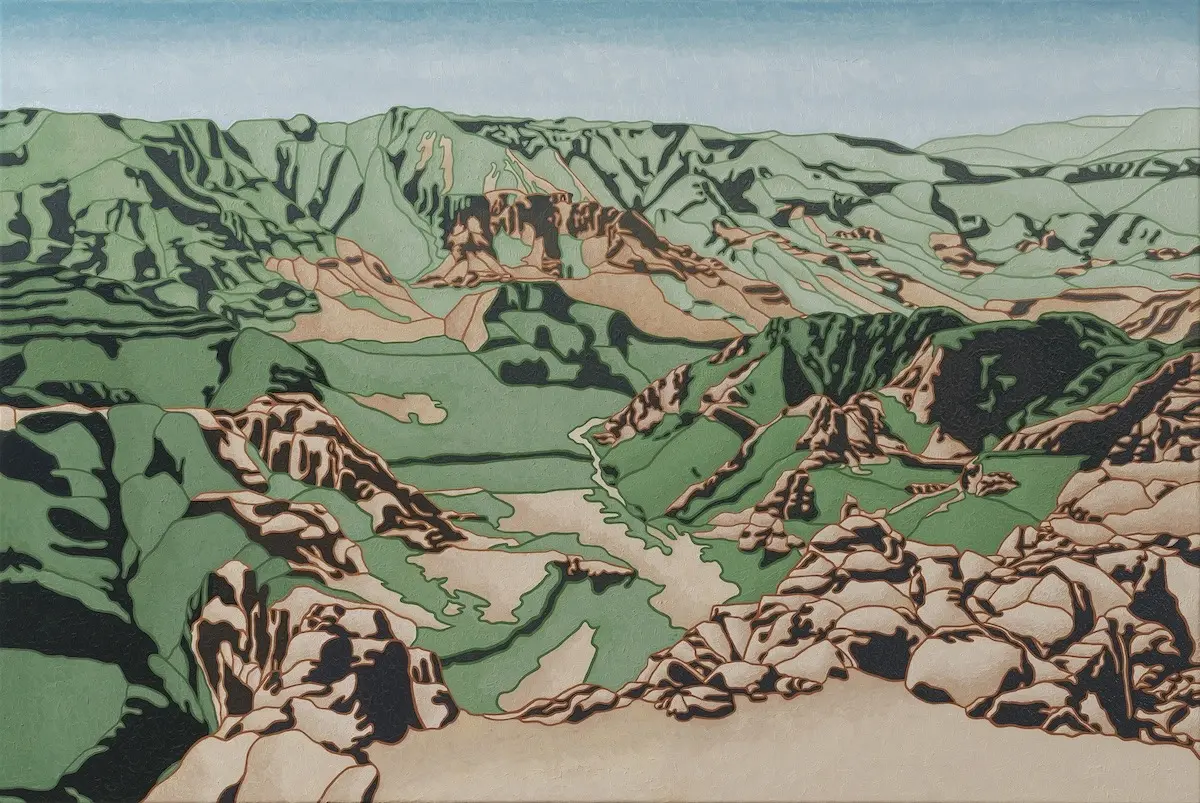
Arizona-based landscape painter Carson Bilger has established a distinct visual vocabulary that bridges the gap between sprawling natural environments and structured, conceptual design. Employing a technique known as planar analysis, Bilger breaks complex three-dimensional scenes down into a series of flat, interlocking planes. This meticulous method allows structure, light, and shadow to emerge on the canvas with the soft, evocative clarity of a faded memory.
Bilger’s artistic output is deeply rooted in human perception, memory, and the fluid nature of perspective. Fascinated by how multiple individuals can experience the exact same geographic location differently based on time, vantage point, and context, his canvases explore the coexistence of seemingly diametrically opposed concepts. Holding a Master’s degree in illustration, Bilger integrates a powerful graphic aesthetic into his fine art practice. His precise linework acts as a visual guide for the viewer’s eye, while carefully calibrated color relationships shape the underlying narrative of each piece.
Represented by the Western Gallery, Bilger’s work has garnered critical acclaim for its ability to balance graphic design principles with emotive, painterly execution. His paintings—such as the 32-by-48-inch oil on canvas Ease the Mind and the sweeping 36-by-72-inch It Would Never End—invite prolonged contemplation, offering audiences multiple visual entry points and rewarding both distant and close-range inspection.
Chronology: The Evolution of Bilger’s Artistic Process
The creation of a Carson Bilger landscape is a deliberate, multi-step journey that transitions from real-world exploration to studio-based abstraction.
- Phase One: Field Documentation and Travel
The artistic process begins outdoors. Bilger travels to various locations, immersing himself in the environment and gathering reference material through photography and direct observation. This phase ensures that every finished painting remains firmly grounded in the reality of an actual physical experience. - Phase Two: Conceptual Reduction and Sketching
Back in the studio, Bilger evaluates his documentation to select compelling compositions. He utilizes ballpoint pens for initial sketches, mapping out complex value structures in his sketchbooks. This stage is crucial for editing the sprawling landscape down to its essential geometric forms. - Phase Three: Small-Scale Color Studies
Before committing to a large canvas, Bilger produces smaller preparatory studies. While he historically relied on watercolor for these exploratory pieces, the transition to larger-format works has prompted him to shift toward acrylics, which provide a more accurate and immediate sense of color balance and intensity. - Phase Four: Final Execution in Oil
The culmination of the process takes place on large-scale canvases using oil paint. Bilger applies his planar analysis framework, building up the composition through calculated lines, textural brushstrokes, and deliberate layering. The resulting works achieve a balance between overarching structural coherence and intricate, abstract surface details.
Supporting Data and Technical Framework
To understand Bilger’s unique aesthetic, one must examine the technical scaffolding that supports his paintings. His work is governed by a strict hierarchy of space, light, and color theory.
- Spatial Hierarchy: When approaching a new landscape, Bilger’s primary consideration is spatial hierarchy. He focuses intently on how individual sections of a terrain recede into the distance to establish and define the horizon line.
- Light and Color Balance: Secondary to structure is the interplay of light. Bilger is consistently drawn to the dramatic ways shadows contrast with the natural colors of a landscape, as well as how atmospheric perspective causes distant tones to wash out.
- Planar Construction: By dissecting natural forms into planar shapes, Bilger translates the overwhelming chaos of nature into manageable visual blocks. This technique gives his landscapes a distinct architectural quality without stripping away their organic fluidity.
- Contained Abstraction: Up close, Bilger’s paintings reveal a second layer of complexity. Through blending, textural brushstrokes, and thicker applications of paint, he introduces what he terms "contained abstraction" within each individual shape. This invites viewers to appreciate the small, singular compositions that collectively build the overarching landscape.
Official Responses and Artist Perspectives
Carson Bilger’s reflections on his craft offer profound insight into the philosophy driving contemporary landscape painting. Rather than seeking pure photorealism, Bilger is interested in the psychological dimensions of seeing.

Discussing the genesis of his stylistic approach, Bilger notes:
"Over the years, my process developed so that the paintings became increasingly more accurate representations of the visions in my mind."
This evolution reflects a transition from simply recording what is visible to interpreting what is felt. The use of planar analysis—breaking three-dimensional realities into flat planes—felt inherently intuitive to him when drawing, and it provided a logical framework for translating vast landscapes onto a two-dimensional surface.
Elaborating on the thematic underpinnings of his work, Bilger explains:
"It speaks to an idea that I have been contemplating, which is that things that are diametrically opposed can coexist."
This philosophy is mirrored in his technical execution, where rigid geometric structures merge seamlessly with loose, painterly brushwork, and stark graphic lines soften into atmospheric memories. Furthermore, by designing his works with multiple visual entry points, Bilger deliberately rejects the notion of a single passive viewing experience.

"I’m trying to create a sort of contained abstraction within each individual shape," Bilger states, detailing his desire for engagement. "This way when the piece is viewed up close, the viewer can see the little, singular compositions that make up the whole."
Implications for Contemporary Landscape Art
Bilger’s methodology holds significant implications for the genre of contemporary landscape painting. In an era saturated with high-resolution digital photography and instantaneous image consumption, his work champions the value of slow, deliberate artistic processing. By filtering physical reality through the lenses of memory, graphic design, and planar geometry, Bilger challenges audiences to reconsider their own relationship with the spaces they inhabit.
His paintings suggest that a landscape is never static; it is continually re-authored by time, perspective, and personal history. As Bilger’s work demonstrates, a place can simultaneously remain "the same, but at the same time different." Through his representation with the Western Gallery and features in publications such as Southwest Art magazine, Bilger continues to expand the boundaries of how contemporary artists document the natural world, proving that structure and emotion are not opposing forces, but rather essential partners in creative expression.
For more information on Carson Bilger’s available works and upcoming exhibitions, visit his official website at carsonbilger.com or explore his portfolio via the Western Gallery.
