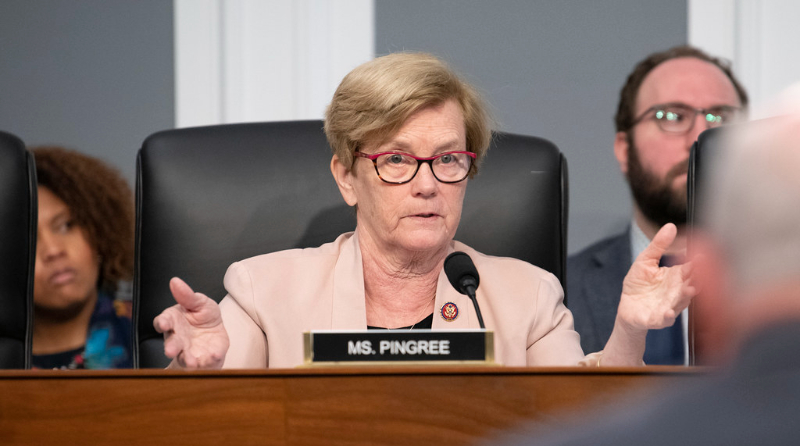
WASHINGTON, D.C. — In an escalating battle over the preparedness of America’s agricultural sector, US Representative Chellie Pingree (D-ME)—a longtime organic farmer and senior member of the House Agriculture Committee—is putting intense pressure on the US Department of Agriculture (USDA). Representative Pingree is formally demanding that the department cease its administrative delays and immediately implement a sweeping series of recommendations issued by the Government Accountability Office (GAO).
The GAO report, titled “Agricultural Diseases and Pests: Nationwide Assessment and Strategy Needed to Enhance the Climate Resilience of Farms and Forests,” paints a stark picture of a federal agency lagging far behind the accelerating curve of ecological threats. According to the findings, the USDA has taken “few actions” to fortify American farms and forests against the rapidly expanding ranges of climate-driven diseases and invasive pests. Compounding the issue, federal funding and staffing for critical frontline programs have faced severe cuts, leaving agricultural producers exposed to unprecedented economic and operational hazards.
The conflict highlights a widening chasm between federal policymaking and the harsh realities faced on the ground by farmers, ranchers, and forest landowners. As shifting weather patterns redraw the boundaries of natural habitats, lawmakers and agricultural advocates warn that bureaucratic inaction could cost taxpayers billions of dollars while destabilizing the nation’s food and timber supplies.
Main Facts: The Escalating Crisis on America’s Lands
The convergence of a warming climate and biological threats has transformed how pests and plant diseases behave across the United States. No longer confined to traditional geographic boundaries or seasonal predictability, outbreaks are initiating earlier, persisting longer, and overwhelming time-tested agricultural management strategies.
The GAO assessment underscores several critical vulnerabilities within the current federal apparatus:
Severe Lapses in Federal Action: Despite clear, long-term trends showing escalating climate and biological risks, the USDA has failed to formulate a cohesive, nationwide strategy to protect agricultural and forestry assets.
Eroding Federal Support: Programs designed to provide early warnings and practical assistance—most notably the USDA’s interagency Climate Hubs—have seen reductions in capacity and funding proposals aimed at their complete elimination.
Astronomical Historical Costs: Invasive species, plant diseases, and forestry pests cost U.S. agriculture and forestry at least $550 billion between 1960 and 2020.
Escalating Future Liabilities: Modern economic projections from 2024 indicate that shifting climatic conditions could inflate federal crop insurance payouts by an additional $300 million to $2.2 billion annually.
Geographic Range Expansion: Rising global temperatures have allowed destructive organisms, such as the southern pine beetle, to migrate hundreds of miles northward into states like Maine, threatening timber industries and compounding wildfire risks.
Chronology: How the Policy Battle Unfolded
To understand the urgency behind Representative Pingree’s recent ultimatum, it is necessary to trace the timeline of compounding environmental pressures and federal oversight reports leading up to the current confrontation.
1960–2020: The Baseline of Invasive Economic Damage
Over a sixty-year period, cumulative damages from invasive species, plant pathogens, and forestry pests inflicted at least $550 billion in direct losses on the U.S. agriculture and forestry sectors. During this era, pest management largely relied on static geographic assumptions and historical weather patterns.
The 2024 Economic Projections
Economists and climate modelers released an analysis projecting that worsening climate trends would structurally increase federal crop insurance outlays by $300 million to $2.2 billion every year. The data signaled that existing risk-mitigation frameworks were financially unsustainable under a changing climate.
The GAO Investigation and Publication (2025–2026)
Prompted by mounting losses and reports of vulnerabilities in rural communities, the Government Accountability Office launched a comprehensive nationwide review. The resulting investigation culminated in the report, Agricultural Diseases and Pests: Nationwide Assessment and Strategy Needed to Enhance the Climate Resilience of Farms and Forests (GAO-26-106756), which exposed the USDA’s lack of preparedness and identified critical gaps in national surveillance, modeling, and technical outreach.
Mid-2026: Congressional Intervention and the Proposed Appropriations Threat
As the Fiscal Year 2027 federal budget took shape, proposed funding bills targeted the USDA Climate Hubs for elimination. In response, Representative Pingree issued a formal public reprimand of the department and dispatched a direct, urgent letter to USDA Secretary Rollins, demanding the immediate adoption of the GAO’s strategic roadmap.
Supporting Data: The Financial and Ecological Toll
The argument for immediate federal intervention rests on an overwhelming body of quantitative evidence compiled by federal auditors, economists, and agricultural scientists.
The Macroeconomic Burden
The $550 billion baseline loss recorded between 1960 and 2020 illustrates that biological invasions are not isolated anomalies, but systemic drains on the U.S. economy. When combined with the projected $300 million to $2.2 billion annual spike in federal crop insurance liabilities, the cost of inaction vastly outweighs the investments required to build climate resilience.
+-------------------------------------------------------------------------+
|                  U.S. Agricultural & Forestry Threats                   |
+-------------------------------------------------------------------------+
| Historical Losses (1960–2020):    | At least $550 Billion               |
+-----------------------------------+-------------------------------------+
| Projected Annual Insurance Spike: | $300 Million to $2.2 Billion / year |
+-----------------------------------+-------------------------------------+
| Primary Driver:                   | Climate-driven pest range expansion |
+-------------------------------------------------------------------------+
On-the-Ground Realities in Northern Ecosystems
In states like Maine, the economic and cultural reliance on healthy working lands brings these statistics into sharp focus. Local producers report spending thousands of private dollars out of pocket to install protective netting, high tunnels, and enhanced physical barriers against unprecedented waves of insect populations. Furthermore, erratic precipitation—ranging from unseasonal late freezes and torrential rainfall to severe droughts—has combined with pest pressures to decimate harvests.
In the forestry sector, the northern migration of the southern pine beetle has introduced catastrophic tree mortality to regions unequipped to handle the pest. Dead and decaying timber creates a hazardous feedback loop, leaving northern forests increasingly vulnerable to subsequent insect infestations and destructive wildfires.
Official Responses: Rep. Pingree’s Ultimatum to USDA Secretary Rollins
Representative Pingree’s letter to USDA Secretary Rollins serves as both a critique of past institutional inertia and a blueprint for immediate administrative correction. Highlighting the lived experiences of farmers and foresters, Pingree underscored that climate change is an active, daily crisis rather than a distant policy debate.
"Farmers, ranchers, and foresters know all too well that the impacts of climate change are not distant or theoretical—they are already materializing on the ground and affecting their operations and livelihoods," Pingree wrote to Secretary Rollins.
The Congresswoman targeted the degradation of the USDA’s Climate Hubs, which were originally established to act as a bridge between cutting-edge scientific research and practical, regional agricultural applications.
"They’re shedding the expertise needed to confront these threats… and, instead, are trying to eliminate funds for Climate Hubs in the proposed fiscal year 2027 Agriculture Appropriations Bill. That is dangerously shortsighted."
Pingree emphasized that the GAO report provides a clear, actionable roadmap that requires zero legislative invention—only political will and administrative execution. She urged the USDA to initiate a comprehensive, nationwide risk assessment in close partnership with agricultural stakeholders, establishing an analytical baseline to protect rural economies.
Implications: A Practical Roadmap for the Future
The GAO report outlines four primary pillars that must form the foundation of any credible national strategy. According to federal auditors and agricultural experts, the USDA must act immediately on these core activities to safeguard domestic food security and forestry assets:
Improve and Coordinate Monitoring and Surveillance: Establishing robust early-detection networks to track the movement of invasive species and plant pathogens before local outbreaks spiral out of control.
Incorporate Climate Information into Modeling and Projection Data: Upgrading predictive analytics to account for shifting temperature zones, volatile precipitation patterns, and ecological tipping points.
Coordinate and Expand Education, Outreach, and Technical Assistance: Restoring and fully funding entities like the USDA Climate Hubs to ensure that actionable data and mitigation tools directly reach farmers, ranchers, and foresters.
Modify Existing or Develop New Pest Management Strategies: Transitioning away from outdated agricultural protocols and investing in modern, resilient practices capable of withstanding the pressures of a warming world.
The Broader Stakes for American Agriculture
The friction between congressional oversight and departmental execution is emblematic of a broader national challenge: aligning federal bureaucracy with the rapid velocity of ecological disruption. Without a coordinated, federally backed response, individual producers will continue to bear an unfair share of adaptation costs, driving up food prices, destabilizing rural economies, and draining public disaster-relief funds.
As the debate over the Fiscal Year 2027 budget intensifies, the pressure on the USDA to pivot toward proactive resilience has never been higher. For America’s farmers, ranchers, and forest landowners, the choice is clear—adapt to the realities of a changing climate through strategic federal partnership, or face mounting, irreversible losses in the fields and forests that sustain the nation.