

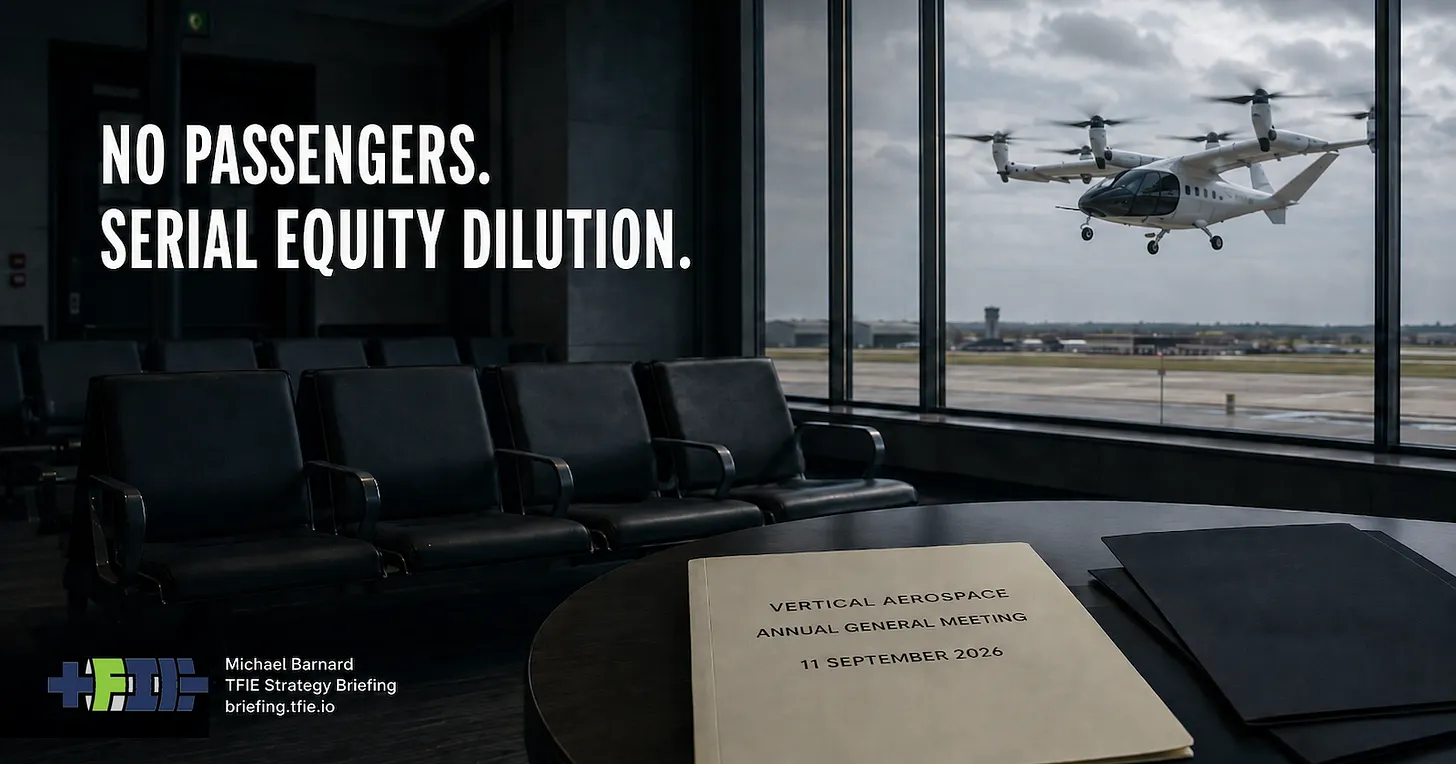
The evolution of advanced air mobility (AAM) has long been defined by a tense duality: the undeniable brilliance of aerospace engineering versus the unforgiving mechanics of commercial markets. This dynamic was brought into sharp focus at the Farnborough International Airshow, where Vertical Aerospace executed a critical flight test that captivated aviation enthusiasts and investors alike. Yet, beneath the celebratory veneer of successful public demonstrations lies a complex web of financial repositioning, shifting capital structures, and persistent questions regarding the viability of an unproven passenger market.
Five years after its public market debut, Vertical remains heavily reliant on outside capital to fund its path toward certification, now targeted for 2029. While the company’s recent technological progress is real and verifiable, the broader discourse surrounding the electric vertical takeoff and landing (eVTOL) sector highlights a widening chasm between engineering triumphs and commercial execution.
Main Facts: The Farnborough Milestone and Financial Realities
Vertical Aerospace’s July appearance at the Farnborough International Airshow marked a watershed moment for the company’s engineering division. For the first time in a public setting, the firm demonstrated a fully piloted transition between vertical lift and wingborne flight. In the realm of powered-lift aircraft, this maneuver is not merely a technical checkbox; it is the ultimate rite of passage. An aircraft of this class must execute the transition safely, predictably, and repeatedly before aviation authorities will even consider advancing the certification process.
Following this breakthrough, Vertical flew its aircraft on successive days before a large, public audience. Industry observers rightly heralded the event as genuine engineering progress. However, industry analysts caution against conflating technical milestones with commercial validation.
The Farnborough demonstrations did not achieve the following market milestones:
- Put paying passengers into routine commercial service.
- Established sustainable commercial utilization rates.
- Demonstrated that passenger revenue can independently support the aircraft, its ongoing operations, and the extensive ground infrastructure required to maintain it.
These commercial uncertainties remain entirely separate from the question of whether brilliant aerospace engineers can successfully design an aircraft to fly. While the flight tests successfully narrowed technical uncertainty, they did very little to resolve the profound commercial ambiguity facing the nascent eVTOL sector.
Chronology: From 2021 Public Listing to the 2026 AGM
To understand how Vertical arrived at its current juncture, one must examine the timeline of its financial evolution since entering the public markets.

- November 2021: Vertical Aerospace officially listed on the New York Stock Exchange (NYSE) following a merger with Broadstone Acquisition Corp. At the time, leadership projected that approximately $300 million in transaction proceeds and convertible senior secured notes would comfortably exceed the roughly $250 million needed to fund operations through type certification and scaled production.
- September 2024: Faced with persistent downward pressure on its share price and a looming conflict with the NYSE’s $1 minimum trading threshold, Vertical implemented a one-for-ten reverse share split. This move was designed to restore compliance and stabilize the stock’s nominal value.
- February 2026: Market analysts assessing the broader electric aviation landscape noted a growing divergence: while eVTOL regulatory certification pathways were finally gaining credibility, the commercial runway and underlying demand models remained stubbornly unconvincing.
- July 2026: Vertical triumphed at the Farnborough International Airshow, successfully executing piloted transitions from vertical to wingborne flight in front of international crowds.
- August 2026: Shortly after its airshow success, Vertical announced an additional ~$100 million in financing. Its H1 2026 business update indicated that cash reserves, new financing commitments, and anticipated facility draws would provide at least 12 months of operational runway while development spending continued.
- September 11, 2026: Vertical’s Annual General Meeting (AGM) convened under the shadow of renewed scrutiny regarding its share price hovering near the NYSE’s $1 continued-listing threshold, forcing common shareholders and leadership to confront the realities of the company’s capital structure.
Supporting Data: Capital Burn, Dilution, and Runway
The financial trajectory of Vertical Aerospace provides a fascinating case study in the cost of developing a novel category of aircraft. When the company went public in 2021, the investment proposition was relatively straightforward: public market proceeds would act as the primary bridge to commercialization.
Five years later, that initial financing model has evolved significantly. Aerospace development schedules are notorious for slipping, and development budgets routinely expand. Vertical’s H1 2026 business update underscored this reality, revealing that while the newly secured $100 million in financing provides a vital 12-month runway, the company is still actively burning capital on three major fronts:
- Regulatory Certification: Navigating the rigorous safety and compliance standards mandated by aviation authorities like the UK CAA and the EASA.
- Manufacturing Readiness: Establishing the industrial footprint required to transition from prototype builds to serial production.
- Hybrid-Electric Development: Expanding technological capabilities beyond pure battery-electric models to address broader market demands.
This ongoing need for capital is not, by itself, an indicator of imminent failure. Development-stage aerospace programs are among the most capital-intensive industrial endeavors on Earth, and a company that retains the ability to secure funding clearly maintains strategic options. However, it does signify that the program has not yet made the critical transition from investor-backed development to customer-funded operations.
Over time, Vertical’s capital structure has grown increasingly complex. The firm has shifted away from simple equity toward a hybrid mix of common equity, convertible securities, preferred capital, and committed financing facilities. Each financial instrument carries distinct implications regarding dilution, control, and priority claims in the capital stack. For common shareholders, this layered financing architecture means that the path to certification is inextricably linked to ongoing equity dilution and market maneuvers.
Official Responses and Industry Perspectives
The challenges facing Vertical Aerospace are emblematic of a wider debate within the advanced air mobility sector. Developers across the globe enjoy an unusually rich calendar of legitimate technical milestones: initial hovers, untethered flights, wingborne transitions, regulatory sign-offs, airshow spectacles, factory groundbreakings, and provisional airline pre-orders. Each of these events provides fertile ground for media cycles and valuation narratives.
However, seasoned aviation analysts argue that the foundational premise of urban air mobility differs fundamentally from traditional regional aviation. When a conventional regional aircraft program faces financial or technical hurdles, its ultimate target market is already well-defined. It relies on pre-existing airports, established flight routes, and a mature base of airline passengers whose travel habits require no invention.
In contrast, urban and premium eVTOL passenger services are tasked with a double burden: they must not only prove the airworthiness of an entirely new vehicle architecture, but they must also cultivate and prove the existence of an entirely new mass passenger market. This market must ultimately be large enough to amortize the staggering costs of development, certification, industrialization, operations, and specialized urban infrastructure (vertiports).

As industry observers note, successive financing rounds are not inherently an indictment of a company’s potential. Commercial aircraft development is brutally expensive, and historical precedents show that even successful programs require immense financial backing. Yet, the ultimate denominator remains the market’s capacity to repay that capital. Whether Vertical can bridge the gap between its impressive engineering feats and a sustainable commercial ledger remains the defining question of its corporate life.
Implications: What the September AGM Reveals
The convergence of events surrounding Vertical’s September 11 Annual General Meeting brings the tensions of the eVTOL sector into sharp relief. With the company’s stock price once again testing the limits of the NYSE’s $1 minimum-price threshold, the optics of market valuation have intersected directly with operational necessity.
While the NYSE framework provides a structured cure process—and a future share-price recovery or compliance action remains entirely possible—the timing of the AGM underscores a deeper truth. Vertical continues to require substantial external capital, and its listed equity remains a vital mechanism within its financing toolkit. Consequently, the health of the stock is far more than a superficial metric; it directly influences the company’s financial flexibility.
Ultimately, Vertical Aerospace may very well achieve its goals. The company may successfully restore exchange compliance, secure additional capital rounds, and ultimately achieve type certification for its aircraft. Any of these milestones would represent a monumental achievement in modern aerospace engineering.
However, none of those outcomes will automatically establish the long-term size, pricing power, or profitability of the urban passenger market it seeks to serve. Farnborough successfully pushed the engineering case forward; however, five years of continuous recapitalization demonstrate why the commercial case demands its own rigorous, independent test.
