

Main Facts
When evaluating the cutting edge of grid-scale energy storage, industry stakeholders often look toward novelty solutions that promise to circumvent the supply chain constraints and degradation issues associated with conventional electrochemical batteries. Among the most publicized of these alternatives is Energy Vault’s gravity-based energy storage system (GESS).
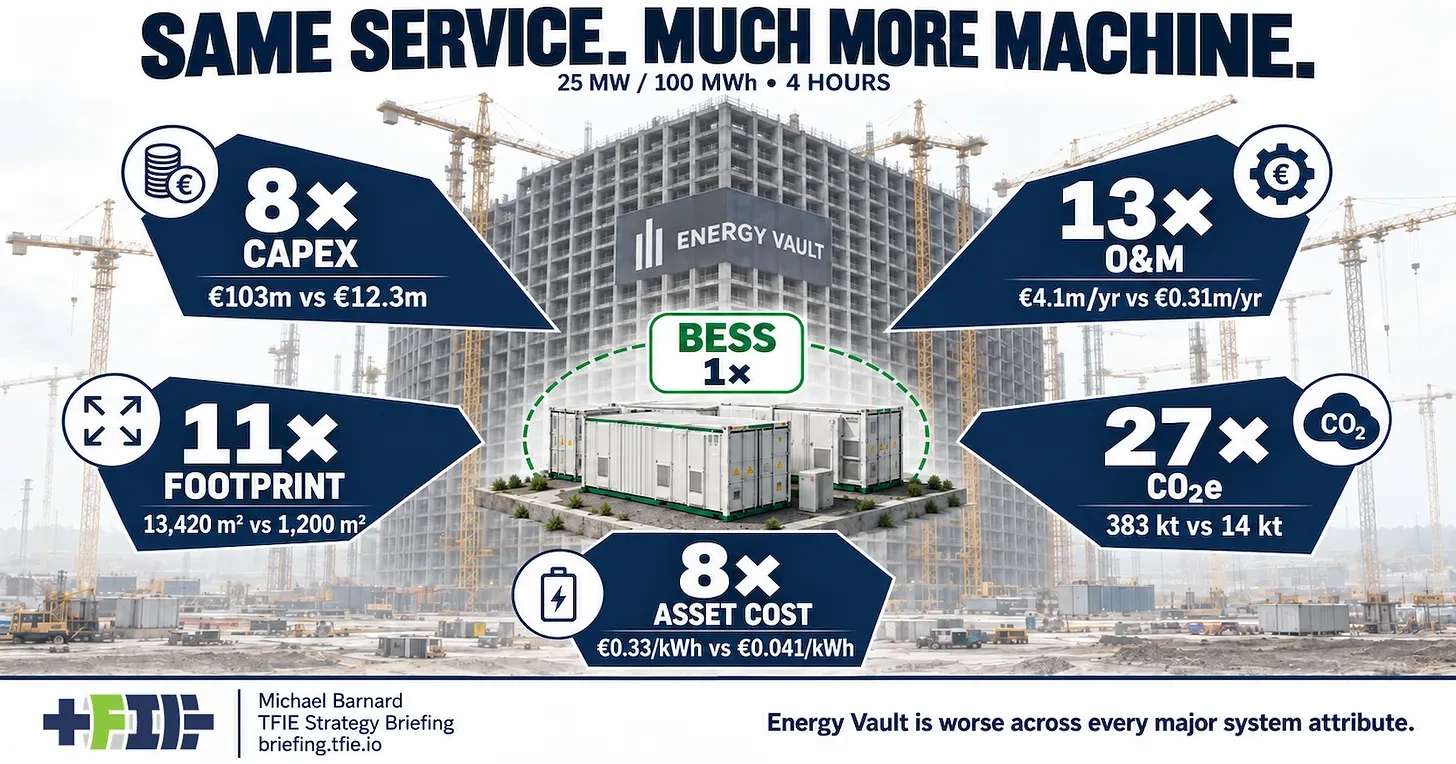
Constructed in Rudong, China, the flagship 25 megawatt (MW) / 100 megawatt-hour (MWh) four-hour gravity storage project serves as a definitive test bed for the technology. However, a rigorous comparative analysis reveals a striking economic and logistical disparity. Delivering the exact same four-hour energy service profile as a contemporary Battery Energy Storage System (BESS), the Rudong gravity installation demands vastly more capital expenditure, physical land footprint, specialized heavy machinery, and initial construction-phase carbon intensity than standard lithium-ion infrastructure deployed in the same regional market.
The facility itself is an imposing piece of civil engineering. Rising approximately 148 meters into the skyline, the Rudong tower utilizes more than 12,000 individual, roughly 25-ton composite blocks, 96 distinct lifting mechanisms, and thousands of deep-bored foundational piles. Despite achieving structural completion and targeted grid synchronization milestones, the sheer scale of the mechanics required to capture and discharge electricity via the controlled elevation and lowering of solid masses raises critical questions regarding economic viability, spatial efficiency, and net carbon debt.
Chronology of Development
The trajectory of Energy Vault and its flagship mechanical storage concept reflects the shifting tides of the broader clean technology sector over the past decade:
- The Crane Concept Era: Energy Vault initially gained widespread attention with its uncontained, six-arm crane architecture designed to stack concrete blocks around a central hub.
- The SPAC Boom and EVx Pivot: Capitalizing on the clean-technology Special Purpose Acquisition Company (SPAC) boom of the early 2020s, the company went public and subsequently transitioned toward its enclosed EVx structural architecture to mitigate environmental and operational vulnerabilities.
- The Rudong Construction Phase: Benefiting from China’s robust industrial supply chains, governmental coordination, and experienced domestic construction partners, the Rudong project was initiated to prove that solid-mass gravity storage could be scaled up for utility use.
- Grid Interconnection Targets: Although full grid interconnection and commissioning phases were projected for completion by late 2023, ongoing tracking by technical analysts indicates that the project’s transition to routine commercial operation has faced the protracted validation periods typical of first-of-kind civil infrastructure.
- Diversification into BESS Integration: Concurrently, Energy Vault’s corporate evolution has seen it pivot away from being a pure-play gravity-storage developer. Today, the corporation functions primarily as a heavily capitalized battery-storage integrator, with its proprietary gravity systems representing only a fractional portion of an expanded, diversified project portfolio that includes conventional lithium-ion assets and microgrid initiatives.
Supporting Data and Comparative Metrics
To understand why gravity storage struggles to compete on a level playing field, one must examine the physical and financial denominators relative to standardized electrochemical installations.
In modern energy markets—particularly in China, which boasts a deeply mature and rapidly standardizing manufacturing base for grid infrastructure—four-hour BESS solutions are routinely procured off the shelf. For example, contemporary deployments utilizing integrated hardware like Sungrow’s PowerTitan 2.0 package 5 MWh of battery capacity alongside 2.5 MW of power conversion systems into compact, standardized 20-foot AC blocks. A complete 100 MWh utility-scale station utilizing this technology requires a minimal land footprint of roughly 1,200 square meters.

In stark contrast, the tower footprint of Energy Vault’s Rudong project occupies an area approximately eleven times larger than its BESS equivalent. Furthermore, preliminary strategic briefings and techno-economic evaluations indicate that the central capital expenditure (CapEx) for the gravity tower is roughly eight times higher than that of an equivalent contemporary Chinese battery installation.
When factoring in the ongoing operations, maintenance (O&M) liabilities associated with thousands of moving mechanical parts, and the massive embodied carbon footprint of pouring structural concrete and driving deep piles, the economic advantages begin to erode. While the composite blocks themselves can theoretically be manufactured from low-value waste materials and do not suffer from electrochemical degradation or cell thermal runaway, the storage medium must not be confused with the storage system. The heavy infrastructure required to move those blocks reliably for decades introduces a level of capital and carbon intensity per kilowatt-hour that rivals fossil-fuel peaker plants.
Official Responses and Industry Perspectives
Public statements from Energy Vault frame the Rudong installation as a monumental milestone in mechanical engineering and long-duration energy storage diversification. The company emphasizes the inherent durability of composite gravity blocks, noting that unlike lithium-ion chemistry, solid mass does not chemically degrade over time, offering a theoretical operating lifespan stretching across decades without capacity fade.
Conversely, independent market analysts, energy strategists, and engineering firms have urged caution, pointing out that technical resilience at the component level does not automatically translate to commercial competitiveness at the system level. Experts argue that while Rudong successfully answers the "easy question"—proving that block-based gravity storage can be engineered at utility scale—it simultaneously exposes the much harder economic reality.
Critics maintain that utilities and project developers have little incentive to absorb the immense mechanical complexity, extended construction timelines, and heightened capital risks of an artificial mountain when factory-assembled battery modules can achieve identical performance metrics within a fraction of the space and budget.
Implications for the Future of Grid Storage
The lessons learned from the Rudong gravity-storage project extend far beyond Energy Vault’s corporate balance sheet, offering critical insights for the global energy transition:

1. The Superiority of Manufactured Modularity
The rapid cost deflation and manufacturing scalability of electrochemical batteries demonstrate the immense value of factory-built modularity over bespoke civil engineering projects. When energy storage can be mass-produced, shipped in standard containers, and deployed rapidly, custom-built mechanical structures struggle to compete on levelized cost of storage (LCOS).
2. Redefining the Carbon Debt
While non-lithium alternatives are frequently marketed as environmentally pristine, the initial carbon debt of heavy civil infrastructure—such as the massive amounts of concrete, steel, and foundational piling required for gravity towers—must be amortized over the operating life of the asset. In many cases, this upfront emissions profile rivals or exceeds that of cleaner, more efficient manufacturing paradigms.
3. The Realities of Mechanical Duty Cycles
The engineering challenges of maintaining thousands of heavy moving objects—including lifts, motors, brakes, transmissions, and control sensors—under continuous cycling conditions introduce complex maintenance profiles. Unlike solid-state electronics, mechanical systems are subject to friction, wear, and tear that necessitate rigorous, ongoing intervention.
Ultimately, the Rudong project is not an engineering failure; erecting a structure of that magnitude and synchronizing its complex lifting machinery represents a legitimate technical achievement. However, as the energy storage market matures into a highly standardized commodity sector, the industry’s trajectory points decisively toward solutions that maximize simplicity, minimize capital exposure, and deliver rapid scalability.
