

By Global Metaphysical & Esoteric Desk
ORLANDO, FLORIDA — In the realm of human consciousness, few phenomena remain as deeply personal yet universally baffling as dreams that transcend ordinary subconscious processing. While standard psychological models attribute nocturnal visions to random neural firings or emotional offloading, a subset of dreamers report experiences so startlingly vivid, coherent, and predictive that they defy conventional scientific categorization.
For Gregg Prescott, M.S., founder and editor of the spiritual portal In5D, a series of profound nocturnal visions recorded over a decade ago continues to challenge mainstream perceptions of reality, soul contracts, and the mechanics of human incarnation. Revisiting a meticulously detailed dream entry from January 23, 2012, Prescott offers a rare, first-person look into what many esoteric philosophies describe as "the other side of the veil."
Main Facts: The 2012 Dream Journal Entry
At the core of Prescott’s narrative is a transcribed dream sequence from 2012 that details the pre-birth preparation stage—a transitional zone where souls allegedly orchestrate their upcoming lifetimes.

According to the journal entry, the dream featured several stark elements:
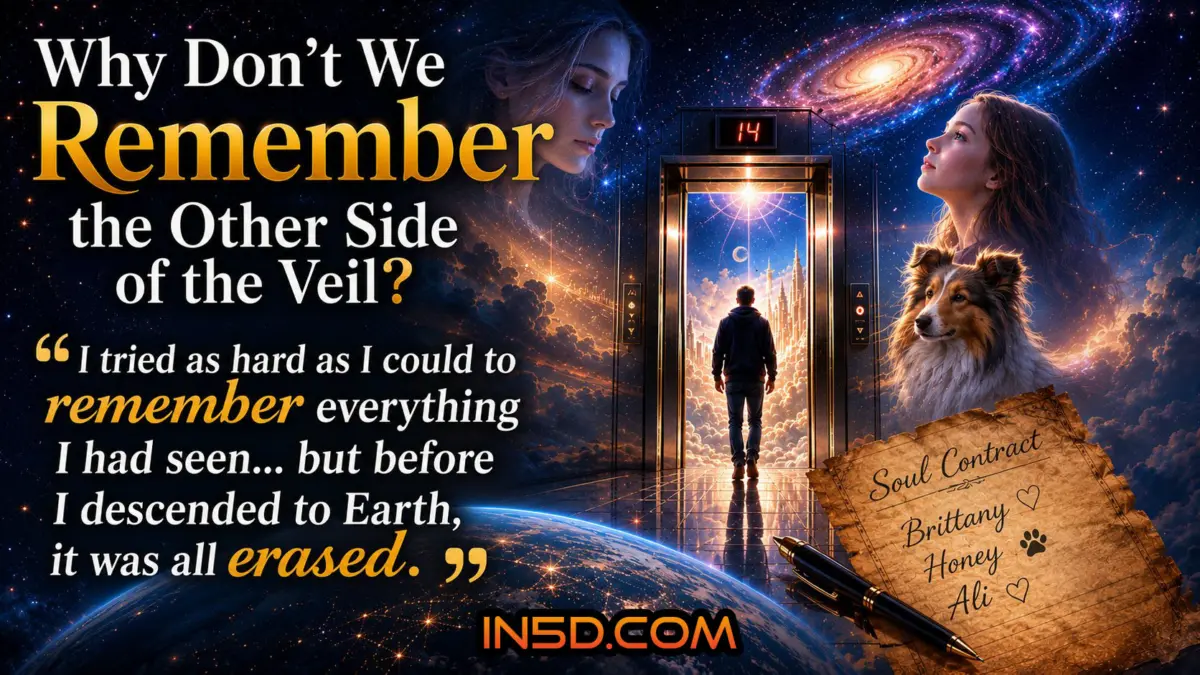
- Pre-Incarnation Soul Contracts: Prescott describes viewing a literal contract or agreement outlining specific terrestrial relationships and milestones. Within this vision, he distinctly observed the name of his future daughter, Brittany, alongside a specific childhood pet, a Shetland Sheepdog named Honey.
- The Descent and Erasure Mechanism: Before entering the physical realm, the dreamer reports being subjected to a memory-wiping protocol designed to sever conscious recollection of the non-physical dimension.
- The "14th Floor" Metaphor: Prescott describes entering an elevator-like structure representing a downward descent from a higher-dimensional state (perceived in the dream as the 14th dimension) into a dense 3rd-dimensional reality.
- The Testing Phase: The dream sequence included a transitional test to ensure that memory deletion protocols were successful, suggesting that retaining too much pre-birth awareness would necessitate a return to clear the consciousness slate entirely.
Years after waking from this experience, Prescott noted striking synchronicities: the names and entities previewed in the dream manifested precisely in his waking life, from his daughter Brittany to his childhood dog Honey.
Chronology: A Lifelong Journey Into Metaphysical Exploration
To understand the weight of Prescott’s 2012 dream journal entry, it is necessary to examine the timeline of his spiritual and professional trajectory:
- Pre-2009 (The Foundation): Prescott spent years navigating conventional academic and professional spaces, holding a Master of Science degree while quietly harboring an interest in esoteric philosophy, metaphysics, and the nature of consciousness.
- 2009 (The "Galactic Download"): A profound spiritual awakening—which Prescott frequently refers to as a "galactic download"—catalyzed a massive shift in his life direction. This catalyst led directly to the founding of In5D.com, a digital hub dedicated to alternative spirituality, metaphysics, and consciousness research.
- January 23, 2012 (The Critical Dream): Amidst a regular practice of tracking and journaling nocturnal visions, Prescott records the detailed pre-incarnation dream involving soul contracts, dimensional descent, and memory scrubbing. Over subsequent years, elements of this dream materialize in his personal life, validating the uncanny familiarity of the vision.
- 2012–2026 (The Expansion of In5D): Over a span of 17 years, Prescott documents thousands of anomalous spiritual experiences, expanding his platform into a multi-channel network spanning YouTube, social media platforms, and live events.
- Mid-2026 (The In5D Infinite App Launch): Capitalizing on decades of documentation philosophy, Prescott launches the In5D Infinite application on Google Play (with an iOS version forthcoming). The application is purposefully designed not to interpret user dreams, but to serve as a digital sanctuary where individuals can record and preserve fleeting spiritual breakthroughs, synchronicities, and nocturnal memories before they fade.
Supporting Data: The Science and History of Anomalous Dreams
While mainstream science—particularly neurobiology—views dreams primarily through the lens of memory consolidation, emotional regulation, and threat simulation, historical and parapsychological data reveal a long-standing human fascination with "transcendent" or "lucid" architecture.

The Role of Dream Journaling in Scientific Inquiry
Psychologists dating back to Sigmund Freud and Carl Jung recognized the immense value of tracking nocturnal visions, though their interpretations differed wildly. Jung, in particular, argued that dreams tap into a "collective unconscious," containing archetypes and inherited patterns that transcend individual lived experience.
Modern sleep laboratories confirm that during Rapid Eye Movement (REM) sleep, the brain exhibits electrical activity remarkably similar to waking consciousness. However, anomalies arise when subjects report hyper-lucid states—dreams characterized by hyper-real sensory input, absolute emotional clarity, and linear narratives that outlast standard dream-fade.
Cross-Cultural Pre-Birth Memories
Prescott’s dream touches upon a recurring motif found across various esoteric traditions: the concept of the "forgetting veil."
- Platonic Philosophy: In the Myth of Er from Plato’s Republic, souls drink from the River Lethe (Forgetfulness) before reincarnating, wiping their memory of the heavenly realm so they can exercise true free will on Earth.
- Eastern Traditions: Concepts of Samsara and the bardo states in Tibetan Buddhism similarly deal with the transitional phases between lives and the obscuring of past-life memories.
- Modern Parapsychology: Researchers studying children who claim to remember past lives (such as the late Dr. Ian Stevenson at the University of Virginia) have documented recurring themes of pre-birth planning, selection of parents, and the eventual fading of these memories as the child ages.
Official Responses and Metaphysical Perspectives
Because metaphysical and esoteric claims regarding soul contracts and dimensional descent operate outside the empirical boundaries of conventional hard science, institutional scientific bodies generally classify these narratives as subjective psychological constructions, vivid paramnesias (distortions of memory), or imaginative fiction.

However, within the alternative spirituality and consciousness communities, the response to Prescott’s work—and the core premise of his 2012 dream—taps into a growing appetite for existential meaning.
The Alternative Viewpoint
Proponents of metaphysical inquiry argue that dismissing such dreams outright ignores the transformative psychological utility they provide. From this perspective:
- Existential Frameworks: Believing in a pre-incarnation plan gives individuals a framework to find meaning in suffering, trauma, and life challenges. If trials are viewed as chosen curriculum rather than random cruelty, psychological resilience often increases.
- The Purpose of Forgetting: As Prescott notes in his journal, retaining total awareness of a blissful non-physical existence might nullify the developmental purpose of Earth life. Without the veil of forgetfulness, human choices would lack genuine risk, faith, and organic discovery.
- Synchronicity as Validation: When internal visions align with external reality—such as Prescott’s identification of his daughter’s name or childhood pets years before their active presence—observers often point to these moments as experiential proofs of non-linear time and interconnected consciousness.
Implications: Why Remembering Matters in a Materialist World
The publication and ongoing discussion of Prescott’s 2012 dream carry several broad implications for how individuals navigate their spiritual awakening and psychological health in the 21st century.
1. Shifting From Answers to Questions
One of the central tenets emphasized by veteran researchers like Prescott is that spiritual experiences do not require universal scientific validation to hold personal value. The true utility of a profound dream or synchronicity lies not in forcing others to believe it, but in the quality of the introspective questions it generates:

- Who am I beneath the conditioning of modern society?
- What lessons am I currently navigating, and what might my deeper purpose be?
- How do my subconscious insights guide my waking choices?
2. The Preservation of Ephemeral Insights
Human memory is notoriously fragile. Psychological studies indicate that individuals forget roughly 50% of a dream within five minutes of waking, and up to 90% within ten minutes. For those who experience profound intuitive flashes, lucid dreams, or synchronistic events, the inability to capture these moments often results in the erosion of valuable self-knowledge.
By shifting tools like the In5D Infinite app into the hands of seekers, the movement toward digital and analog self-documentation gains momentum. Preserving these fragments allows individuals to track patterns, identify long-term personal growth arcs, and connect psychological dots that might otherwise be lost to the relentless pace of daily life.
3. Redefining the Human Narrative
Ultimately, whether one interprets experiences like Prescott’s through a lens of quantum consciousness, dimensional physics, deep Jungian psychology, or spiritual metaphysics, the underlying takeaway remains consistent: human identity is far more layered than materialist paradigms suggest.
As society grapples with rapid technological advancement, artificial intelligence, and existential shifts, the internal landscape—our dreams, our intuition, and our search for origin—remains the final frontier. In the words of Prescott, the ultimate mystery may not be whether we lived before, but rather how much we have forgotten since we arrived, and how tools of mindfulness and memory can help us gently wake up from the dream of waking life.
