

Main Facts
The human subconscious remains one of the final true frontiers of modern science and metaphysics. While neuroscientists categorize dreaming as a byproduct of neural activity, rapid eye movement (REM) cycles, and memory consolidation, millions of individuals across the globe report experiences that transcend ordinary cognitive recycling. Among these are recurring, hyper-realistic dreams featuring locations never visited in waking life, yet greeted with an overwhelming, visceral sense of familiarity—a profound sensation of "coming home."
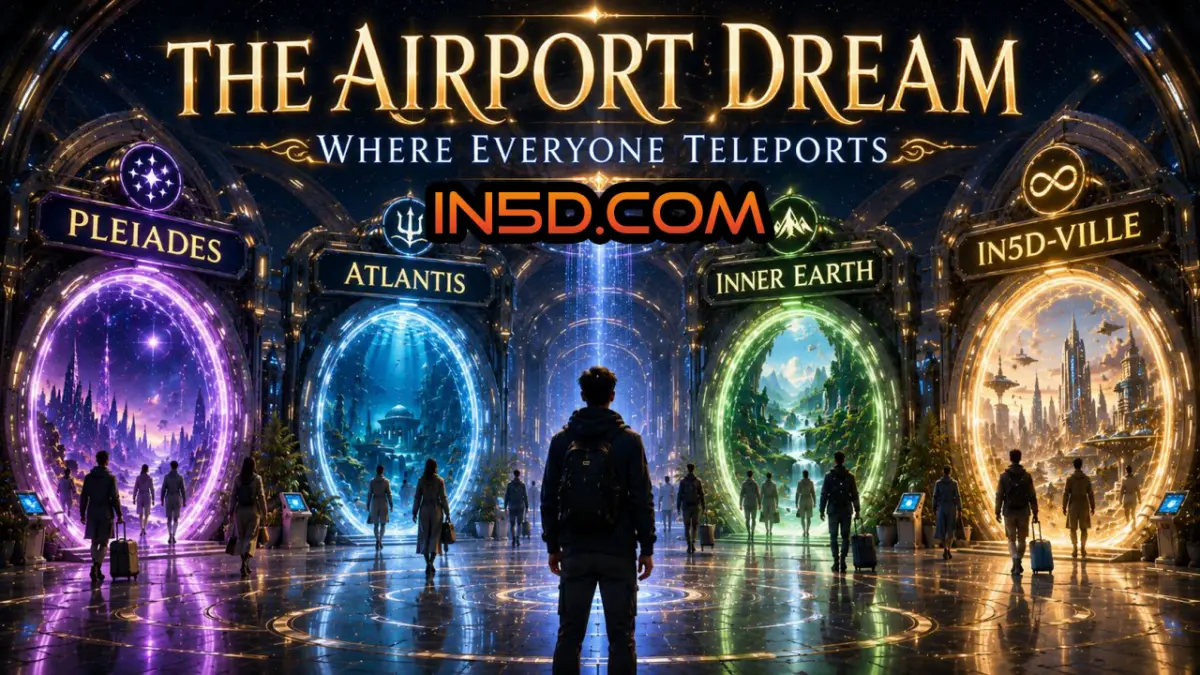
In January 2014, In5D.com founder and researcher Gregg Prescott experienced a paradigm-shifting dream that highlights this phenomenon. Standing inside a sleek, architectural environment resembling a modern transit hub or airport, Prescott observed an entirely different mode of operation: zero airplanes, runways, or boarding gates existed. Instead, the occupants of this space seamlessly teleported from one location to another. Crucially, neither Prescott nor the other individuals in the dream experienced shock or confusion; the instantaneous relocation felt entirely natural, intuitive, and orderly.
Key elements of this phenomenon include:
- The Illusion of Distance: In these specialized states of consciousness, spatial barriers are dissolved, allowing the mind to conceptualize instantaneous travel over vast, unimaginably remote distances.
- The "Homecoming" Effect: Subjects report an absolute lack of alienation in entirely foreign landscapes, suggesting a deep-seated memory of spaces unrelated to terrestrial waking reality.
- The Pattern Recognition Deficit: Human beings typically evaluate dreams as isolated, ephemeral events, failing to chart the longitudinal data that connects symbolic motifs across decades of sleep.
Chronology of an Ongoing Phenomenon
To understand how individual anomalies become collective subjects of study, we must examine the progression of dream research, metaphysical exploration, and the evolution of digital consciousness tracking.
- Pre-2010s (The Era of Isolated Subjectivity): For decades, dream analysis relied heavily on handwritten journals, fragmented morning recollections, and subjective interpretations derived from psychoanalytic frameworks. Dreamers noted recurring motifs—such as flying, falling, or navigating non-existent cities—but lacked tools to cross-reference these experiences across long spans of time.
- January 2, 2014 (The Transit Hub Experience): Gregg Prescott experiences the pivotal "teleportation airport" dream. Unlike typical anxiety or fantasy-based dreams, this vision carries a distinct emotional signature of familiarity and profound anticipation of deep-space travel without traditional mechanics.
- The 2010s to 2020s (The Rise of Metaphysical Data Collection): With the proliferation of digital platforms dedicated to esoteric research, millions of global users share striking synchronicities regarding alternate realities, futuristic architectures, and portals encountered during sleep.
- The Present Era (Algorithmic Consciousness Mapping): Recognizing that human memory inherently fails to connect long-term patterns, developers and researchers begin introducing technology designed to catalog subconscious data. The official release of tools like the In5D Infinite application marks a shift toward treating dream archives as chronological data sets rather than fleeting thoughts.
Supporting Data and the Science of Subconscious Patterns
While mainstream science attributes dreams to chaotic brainstem signaling, anomalies within quantum consciousness theories and parapsychology suggest that the sleeping mind may interface with non-local dimensions of reality.
The Problem with Human Memory Retention
Psychological studies consistently demonstrate that humans forget approximately 95% of their dreams within minutes of waking up. Over a period of years, even profoundly impactful dreams dissolve into vague impressions unless actively recorded. This cognitive limitation prevents individuals from recognizing vital meta-patterns in their subconscious states.
Data Points in Dream Mapping
- Temporal Clustering: Longitudinal tracking of subconscious phenomena indicates that specific dream themes—such as portal traversal, antigravity movement, or high-tech transit stations—frequently cluster around periods of intense personal transformation, biological stress, or life transitions.
- Collective Archetypes: Carl Jung postulated that the collective unconscious houses universal symbols (archetypes) shared by all human beings. Dreams of advanced, non-terrestrial hubs challenge traditional Jungian archetypes by introducing futuristic, highly structured mechanics (such as teleportation systems) that predate the dreamer’s waking technological exposure.
- The Physics of Non-Local Awareness: In deep states of lucidity or REM cycles, the brain exhibits patterns similar to deep meditation. Quantum consciousness proponents suggest that the mind is not merely a generator of internal imagery, but a receiver—tuning into alternate timelines or dimensional planes where distance and time are non-existent.
Official and Academic Responses to Alternate Realities in Sleep
The intersection of quantum theory, neuroscience, and metaphysics elicits diverse responses from institutional science versus independent researchers.
The Neuroscientific Standpoint
Mainstream neuroscientists, sleep researchers, and cognitive psychologists firmly maintain that dreams are internal simulations generated by the brain. Dr. Robert Stickgold of Harvard Medical School and other prominent sleep researchers argue that REM sleep acts as a neurological "offline" processor. During this phase, the brain tests associations, prunes unnecessary neural connections, and weaves waking emotional residues into narrative formats. From this perspective, a dream about teleportation in an airport is simply a creative synthesis of modern travel concepts mixed with abstract notions of speed and freedom.

The Metaphysical and Parapsychological Perspective
Conversely, independent researchers, consciousness explorers, and parapsychologists argue that viewing dreams strictly as biological static ignores the depth of human experience. Proponents of this view point to historical accounts of scientific breakthroughs born in dreams (such as Dmitri Mendeleev’s visualization of the periodic table or Paul McCartney’s composition of "Yesterday"). They propose that the sleeping state acts as a multidimensional gateway.
When individuals experience locations that feel undeniably more real than waking life, researchers like Prescott suggest that consciousness is visiting etheric planes, parallel realities, or template worlds that exist independently of the physical brain.
Implications for the Future of Consciousness and Human Evolution
The realization that our sleeping lives may represent a parallel existence carries staggering implications for human self-awareness, personal growth, and technological development.
1. Shifting from Interpretation to Pattern Recognition
For generations, the multi-billion-dollar dream dictionary industry has attempted to assign rigid, universal meanings to symbols (e.g., "water means emotion," "flying means ambition"). However, modern approaches emphasize that individual context is paramount. By utilizing longitudinal data tracking—such as digital archiving tools—individuals can map their own unique symbolic languages over decades, uncovering personalized roadmaps of spiritual and psychological evolution.
2. Preparing for Altered States and Dimensional Shifts
If dreams of teleportation, portals, and non-linear travel are glimpses into the mechanics of expanded consciousness, humanity may be collectively adapting to a broader understanding of physics. As societal interest in quantum mechanics, non-locality, and alternate dimensions grows, the barrier between waking logic and sleeping intuition continues to thin.
3. Redefining Human Identity
Ultimately, phenomena like the "teleportation airport dream" force us to question the strict boundaries of identity. If a person can wake up with the absolute certainty that they have returned home to a place they have never physically visited, it implies an origin and a destiny far grander than terrestrial existence.
As technology evolves to help us remember what we naturally forget, we stand on the precipice of a new era in self-discovery—one where the dream world is no longer dismissed as an illusion, but embraced as an essential map of our multidimensional journey.
