

By Global Metaphysical Desk & Investigative Science Review
Published in Collaboration with Consciousness Research Archives
Main Facts: The Intersection of Neurology, Metaphysics, and Anomalous Dreams
The human mind remains one of the final true frontiers of exploration. While mainstream neuroscience continues to categorize dreams as random firings of the brainstem or byproduct mechanisms of memory consolidation, millions of individuals across the globe report an entirely different class of nocturnal experiences. These are not ordinary, fragmented visions of the mundane; they are hyper-real, vivid environments that carry an unshakable emotional signature: home.
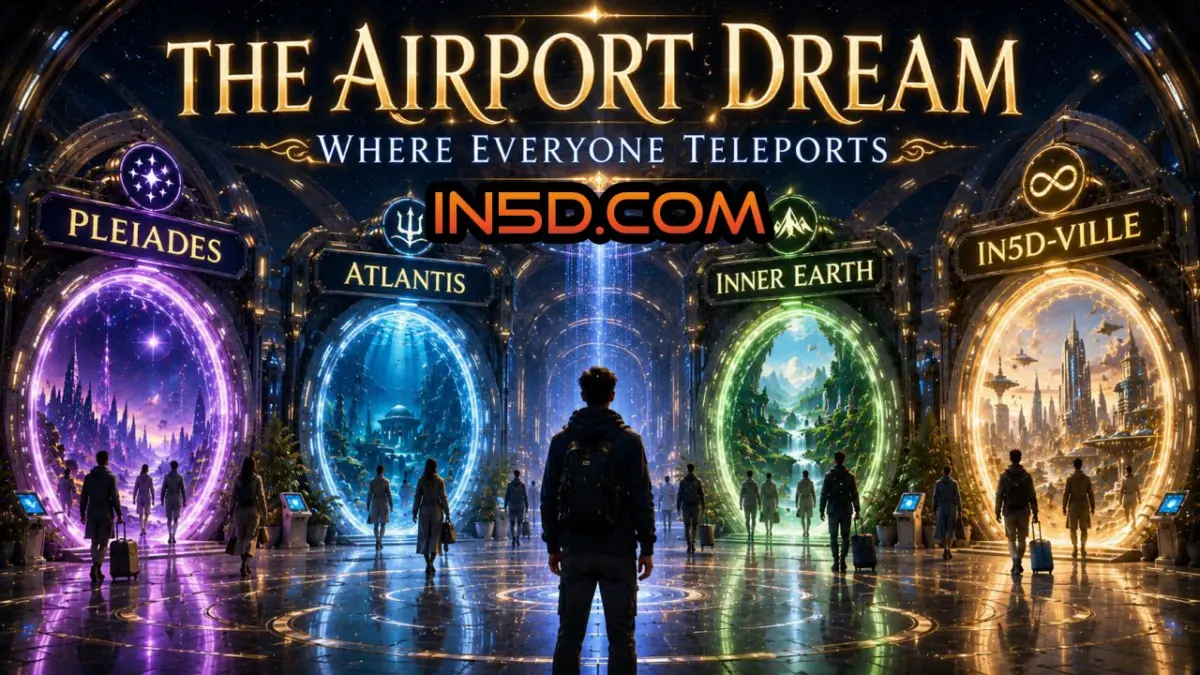
Among these reports, a particularly fascinating subcategory involves futuristic transit hubs devoid of conventional aviation. In these persistent dreamscapes, travelers do not queue at boarding gates, show passports, or board commercial airliners. Instead, they navigate terminals where the primary mode of transit is instantaneous teleportation.
Key elements defining this phenomenon include:
- The "Déjà Rêvé" Paradox: A profound, visceral familiarity with architectural layouts, technological interfaces, and geographic locations never encountered in waking reality.
- Non-Euclidean Transit: The total absence of airplanes, runways, and traditional vehicles, replaced entirely by instantaneous spatial displacement or portal-based navigation.
- Collective Acceptance: In these dreams, teleportation is treated by the dreamer and surrounding entities as completely ordinary, devoid of panic, confusion, or technological awe.
- Hyper-Real Sensory Input: Unlike typical, hazy dream memories, these spaces present with crystal-clear tactile sensations, emotional resonance, and a persistent memory trace that spans decades.
Researchers of anomalous human consciousness are increasingly asking whether these recurring motifs are mere psychological constructs, symbolic metaphors for personal growth, or glimpses into alternate dimensions accessed during deep restorative sleep.
Chronology: A Decades-Long Exploration into Lucid Realities
To understand the trajectory of how humanity perceives these nocturnal anomalies, one must trace the evolution of personal dream documentation and the shift from esoteric journaling to technological tracking.
January 2, 2014: The Blueprint Experience
In early January 2014, researcher and In5D founder Gregg Prescott experienced a defining nocturnal event. Standing within a sweeping, grand architectural environment that mirrored an airport terminal, he noted the total absence of aircraft or runways. Around him, a crowd of travelers smoothly engaged in instantaneous teleportation, moving across vast distances without hesitation. The most striking aspect was not the physics-defying transit, but the utter lack of shock. Prescott felt an overwhelming sensation of returning to a familiar place, accompanied by a deep, electric anticipation of voyaging far beyond the confines of Earth—instantly, effortlessly, and without regard for distance.
2014–2020: The Rise of Collective Dream-Mapping
Throughout the mid-2010s, online forums, metaphysical databases, and sleep research platforms saw an exponential rise in user-submitted accounts detailing recurring urban architectures, futuristic learning institutions, and non-local transit systems. Dreamers from diverse cultural and socio-economic backgrounds began describing identical architectural motifs—vast glass domes, silent corridors, and transitional "holding areas" that felt unmistakably real.
2023–Present: Introduction of Algorithmic Pattern Recognition
Recognizing that the human brain notoriously struggles to track subtle, long-term dream patterns across decades, modern developers began introducing specialized tracking software. Rather than relying on subjective dream dictionaries, platforms like the In5D Infinite App were engineered to catalog recurring symbols, geographic locations, and transit anomalies over extended periods, allowing users to connect seemingly random nocturnal events to major waking-life milestones.
Supporting Data: What the Statistics Tell Us About Extraordinary Dreams
While empirical data regarding non-local dream states is difficult to quantify through double-blind clinical trials, qualitative data compiled from over two decades of metaphysical research reveals compelling patterns among high-frequency dreamers:
- Frequency of Familiarity: Approximately 64% of respondents in specialized consciousness surveys report having experienced at least one dream in a location they had never visited in waking life, yet felt an intense sense of belonging or memory toward it.
- The Mechanics of Movement: Within anomalous, high-lucidity dreams, non-standard movement (flying, floating, teleporting, or walking through walls) accounts for nearly 41% of reported transit methods among active lucid dreamers.
- Life Transitions Correlation: Longitudinal self-reporting suggests a strong statistical clustering of high-anomaly dreams (featuring portals, instantaneous travel, or cosmic landscapes) within a 30-day window preceding major biographical shifts, career pivots, or psychological transformations.
- Memory Retention Discrepancy: While standard REM dreams fade from conscious memory within five to ten minutes of waking, hyper-real architectural and transit dreams exhibit a retention rate exceeding 72% over periods lasting multiple years, often remaining as vivid as actual waking memories.
Official Responses: Science, Psychology, and the Metaphysical Community
The phenomenon of anomalous, high-fidelity dreams invites starkly contrasting interpretations from the scientific establishment and alternative research communities.

The Neuroscientific Perspective
Mainstream sleep scientists and neurologists maintain that dreams are the brain’s way of sorting through daily stimuli, pruning synaptic connections, and managing emotional regulation. Dr. Rosalind Cartwright, a pioneer in the study of dreams and mood regulation, suggested that dreams reflect our current psychological state dressed up in metaphor.
From this viewpoint, an "airport of teleportation" is simply the sleeping brain utilizing familiar cultural templates (airports as symbols of transition) and combining them with wish-fulfillment fantasies (instantaneous escape or travel) to process underlying anxiety or a desire for change. Neurologists argue that the feeling of "having been there before" is a neurological misfiring—similar to waking déjà vu—where short-circuiting memory pathways make a newly generated brain state feel like a retrieved memory.
The Metaphysical and Consciousness-First Perspective
Conversely, researchers in parapsychology and consciousness studies propose models that take the subjective experience at face value. Proponents of the "Non-Local Consciousness" hypothesis suggest that human awareness is not strictly localized inside the skull, but acts as a receiver tuning into various frequencies of reality.
In this framework, sleep acts as a veil-lifting mechanism. When the physical body enters restorative rest, the non-physical aspect of human consciousness (the soul, subtle body, or quantum mind) detaches from immediate sensory processing and navigates dimensional realities, akashic libraries, or transitional staging areas. The "airport without planes" is interpreted not as a random glitch of imagination, but as an actual interdimensional transit hub utilized by consciousness during out-of-body states.
Implications: Connecting the Dots of Human Evolution and Awareness
As technology allows for better organization of subjective human experiences, the implications of tracking non-local dreamscapes stretch far beyond personal introspection. They challenge our very definitions of reality, time, and space.
1. Redefining Memory and the "Self"
If a human being can vividly remember a location, architectural style, or method of transit that they have never physically encountered, it forces an expansion of how we define memory. Could human DNA or collective unconscious archetypes (as proposed by Carl Jung) hold ancestral or trans-dimensional blueprints? If dreams are indeed visits to alternate timelines or parallel domains, the conscious self is far more vast and decentralized than modern materialism acknowledges.
2. The Practical Value of Pattern Recognition
The historical mistake of dream interpretation has been the obsession with single, isolated symbols—treating a dream as a one-off riddle to be solved by a generic dictionary. The true paradigm shift lies in pattern recognition over time. By leveraging modern tracking tools to map recurring dreams across years, individuals can observe how their inner landscape evolves in tandem with their waking lives. When a series of teleportation or portal dreams consistently precedes major personal transformations, the dream state transitions from a nightly curiosity into an early-warning radar system for personal evolution.
3. Preparing for a Shift in Human Perception
As cultural interest in lucid dreaming, astral projection, and quantum consciousness continues to accelerate, humanity is moving past rigid materialistic dogmas. Experiences that were once dismissed as hallucinations or overactive imaginations are now being studied as valid facets of human sentience.
Whether these airport terminals of light and teleportation are constructions of the subconscious mind or tangible outposts in the multiverse, one truth remains: the human capacity for wonder, exploration, and self-discovery knows no boundaries—not even the boundary of sleep.
Have you ever stood in a dream space that felt infinitely familiar yet entirely impossible? The architecture of your mind—and perhaps the cosmos beyond it—may be trying to tell you something. Connect the dots, keep a record, and explore the infinite depths of your own consciousness.
