

Main Facts
The human subconscious remains one of the final frontiers of modern science, a sprawling inner cosmos that continues to challenge our understanding of reality, memory, and consciousness. Among the most intriguing anomalies reported by individuals worldwide are recurring dreams of advanced, non-local transit—most notably, scenarios involving mass teleportation rather than traditional mechanical travel.
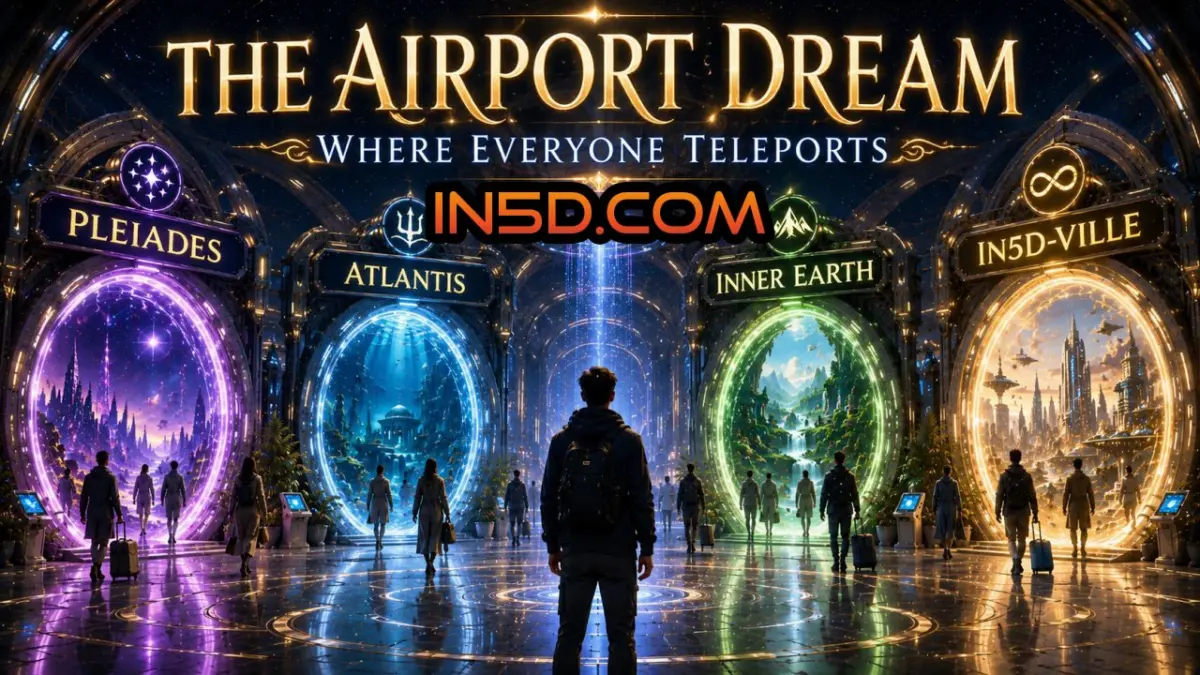
In January 2014, Gregg Prescott, founder and editor of the metaphysical research portal In5D.com, experienced a profound dream that defied the standard parameters of nocturnal visions. Standing within a structure closely resembling a modern airport terminal, Prescott observed an environment entirely devoid of airplanes, runways, and boarding gates. Instead, the occupants of this space traversed massive distances effortlessly through instantaneous teleportation. What distinguished the experience from ordinary surreal dreams was the complete absence of disorientation; both the dreamer and the crowds around him moved with an innate, instinctual understanding of the process, accompanied by an overwhelming sense of profound familiarity and emotional resonance.
This phenomenon raises fundamental questions regarding the nature of dreaming. Are these visions merely random firings of neurons during rapid eye movement (REM) sleep, or do they represent glimpses into alternate timelines, symbolic processing hubs, or actual dimensions of consciousness visited by the soul while the physical body rests? While mainstream psychology attributes dreams to memory consolidation and emotional regulation, esoteric researchers and consciousness advocates argue that patterns within these dreams point toward a deeper, synchronized architecture of human experience.
Chronology
To understand how individual anomalies evolve into a broader conversational landscape regarding human consciousness, one must trace the timeline of dream documentation, technological integration, and pattern recognition:
- Pre-2014 (The Era of Isolated Anecdotes): For decades, spiritual seekers, lucid dreamers, and metaphysical writers shared isolated accounts of futuristic cities, non-existent schools, and impossible architectures. These experiences were typically recorded manually in personal dream journals or discussed in niche forums, rarely yielding macro-level data analysis due to the limitations of human memory.
- January 2, 2014 (The Catalyst Event): Gregg Prescott experiences the "Teleportation Airport" dream. Unlike fleeting nightmares or chaotic dreamscapes, the event leaves a permanent psychological footprint characterized by an acute sense of "returning home" rather than visiting a novel location.
- 2014–2020 (Decades of Documentation): Prescott spends years cataloging dreams, noting that the human tendency to forget nocturnal experiences represents a major blind spot in consciousness research. The focus shifts from interpreting isolated dreams to identifying long-term thematic patterns.
- The Modern Era (Technological Pattern Recognition): Recognizing that human memory is inherently flawed when tracking abstract data over long periods, the development of specialized journaling infrastructure—such as the In5D Infinite application—begins. Rather than relying on subjective fortune-teller interpretations, software-driven data aggregation allows users to map correlations between recurring dream motifs (such as teleportation, flying, or portals) and real-world milestones.
Supporting Data
The scientific study of dreams, or oneirology, has historically relied on subjective self-reporting, making quantitative analysis difficult. However, modern psychological frameworks and digital archiving tools are beginning to bridge the gap between subjective experience and empirical pattern recognition.
- Memory Decay Rates: Psychological studies on memory retention indicate that humans forget approximately 95% of their dreams shortly after waking up. Without immediate recording, complex recurring motifs—such as spatial mechanics, architectural layouts, and transit methods—fade from the conscious mind within minutes.
- Thematic Clustering: Data gathered from digital dream-tracking platforms suggests that abstract dreams involving spatial displacement (teleportation, flying, or sudden relocation) frequently cluster around specific windows of psychological stress or personal transformation.
- The Familiarity Response: Neurological studies on déjà vu and dream recall show that the brain activates similar neural pathways when processing both actual memories and deeply resonant dream environments, explaining why unfamiliar locations in dreams can evoke a powerful sense of nostalgia or recognition.
Official Responses and Perspectives
The scientific and metaphysical communities approach phenomena like teleportation dreams from drastically different epistemological frameworks, creating a fascinating dialogue between reductionist science and holistic philosophy.
The Neuroscientific Viewpoint
Mainstream neuroscientists and sleep researchers, such as those studying REM sleep mechanics, view dreams as internal simulations generated by the brain. According to this perspective, the prefrontal cortex—responsible for logical reasoning and spatial orientation—exhibits reduced activity during sleep, while the limbic system (emotional processing) remains highly active.
From this viewpoint, dreaming of an airport without airplanes where people teleport is simply the brain synthesizing disparate visual memories (airports, crowds, travel) into a novel narrative. The feeling of "having been there before" is classified as a neurological misfire in the brain’s familiarity circuits, creating a false sense of recognition.

The Metaphysical and Consciousness-Based Viewpoint
Conversely, researchers in parapsychology and consciousness studies propose that the mind acts as a receiver rather than merely a generator of experience. Proponents of this model argue that consciousness operates independently of the physical brain to varying degrees during deep sleep.
In this framework, spaces like the "teleportation airport" are interpreted as etheric waystations, non-physical dimensions, or localized thought-forms within the collective unconscious. The emotional certainty of having "been home" is taken at face value—as an indicator of the soul’s multidimensional nature and its capacity to access realities beyond the physical constraints of space and time.
Implications
The exploration of recurring dream motifs and non-local transit carries profound implications for how humanity understands identity, psychology, and the evolution of consciousness.
1. Re-Evaluating the Self and Reality
If a significant portion of the global population experiences persistent, highly structured environments that feel more real than waking life, our definition of "consensus reality" must expand. These experiences suggest that human awareness is not strictly bound to the physical body, opening pathways for advanced lucid dreaming, astral projection research, and a deeper understanding of human potential.
2. The Shift from Interpretation to Data Analysis
For centuries, dream analysis relied heavily on subjective symbolism—interpreting a specific animal, object, or action through rigid dictionary definitions. The modern shift toward longitudinal data collection, as facilitated by tools like the In5D Infinite application, changes the paradigm. By tracking dreams over years rather than days, individuals can uncover personal blueprints—revealing how their inner psychological landscape mirrors outer life transitions, transformations, and spiritual awakenings.
3. Bridging Science and Spirituality
As technology allows for better tracking of subjective human experiences, the historical divide between empirical science and metaphysical philosophy begins to narrow. Recognizing patterns in dreams does not require abandoning scientific rigor; rather, it invites a more comprehensive, holistic approach to the study of the human mind—one that honors both the measurable mechanics of the brain and the ineffable depths of human consciousness.
Ultimately, whether these nocturnal waystations are creations of the neural network or glimpses into alternate dimensions, they serve as vital mirrors reflecting our inner journey through life, urging us to look closer at the invisible dots connecting our waking and sleeping worlds.
