

By Global Metaphysical Desk
Published in association with In5D Research Chronicles
Main Facts
The human subconscious remains one of the final true frontiers of scientific and metaphysical exploration. While conventional psychology categorizes dreams as random firings of neurons or symbolic processing units for daily stress, a growing body of anecdotal and phenomenological evidence points toward something far more expansive. Millions of individuals across the globe report experiencing complex, highly vivid dreams set in locations they have never physically visited, yet which evoke an immediate, visceral sense of recognition and "home."
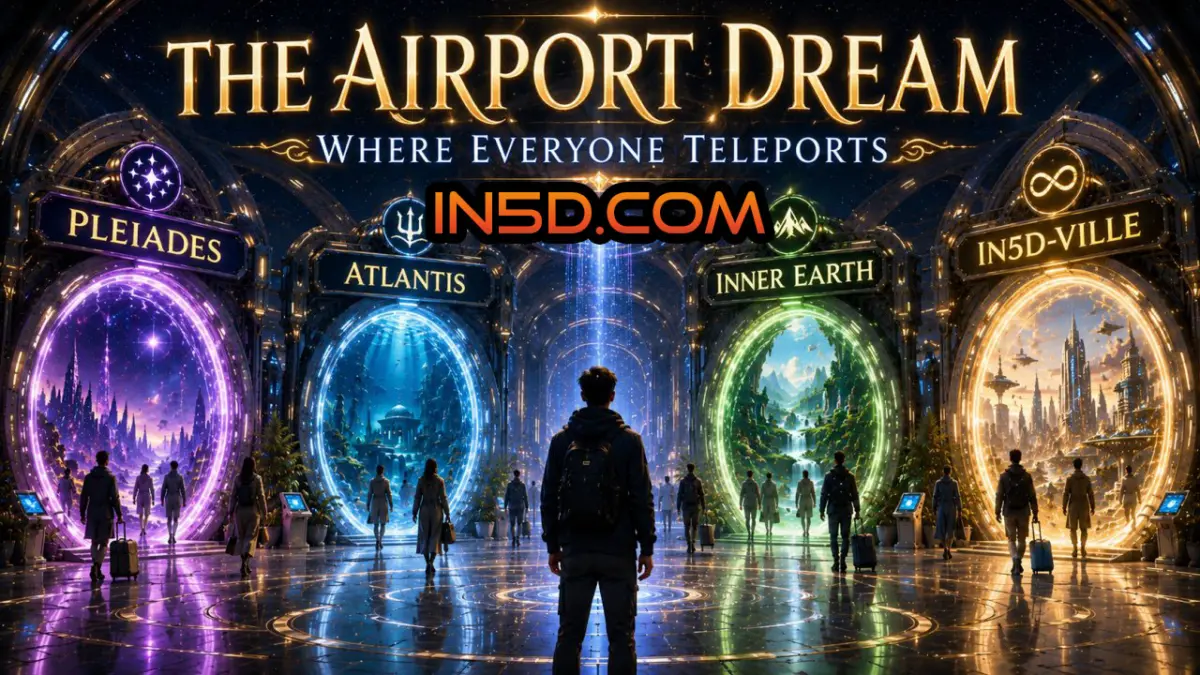
A prominent example of this phenomenon involves recurring accounts of "non-local transit hubs"—environments superficially resembling airports, train stations, or grand terminals, but entirely devoid of traditional physical infrastructure like airplanes, runways, or ticket counters. Instead, inhabitants of these dreamscapes navigate vast distances through instantaneous teleportation.
Key observations of these anomalous dream states include:
- The Teleportation Dynamic: Inhabitants move from point to point via pure intent or instantaneous shifting, bypassing physical motion entirely. This occurs without cognitive dissonance or shock on the part of the dreamer.
- Profound Familiarity: Dreamers routinely report experiencing zero cultural or environmental shock, noting that returning to these anomalous zones feels akin to walking back into one’s childhood living room.
- Cosmic Anticipation: These dreams are frequently accompanied by a profound emotional backdrop of excitement, telepathic connection, and an absolute certainty of impending interstellar or interdimensional travel.
- The Pattern Recognition Deficit: Historically, researchers note that individual dream logs fail to yield insights because subjects examine dreams in isolation rather than mapping overarching, multi-year behavioral and psychic trends.
Chronology
To understand how individual anomalies evolve into a broader conversational paradigm, it is necessary to examine the timeline of how non-local dream research and experiential cataloging have matured over the past decade.
- January 2, 2014: Metaphysical researcher and author Gregg Prescott experiences a watershed dream in which he finds himself in an airport-like structure devoid of aircraft. Rather than boarding planes, all occupants effortlessly teleport. The experience leaves an indelible mark due to its absolute lack of unfamiliarity—despite never seeing such a place in waking reality, Prescott recognizes it intrinsically.
- 2014 – 2020: Across various online forums, spiritual databases, and consciousness research platforms, a rising statistical cluster of individuals begins reporting identical motifs: futuristic transit hubs, unearthly educational institutions, massive geometries, and seamless teleportation mechanics.
- 2021 – 2023: Researchers begin analyzing the limitations of human memory regarding sleep states. It becomes apparent that while vivid dreams are experienced nightly, the human brain systematically purges up to 95% of dream data within minutes of waking, obscuring macro-patterns that could span decades.
- Late 2025 – Early 2026: Technological integration meets metaphysical curiosity with the development and official Google Play release of specialized pattern-tracking software, such as the In5D Infinite application. Designed not to interpret dreams arbitrarily, but to log and correlate multi-year subconscious data, the application introduces a systemic approach to tracking dream frequency, symbols, and life transitions.
Supporting Data & Phenomenological Metrics
While mainstream empirical science struggles to quantify subjective dream experiences through standard double-blind methodologies, parapsychology and cognitive anthropology provide intriguing metrics regarding sleep state anomalies and memory retention.
- The Forgetting Curve in Sleep Studies: According to classical psychological data originating from Hermann Ebbinghaus and later adapted for REM sleep research, individuals forget roughly 50% of a dream within 5 minutes of awakening, and up to 90% within 10 minutes. This neurological bottleneck explains why rare, profound archetypes—such as multi-dimensional transit hubs—slip away before they can be systematically analyzed.
- Cluster Correlation Statistics: Preliminary longitudinal observations gathered via subjective user logs indicate a fascinating statistical overlap. When subjects utilize dedicated tracking databases over a 36-month period, anomalous dream patterns (such as recurring instances of flying, portalling, or teleportation) frequently cluster within a 30-day window surrounding major life transitions, career shifts, or psychological awakenings.
- Cross-Cultural Archetypes: Carl Jung famously posited the existence of the collective unconscious, populated by universal archetypes that transcend individual experience. Modern phenomenological surveys suggest that futuristic technologies—such as teleportation hubs or non-linear navigation points—may be emerging as contemporary archetypes for an industrialized, space-faring global consciousness anticipating an evolutionary leap.
Official Responses and Metaphysical Perspectives
Because dreams occupy a nebulous space between neurology, psychology, and esoteric philosophy, "official" institutional responses vary wildly depending on the lens of the observer.
The Neuroscientific View
Mainstream neurology generally views dreams as the brain’s mechanism for memory consolidation, emotional regulation, and synaptic pruning. From this perspective, an airport without airplanes or a dream involving teleportation is simply the neocortex synthesizing disparate visual memories (airports, science fiction films, spatial awareness) into a novel narrative. Neurologists argue that the feeling of "profound familiarity" is a localized glitch in the temporal lobe—specifically the déjà vu mechanism—misfiring during the chaotic synthesis of REM sleep.

The Metaphysical and Consciousness-First View
Conversely, researchers in consciousness studies, quantum metaphysics, and esoteric philosophy propose a radically different interpretation. Proponents of this school of thought—drawing from ancient shamanic traditions, astral projection frameworks, and modern non-local consciousness theories—suggest that the physical body’s dormancy acts as a veil-lifting mechanism.
In this view, consciousness is not merely a byproduct of gray matter, but a fundamental property of the universe. Consequently, sleep is interpreted as a temporary disengagement from physical constraints, allowing the soul or higher mind to travel to literal, objective non-physical realms, alternate timelines, or dimensional waystations. The "airport" is thus not a hallucination, but a literal metaphysical transit lounge utilized by consciousness during inter-dimensional or inter-state transitions.
Implications
The exploration of recurring, anomalous dreamscapes carries profound implications for how humanity perceives identity, reality, and the architecture of the mind. If places like the teleportation hub described by Prescott are more than just idle brain noise—whether viewed as alternate realities, symbolic landscapes of the collective unconscious, or genuine dimensions visited during sleep—our understanding of existence undergoes a fundamental shift.
1. Redefining Human Continuity
By relying solely on waking consciousness, humanity operates with a fraction of its total experiential data. Software solutions and systematic journaling tools that map multi-year subconscious trends bridge the gap between the sleeping and waking self. When an individual realizes that their dreams of teleportation or unearthly travel correlate precisely with major terrestrial life transformations, the boundary between "inner fantasy" and "outer reality" begins to dissolve.
2. Preparing for a Shift in Consciousness
As global interest in expanded states of awareness intensifies, the collective human psyche appears to be generating futuristic, boundary-expanding imagery. Whether these dreams serve as preparation for future technological paradigms, psychological integration tools, or literal memories of nonlocal existence, they challenge us to look beyond the immediate physical horizon.
As researchers continue to map the patterns hidden beneath the threshold of sleep, one central question remains: Are we merely imagining these strange, familiar worlds, or are we finally beginning to remember where we truly come from?
Infinite Love and Light.
