

By the Editorial Desk
Published in Conjunction with In5D.com Insights
Main Facts: The Astrological Blind Spot
For generations, pop culture astrology has reduced a complex, multi-layered cosmic science into a neat, one-size-fits-all monthly column. Ask anyone at a dinner party what their zodiac sign is, and you will almost invariably receive a single, definitive answer: "I’m a Libra," "I’m a Leo," or "I’m a Pisces."
However, according to modern metaphysical researchers and veteran astrologers, relying solely on your Sun sign is like trying to understand an entire feature-length film by watching a single promotional trailer. You are missing roughly two-thirds of the narrative.
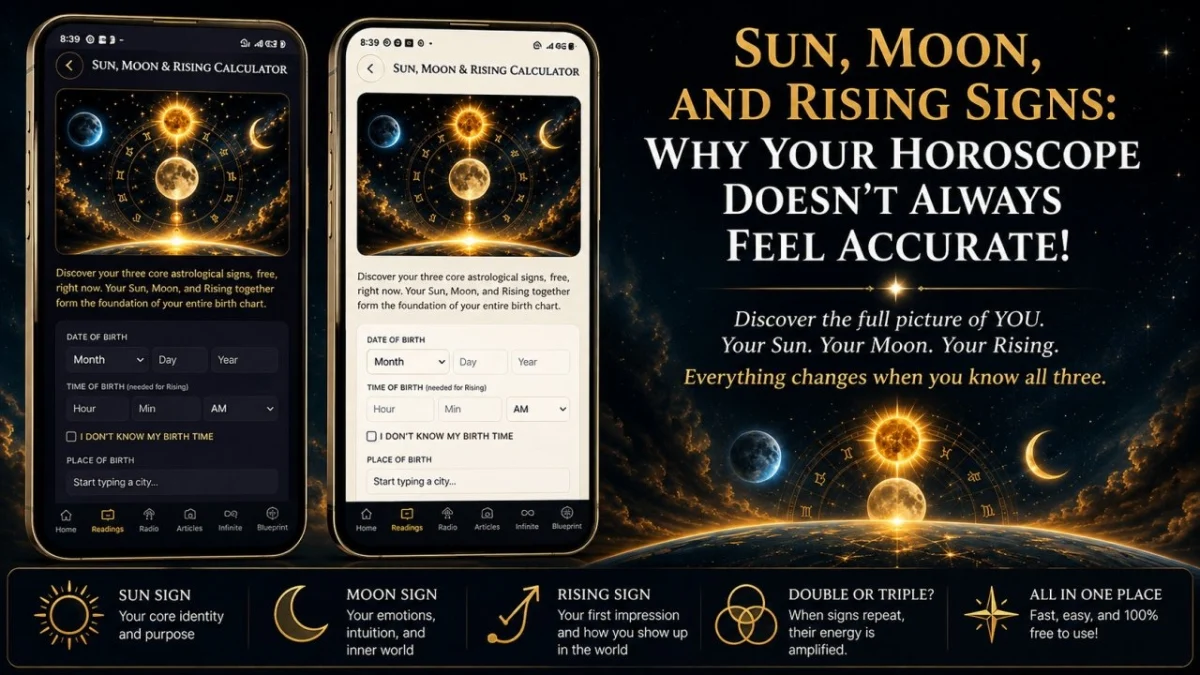
To truly decode the psyche, astrologers emphasize the "Big Three"—a combination of the Sun, Moon, and Rising (Ascendant) signs. While the Sun sign outlines your core identity and overarching life purpose, the Moon sign governs your hidden emotional landscape, and the Rising sign dictates the social filter through which the world perceives you. Without evaluating all three in unison, individuals often find themselves scratching their heads, wondering why conventional horoscopes frequently miss the mark.
Chronology: From Ancient Charts to the Digital Age of Self-Discovery
The practice of mapping the celestial bodies dates back thousands of years to ancient Babylonian, Hellenistic, and Vedic traditions. Early astronomers recognized that the sky was not merely a backdrop of static stars, but a dynamic clockwork system tracking human psychology and terrestrial cycles.

- Ancient Roots: For centuries, constructing a complete natal chart required complex manual calculations involving ephemerides—thick books tracking planetary positions down to the minute—and exact local birth times. Because of this mathematical barrier, comprehensive astrology remained largely in the realm of specialized practitioners.
- The Twentieth-Century Awakening: The mid-to-late 20th century saw a massive surge in popular astrology, largely popularized through newspaper columns. While this brought the concept of zodiac signs to the mainstream masses, it simultaneously flattened the art form, reducing it strictly to Sun-sign horoscopes due to space limitations and calculation complexities.
- The Digital Revolution (2009–Present): With the advent of the internet and mobile applications, complex astronomical calculations became instantly accessible to the general public. Platforms like In5D.com, founded by researcher and author Gregg Prescott, M.S., emerged as hubs for conscious media and metaphysical exploration. Prescott, following what he describes as a profound "galactic download" in 2009, dedicated his platform to bridging ancient esoteric knowledge with modern digital utility—culminating in the recent rollout of accessible astrological calculators designed to democratize deep chart analysis.
Supporting Data and Astrological Anatomy: The Big Three Breakdown
To understand why individual horoscopes can feel so inaccurate, one must dissect how the three primary planetary placements interact within a single psychological profile.
1. The Sun Sign: The Architectural Foundation
Determined by the exact position of the sun on the day of your birth, your Sun sign represents your conscious ego, core vitality, and overarching life direction. It is the fundamental blueprint of your identity—the person you are striving to become and the intrinsic traits you naturally gravitate toward. If you summarize your character in a single sentence, your Sun sign does the heavy lifting.
2. The Moon Sign: The Internal Emotional Engine
While the Sun represents external action and identity, the Moon governs the internal world: feelings, intuition, instinctual reactions, and private vulnerabilities. Because the Moon changes zodiac signs approximately every two and a half days, two people born under the same Sun sign can react to a crisis in entirely diametrically opposed ways. Your Moon sign explains your private emotional processing—the side of you typically reserved for close family and intimate partners.
3. The Rising Sign (Ascendant): The Social Facade
Calculated using the exact minute and geographical location of your birth, the Rising sign is the specific constellation ascending over the eastern horizon at your precise moment of entry into the world. This placement dictates your automatic behavioral responses, physical mannerisms, and first impressions. It is the energetic armor or filter you project into society before people get to know your deeper Sun and Moon layers.
The Anomaly of Double and Triple Signs
The complexities of astrology deepen exponentially when individuals possess "Double" or "Triple" configurations—instances where the same zodiac sign dominates two or all three pillars of their Big Three.

Gregg Prescott himself serves as a prime example of a Triple Libra (Libra Sun, Libra Moon, and Libra Rising). Reflecting on his chart discovery via astrologer and conference co-host Helane Lipson, Prescott noted how the placement completely demystified his lifelong behavioral patterns:
"When she told me I was a Triple Libra, I was like, ‘Huh???’… After that, everything all came together as to why I have a hard time making decisions. Most people think that Libras are all about balance, and that’s true, but what most people don’t realize is that we’re constantly seeking balance. That’s a HUGE difference! And don’t ask a Libran to make a decision about anything. We’re amazing at seeing the bigger picture of A and Z, but struggle with B through Y."
When a single sign is amplified across multiple pillars, its inherent traits are woven deeply into every layer of the psyche, intensifying specific qualities—such as the relentless diplomacy of a Triple Libra, the magnetic charisma of a Double Leo, or the hyper-vigilant eye for detail found in a Double Virgo.
Official Responses and Expert Perspectives Within the Metaphysical Community
Mainstream scientific skeptics have historically dismissed astrology as a pseudoscience, citing the lack of empirical mechanisms governing gravitational or electromagnetic influence at birth. However, within psychological and esoteric communities, astrology is increasingly viewed not as a deterministic prophecy, but as a symbolic language and sophisticated framework for self-reflection.
Holistic researchers emphasize that understanding the interplay between disparate elemental energies (such as an airy, intellectual Triple Libra placement interacting with a fiery, action-oriented child’s Leo chart) fosters profound empathy in interpersonal relationships. By moving past rigid Sun-sign generalizations, practitioners argue that individuals can unpack trauma, recognize recurring behavioral triggers, and cultivate radical self-acceptance.

Furthermore, technological developers in the wellness space are responding to public demand for hyper-personalized data. Rather than relying on generalized monthly horoscopes written for millions of people simultaneously, modern users are demanding granular, algorithmic breakdowns of their distinct natal configurations.
Implications: A Shift Toward Hyper-Personalized Self-Awareness
The movement away from simplistic Sun-sign astrology and toward comprehensive Big Three analysis carries significant implications for personal development, mental health, and modern wellness culture.
- Dismantling Reductionist Stereotypes: For decades, zodiac signs have been flattened into internet memes (e.g., "Virgos are neat freaks," "Geminis are two-faced"). Factoring in Moon and Rising signs shatters these cartoonish stereotypes, revealing the intricate, paradoxical layers that make up every human personality.
- Enhanced Interpersonal Empathy: Recognizing that a quiet, introverted Sun sign (such as a Cancer) may present as exceptionally bold and outgoing due to an externalized Rising sign (such as a Leo) prevents premature judgment. It encourages a deeper, more compassionate understanding of friends, family members, and romantic partners.
- Technological Accessibility: The integration of automated astrological calculators into everyday digital platforms—such as the free Sun, Moon, and Rising calculator featured on the In5D Infinite app—lowers the barrier to entry for self-exploration. Users no longer need an advanced degree in celestial mechanics to map out their psychological architecture.
- The Quest for Identity: In an era marked by cultural fragmentation and digital noise, ancient systems of self-inquiry offer grounding frameworks. Asking the fundamental question, "Who am I, really?" becomes far more productive when answered not with a single twelve-part horoscope, but through a nuanced, multidimensional cosmic portrait.
As more seekers look beyond the surface of pop-culture horoscopes, the resurgence of comprehensive astrological literacy promises a richer, more empathetic approach to understanding both the self and the collective human experience.
