

NEW YORK — Long before graphic tees and capsule collections paid homage to the world’s most famous beagle, Peanuts had already established itself as an arbiter of taste. This week, the enduring cultural footprint of Charles M. Schulz’s legendary creation is celebrated in a new pop-up exhibition titled “Snoopy in Style,” located in the heart of New York City’s Meatpacking District. Featuring rare archival materials sourced directly from the Charles M. Schulz Museum alongside modern, Peanuts-inspired interpretations from contemporary fashion houses such as Adidas, Bode, Sandy Liang, Tanner Fletcher, and Tory Burch, the exhibition cements the comic strip’s legacy as a perennial fashion icon.
Yet, to limit the influence of Peanuts strictly to sartorial trends is to overlook a far more subtle, deeply architectural narrative. Beneath the melancholy sighs of Charlie Brown, the philosophical musings of Linus, and the joyful capers of Snoopy lies a meticulous visual chronicle of American residential architecture and interior design. Across five decades of publication, Schulz used the backdrop of suburban domesticity to map the changing tastes, furniture icons, and spatial layouts of middle-class America, transforming the comic strip into an unintended historical archive.
Main Facts: The Intersection of Pop Culture and Domestic Design
The “Snoopy in Style” exhibition—running from September 2 through September 26 at 25 Little West 12th Street—shines a spotlight on the intersection of high fashion, pop culture, and visual art. Curated to highlight the timeless appeal of Schulz’s characters, the pop-up juxtaposes historical artifacts with avant-garde fashion statements.

However, exhibition designers and architectural historians emphasize that the true genius of the strip’s physical world lay in its understated realism. While contemporaries like The Jetsons leaned heavily into overt, futuristic interpretations of midcentury modernism, Peanuts took a remarkably understated approach.
"This minimalist approach allowed the focus to remain on character development, dialogue, and the central jokes," explains Benjamin L. Clark, curator of the Charles M. Schulz Museum.
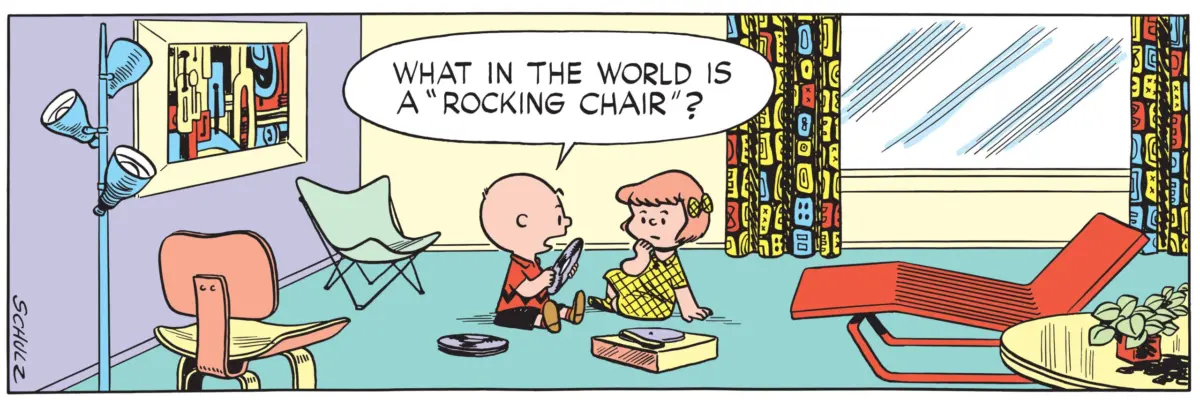
Schulz mastered the art of visual shorthand. With just a few clean ink strokes—a gabled roofline, a neatly manicured patch of grass, a casement window, or an abstract canvas on a living room wall—he transported readers into fully realized physical spaces. These backdrops were never merely decorative; they were anchoring devices that provided a sense of normalcy and psychological grounding for a cast of children grappling with the existential anxieties of postwar America.

Chronology: A Half-Century of Changing American Interiors
The spatial evolution of the Peanuts universe mirrors the broader timeline of American domestic design from 1950 to the turn of the century. While the architectural envelope—the classic postwar tract home featuring a gabled roof and a ranch-style silhouette—remained remarkably consistent, the interior landscapes shifted in tandem with cultural eras.
The 1950s: The Zenith of Midcentury Modernism
When Peanuts debuted in the early 1950s, American interior design was undergoing a radical democratization. Manufacturers like Herman Miller and Knoll were introducing forms that would become permanent fixtures of the modern design canon. Schulz was a keen observer of these shifts.
In a widely celebrated strip from 1953, Schulz rendered a domestic living room populated by genuine midcentury icons: the Eames LCW (Lounge Chair Wood), the iconic Butterfly chair, and the ergonomic Barwa lounge chair. Nearby, an abstract painting hung on the wall, while a Noguchi-inspired, kidney-shaped coffee table anchored the seating arrangement opposite a hairpin-leg side table topped with a playful, jigsaw-patterned lamp. Other strips from the decade featured Saarinen-style Womb chairs, sleek executive desks, and streamlined, flat-front kitchen cupboards that captured the postwar obsession with efficiency and clean lines.

The 1980s: Floral Chintz and the Rise of the Kitchen Island
As decades progressed, the minimalist austerity of the 1950s gave way to more decorative and domestic-focused trends. By the 1980s, the sharp angles and primary colors of midcentury modernism had receded, replaced in the Peanuts household by Laura Ashley–style floral chintz upholstery, patterned armchairs, and cozy, traditional textiles.
Simultaneously, the floor plan of the suburban home evolved. In a notable 1982 strip, Charlie Brown is depicted standing on a turned-leg stool over what appears to be a kitchen island—a spatial typology that was rapidly redefining suburban family life by shifting the kitchen from a utilitarian back-of-house workspace into the social epicenter of the home.
The 1990s: Eclectic Prints and Modern Layering
By the final decade of the comic’s run, the Peanuts living room had absorbed the eclectic, pattern-driven maximalism of the late 20th century. Layered textiles, bolder color palettes, and mixed-pattern upholstery reflected an era where interior design prioritized personal expression and comfort over strict stylistic purity.

Supporting Data: Schulz’s Methodological Realism
How did a cartoonist working under tight deadlines manage to document the subtle nuances of American interior design with such architectural precision? According to museum curators and exhibition organizers, Schulz’s work was fueled by a lifelong habit of hyper-observation.
"He talked about how, if he saw interesting curtains anywhere he was, he was drawing in his mind the entire time," notes Benjamin L. Clark. "He saw those curtains somewhere, and in his brain he’s like, ‘Oh, those are interesting curtains, and I’m drawing them.’"
Matt Murphy, exhibition designer for Snoopy in Style, points out that Schulz possessed a rare talent for translating cold, industrial design forms into deeply human objects. "It’s interesting to see an Eames chair through the lens of Schulz and how he translated those forms into a really very human kind of thing—there’s a warmth there," Murphy observes.

Rather than imposing an avant-garde aesthetic from an ivory tower, Schulz absorbed the built environment of his own life—tracing a trajectory from his upbringing in St. Paul, Minnesota, to his postwar tract home in Colorado Springs—and projected it onto the page. To the average American reader of the 1950s and ’60s, the physical world of Peanuts was not an abstraction; it was a mirror image of their own living rooms, kitchens, and neighborhoods.
Official Responses and Curatorial Perspectives
The convergence of high fashion, contemporary curation, and historical cartooning has drawn widespread praise from design critics and cultural historians alike. The “Snoopy in Style” exhibition acts as a bridge, reminding the public that popular culture and high design are not mutually exclusive.
"Schulz was a chronicler of the ordinary who managed to capture the extraordinary essence of human emotion through the mundane details of daily life," says Clark. By grounding his philosophical dialogues and absurd comedic moments within meticulously rendered architectural and decorative contexts, Schulz created a sense of place that resonated globally.

Collaborating brands like Adidas, Bode, and Tory Burch have echoed these sentiments, noting that the clean lines, primary color palettes, and nostalgic geometry of the Peanuts universe offer an endless well of creative inspiration. The garments and installations featured in the Meatpacking District pop-up serve as physical manifestations of the strip’s enduring aesthetic currency.
Implications: The Lasting Legacy of Suburban Normalcy
The architectural and design legacy of Peanuts offers profound implications for how we view popular culture as a historical document. While architectural histories often focus on grand monuments, custom-built modernist villas, or avant-garde manifestos, the everyday architecture of the suburban tract home—as filtered through the ink of a comic strip—plays an equally vital role in shaping cultural memory.
By projecting a sense of normalcy, safety, and domestic familiarity, Peanuts provided millions of readers with a psychological harbor during periods of intense social and political upheaval in America. The gabled roofs, the stone-surround fireplaces, the Eames lounge chairs, and the quiet neighborhood sidewalks were more than mere backdrops; they were the foundational elements of a shared American vernacular.

As visitors walk through the “Snoopy in Style” exhibition this September, they are invited to admire the fashion collaborations and archival drawings. Yet, beneath the surface lies a quiet invitation to look closer at the spaces we inhabit, reminding us that the furniture, curtains, and floor plans of our daily lives are actively writing the history of our times—just as Charles M. Schulz captured them decades ago.
“Snoopy in Style” is on view from September 2 through September 26 at 25 Little West 12th Street, New York, NY.
