

By Gayathri Narayanan
Published in partnership with contemplative communities and cultural retrospectives
Main Facts: A Quarter-Century Legacy of Unconditional Regard
August 31 marks twenty-five years since the final broadcast of Mister Rogers’ Neighborhood, the seminal children’s television program that reshaped the landscape of American educational media. For more than three decades, ordained Presbyterian minister Fred Rogers invited generations of children into a quiet, unhurried television living room where they were met with a singular, revolutionary message: You are special, and you do not need to change anything about yourself to be loved.
In an era dominated by high-speed animation, commercial noise, and increasingly fragmented media environments, the anniversary serves as a profound cultural touchstone. Far from being a relic of nostalgic television history, Rogers’ work continues to challenge modern paradigms of education, media consumption, and human empathy. His unique philosophy—bridging deep spiritual conviction, psychological attunement, and quiet activism—remains a masterclass in how society treats its most vulnerable members.
Chronology: From Childhood Struggles to a Cultural Institution
To understand the architecture of Fred Rogers’ empathy, one must trace the timeline of a man who transformed personal vulnerability into a public sanctuary.
- 1928: Fred McFeely Rogers is born in Latrobe, Pennsylvania. A sickly child who suffers from severe childhood illnesses and frequent bouts of bullying, he is nicknamed "fat Freddy," instilling in him a lifelong sensitivity to the isolation of the outsider.
- 1951: Rogers graduates from Rollins College with a degree in music composition, initially intending to enter seminary. Instead, he encounters early television, famously declaring the new medium "hideous" but recognizing its immense potential to shape young minds. He takes a job as an NBC page and floor assistant in New York.
- 1953–1968: Rogers works behind the scenes and on-air in children’s programming, notably with CBC in Canada, where he develops the gentle pacing and persona that would define his life’s work. Concurrently, he attends Pittsburgh Theological Seminary, where he is ordained as a Presbyterian minister in 1963, viewing his television ministry as an extension of his faith.
- 1968: Mister Rogers’ Neighborhood premieres nationally on the newly formed Public Broadcasting Service (PBS).
- 1969: In a watershed moment for American television, Rogers invites François Clemmons, a Black cast member playing Officer Clemmons, to share a small wading pool and cool their feet together—a direct, subversive challenge to racial segregation. Later that year, Rogers delivers historic, unscripted testimony before the U.S. Senate Subcommittee on Communications, successfully defending federal funding for public broadcasting through the sheer force of his moral clarity.
- 1981: Ten-year-old Jeff Erlanger, a boy with a spinal condition who uses a wheelchair, appears on the show. The unscripted, deeply respectful dialogue between Rogers and Erlanger becomes one of the program’s most enduring expressions of radical inclusion.
- 2001: The final new episode of Mister Rogers’ Neighborhood airs on August 31, 2001—just eleven days before the tragedy of September 11. In the wake of the attacks, a reluctant Rogers returns to the studio to record reassuring messages for traumatized parents and children.
- 2003: Fred Rogers passes away at the age of 74, leaving behind a legacy cemented by multiple honors, including the Presidential Medal of Freedom.
- 2018–2019: A cultural resurgence of interest in Rogers takes hold with the release of the acclaimed documentary Won’t You Be My Neighbor? and the biographical drama A Beautiful Day in the Neighborhood, starring Tom Hanks.
- 2026: Society marks twenty-ished years since the final broadcast, prompting renewed global inquiry into the mechanics of his compassion.
Supporting Data & Media Analysis: The Mechanics of Presence
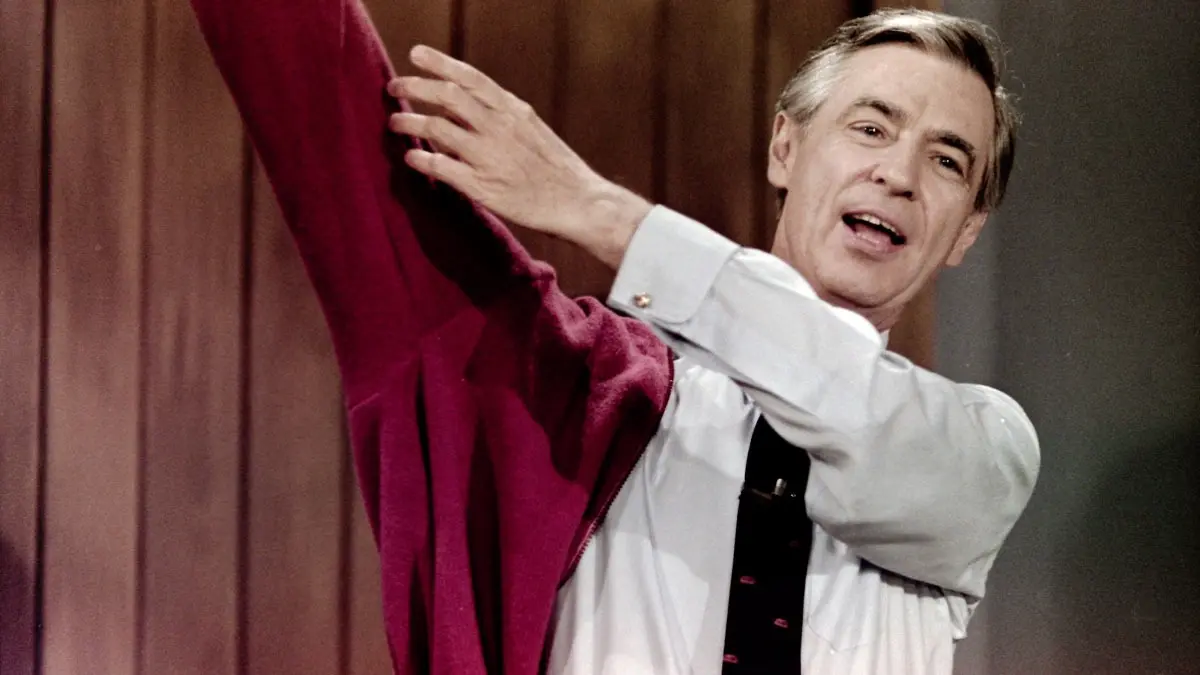
While millions remember Rogers for changing his shoes and zipping his cardigan, media scholars and psychologists point to the rigorous, intentional structural design of his show. Mister Rogers’ Neighborhood ran counter to almost every rule of modern commercial television.
- Pacing and Cognitive Load: Unlike contemporary children’s shows designed to maximize retention through rapid cuts and sensory overstimulation, Rogers utilized slow, deliberate pans, long conversational pauses, and extended unedited shots.
- Direct Eye Contact: Research into non-verbal communication highlights Rogers’ technique of looking directly into the camera lens. He did not talk at an audience; he used focal techniques that made individual viewers feel as though they were being looked at as the most important person in the room.
- Empirical Impact on Emotional Literacy: Studies evaluating educational public television from the era indicate that children exposed to Rogers’ model demonstrated higher capacities for emotional self-regulation, empathy toward peers with disabilities, and lower baseline anxieties compared to peers consuming fast-paced commercial alternatives.
- Physical Discipline: Beneath his calm exterior lay a rigorous personal routine. Rogers swam a mile every morning, maintained strict dietary and weight-monitoring habits to manage his childhood trauma around body image, and maintained a disciplined schedule of prayer, scriptural study, and musical composition.
Official Responses and Cultural Critiques
Fred Rogers was not universally praised during his lifetime, and the institutional reactions to his philosophy reveal deep cultural divides over the nature of childhood and worth.
Conservative Commentary and the "Entitlement" Debate
During the height of his popularity, and posthumously in the early 2000s, some conservative cultural commentators leveled criticism at Rogers, accusing him of helping to spawn a generation of entitled children. The argument posited that telling children they are loved simply for being, without requiring tangible achievement, academic success, or behavioral compliance, fostered narcissism.
Defenders and biographers, however, argue that these critics misunderstood Rogers’ theological foundation. As an ordained minister, Rogers was not offering empty self-esteem boosts or participation trophies. He was speaking from a deep-seated spiritual conviction regarding the inherent sacredness—or basic goodness—of every human being.
Political Power through Quiet Conviction
Perhaps the most famous official response to Rogers came during his 1969 appearance before the U.S. Senate subcommittee chaired by the notoriously gruff Senator John O. Pastore. Rogers was asked to defend a proposed $20 million federal budget cut to public broadcasting.
Instead of delivering a policy-heavy, data-driven speech, Rogers read a simple poem about children’s inner emotional lives and described his work’s core mission: helping children deal with difficult feelings constructively. Visibly disarmed and deeply moved, Senator Pastore declared on the record: "I’m supposed to be a tough guy… but I’m going to tell you, you just earned your twenty million dollars." It stands as a historic instance where radical gentleness dismantled political posturing.
Implications: Bridging Traditions of Compassion
The twenty-fifth anniversary of the show’s final episode invites a broader philosophical examination of how Rogers’ work intersects with global wisdom traditions.
The Convergence of Metta, Grace, and Non-Duality
For many observers approaching Rogers from outside mainstream American Christianity, his presence evokes parallel concepts found in Eastern contemplative traditions. In Buddhism, metta refers to loving-kindness—an unconditional friendliness and goodwill toward self and others. Rogers’ insistence that people are lovable prior to any accomplishment mirrors the practice of unconditioned regard.
Similarly, within Hindu philosophical frameworks such as Advaita Vedanta, the perceived boundary between "me" and "you" begins to dissolve. When Rogers looked across the set at a child in a wheelchair, a Black police officer cooling his feet in a turbulent era of segregation, or a television viewer millions of miles away, he operated from a space where otherness was systematically dismantled.
As Thich Nhat Hanh’s teaching reminds us—“No mud, no lotus”—Rogers’ capacity for vast compassion was forged in the mud of his own childhood illnesses and bullying. His beloved puppet, Daniel Striped Tiger, served as an alter ego through which he safely externalized his own fear, vulnerability, and insecurity. He chose to transmute his suffering into a shield that protected others from walking the same lonely path.
The Cost of Radical Inclusion
Rogers was human, and his idealism had its boundaries. In a moment that continues to spark critical discussion, Rogers asked the actor François Clemmons—who was a gay Black man—to keep his private life strictly confidential to avoid a public controversy that could jeopardize the show’s funding and educational reach. While framed as a pragmatic defense of a broader good, it exacted a real psychological and emotional cost on Clemmons. This historical footnote underscores that Rogers was not a detached deity living above the fray, but a mortal man navigating the severe social constraints of mid-century America.
A Blueprint for Modern Activism
In today’s hyper-polarized socio-political climate, where outrage is monetized and digital spaces are engineered for division, the legacy of Mister Rogers offers a radical counter-proposal.
Rogers did not ask viewers to fix all the geopolitical crises of the world. Instead, he asked them to tend to their immediate surroundings—to pay deep, unhurried attention to whoever happens to be standing directly in front of them. Whether viewed through the lens of Christian grace, Jewish tikkun olam ("repairers of creation"), or meditative loving-kindness, his work suggests that activism begins with how we treat our neighbors.
Twenty-five years after the cameras stopped rolling on his neighborhood, Fred Rogers’ enduring challenge remains simple, demanding, and utterly transformative: Can we slow down enough to truly see one another, and can we find the courage to say, "I like you just as you are"?
