For nearly three decades, the elite athletes of the Women’s National Basketball Association (WNBA) faced a peculiar paradox: they were celebrated globally as the pinnacle of basketball talent, yet domestically, they lacked a fundamental security that professional athletes in major men’s leagues took for granted—a stable, year-round home court advantage in the United States.
From the league’s inception in 1996 until recently, compensation structures were meager. To sustain their careers and maximize their earnings, WNBA players routinely spent their off-seasons chasing lucrative contracts overseas. This global migration brought starkly contrasting experiences. While retired star Diana Taurasi was accommodated with a personal driver and expansive skyline views in Yekaterinburg, Russia, other players endured far more austere conditions, such as Marina Mabrey’s stint in a Latvian apartment equipped with miniature appliances and no clothes dryer.
However, the landscape of women’s professional basketball underwent a seismic shift in May 2026. Following protracted, high-stakes negotiations between the Women’s National Basketball Players Association (WNBPA) and league executives, a landmark collective bargaining agreement (CBA) was struck. This new contract dramatically altered the financial reality of the sport:
Minimum Salaries: Soared by 300% to $270,000 for the season.
Supermax Cap: Reached a ceiling of $1.4 million.
While these figures still represent a fraction of men’s NBA compensation, they have delivered life-changing financial security. Crucially, this economic uplift has fundamentally transformed how WNBA players live, allowing them to finally establish permanent roots, invest in domestic real estate, and focus entirely on their craft without the exhausting cycle of overseas winter leagues.
Chronology of Change: From Overseas Hustle to Domestic Stability
1996–2025: The Era of the Off-Season Exodus
1996: The WNBA is founded, promising a new frontier for women’s basketball, but initial player salaries remain low, forcing athletes to look abroad for financial viability.
1999: The league institutes team-provided housing to help offset low wages, a stopgap measure that remains in place for over two decades.
2015–2023: Stars like Diana Taurasi and Marina Mabrey document the contrasting realities of playing winter basketball in Russia, Europe, and Asia. Meanwhile, domestic housing remains out of reach for a significant portion of the roster outside of their short summer playing season.
2024–2026: The Fight at the Bargaining Table
Spring 2024–Early 2025: Players begin putting down roots domestically despite financial constraints. Athletes like Lexie Hull purchase homes in Indianapolis, while Nneka Ogwumike acquires her West Coast condo.
Late 2025: The WNBA proposes an earlier training camp start coupled with an immediate and complete elimination of league-provided team housing—a benefit active since 1999.
May 2026: After more than a year of intense negotiations, the WNBPA and the league reach a historic collective bargaining agreement. Minimum salaries jump to $270,000, and player housing is agreed to be phased out gradually rather than abruptly.
August 2026: Nneka Ogwumike announces her upcoming retirement, cementing a legacy defined as much by her championship pedigree on the court as her monumental leadership off it during the CBA battles.
Supporting Data & Economic Realities
The transition from league-subsidized housing to independent homeownership marks a major economic milestone for women’s sports. The following data highlights the shift in WNBA player economics under the 2026 CBA:
Financial Metric
Prior Baseline (2025)
New CBA Standard (2026)
Minimum Player Salary
$66,079
$270,000
Supermax Salary Cap
Significantly lower tier limits
$1.4 Million
Housing Provision
100% League-Provided (since 1999)
Phased-out transition to allow individual wealth building
Year-Round US Residency
Rare for junior/mid-tier players
Standardized and financially viable
Official Responses and Union Advocacy
The journey toward financial autonomy was not achieved without fierce institutional pushback. When league officials proposed an immediate, unyielding halt to team-provided housing—a perk players had relied upon since 1999—the WNBPA immediately raised objections.
Nneka Ogwumike, veteran forward for the Los Angeles Sparks and president of the WNBPA, spearheaded the union’s defense. Reflecting on the union’s strategic pushback, Ogwumike stated:
"We need players to be afforded an opportunity to build the wealth so that they can afford housing."
Ogwumike emphasized that stripping away the safety net of team housing without first ensuring baseline salaries could support mortgages and long-term leases would destabilize younger athletes. By pushing back, the union successfully negotiated a slower, phased-out transition for housing support, giving athletes time to accrue capital.
Ogwumike envisions a new era where players can "focus only on basketball" with the total freedom to live however and wherever they choose.
Implications: Inside the Homes of WNBA Stars
With financial stability and long-term domestic security finally within reach, four prominent WNBA stars opened the doors to their personal sanctuaries, showcasing how modern wealth and personal identity manifest in their living spaces.
1. Nneka Ogwumike: The "Hotel" in Los Angeles
Affectionately known as "Madame President" for her decade-long leadership of the players’ union, Ogwumike purchased a vibrant West Coast condominium in 2022 after years of disciplined saving ("frugality is definitely my default," she notes).
Design & Aesthetic: Decorated with a bold, 1970s-inspired palette and sun-drenched rooms, the condo reflects a newfound personal confidence.
Family Impact: The home serves as a welcoming hub for her relatives. Her sister, ESPN broadcaster Chiney Ogwumike, famously dubbed the workout and lounge space the "Nneka-lodeon room" due to its striking vintage orange sofa. Ogwumike’s father fondly refers to the property as "The Hotel," maintaining an open-door policy for family members, complete with a shared wardrobe policy for her younger sisters.
2. Lexie Hull: Heartland Community in Indianapolis
When West Coast native and Stanford alumna Lexie Hull was drafted by the Indiana Fever in 2022 and subsequently purchased a home in Indianapolis with her fiancée, Will Matthiessen, she never expected to fall in love with the Midwest.
Community Connection: Initially a stranger to the region, Hull is now deeply integrated into her neighborhood, where local fans fly team flags, shovel snow, and help with yard work while the Fever are on the road.
The Living Space: The couple transformed a three-year-old ranch home featuring soaring ceilings into an entertainer’s paradise. Complete with an expansive backyard for hosting teammates and neighbors, the household is officially run by their miniature Australian labradoodle, Libby, who cheerfully patrols the fence line.
3. Natisha Hiedeman: High-Rise Views and Pet Havens in Seattle
As the starting guard for the Seattle Storm and one half of the viral Twitch streaming duo "StudBudz" alongside Courtney Williams, Natisha Hiedeman is experiencing life on the West Coast for the first time.
The Apartment: Opting for franchise-provided high-rise housing in Seattle, Hiedeman selected a spacious three-bedroom layout equipped with floor-to-ceiling windows overlooking Mount Rainier and two expansive balconies.
A Menagerie of Pets: The home is custom-designed for her extensive pet family—dogs Frankie (famously sporting a mohawk and StudBudz merch) and Finn, alongside cats Maverick and Saint, who lounge in sunlit window hammocks. Hiedeman’s vibrant energy is reflected in her decor, highlighted by a bright orange BE@RBRICK figure modeled after her favorite comic strip, Garfield.
4. Chelsea Gray: Family-Centric Sophistication in Las Vegas
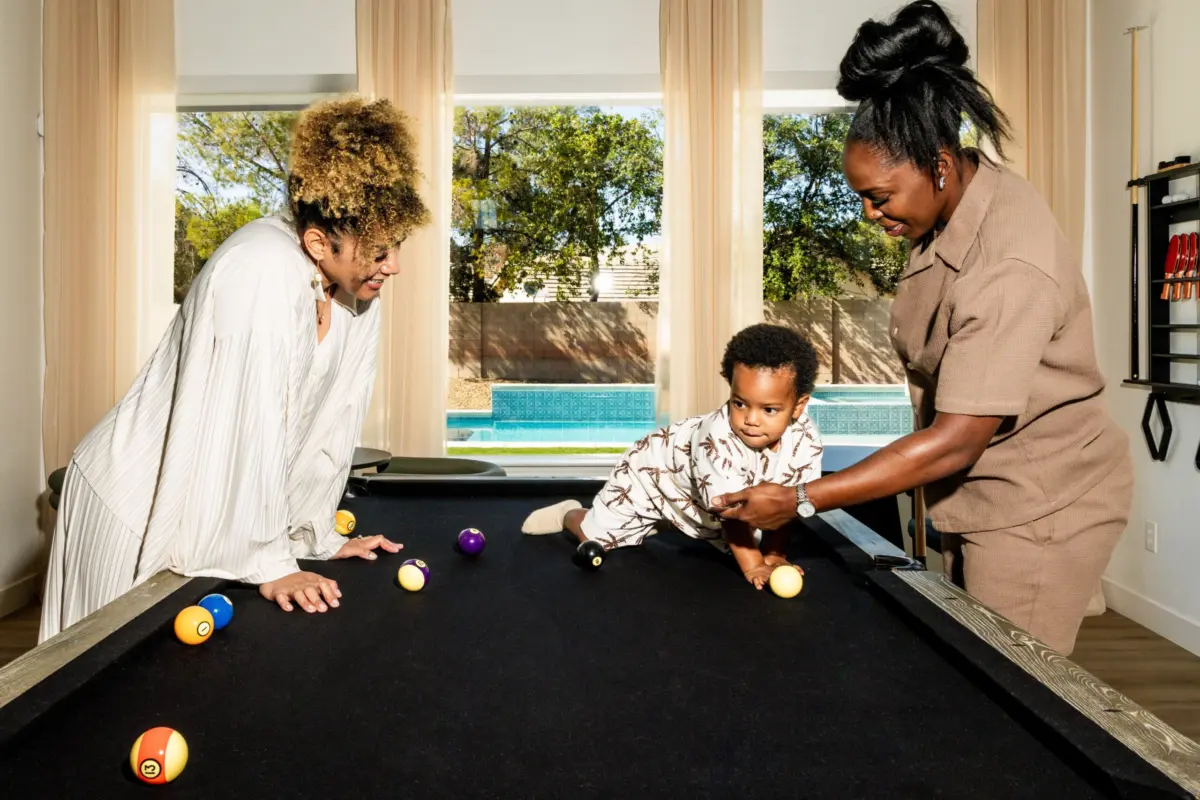
Four-time WNBA champion and Las Vegas Aces guard Chelsea Gray—widely celebrated as the "Point Gawd"—designed her dream family home alongside her wife, Tipesa, welcoming their son, Lennox, in February 2024.
Design Philosophy:"When you come into our house, I want it to be warm, sophisticated, and to feel like, Oh yes, Black people live here," Gray explains.
Interactive Living: The open-concept floor plan ensures Gray never misses a moment while cooking. Her two-year-old son acts as a regular sous-chef on his toddler tower. The home features personalized touches, including a custom office displaying her Duke University and WNBA jerseys, a music-filled environment across every room, and a rich, chocolate-toned movie room adorned with posters of iconic Black actors.
Conclusion
The evolution of WNBA player housing is a testament to the power of collective bargaining and unwavering athletic excellence. By fighting for—and winning—historic salary increases and structural protections, WNBA players have dismantled the transient lifestyle that defined the league’s early decades. Today, whether relaxing in a sunlit Los Angeles condo, enjoying Midwestern hospitality in Indianapolis, gazing at Mount Rainier from a Seattle high-rise, or cooking breakfast with family in Las Vegas, WNBA stars have finally secured what every professional athlete deserves: a true home court advantage.