DENVER, CO — Six decades ago, inside the rustic confines of a Sedona, Arizona tavern, four visionary cowboy artists—Joe Beeler, Charlie Dye, John Wade Hampton, and George Phippen—sketched out the bylaws for a collective that would forever alter the landscape of American art. United by a fierce dedication to capturing the untamed spirit, grit, and romanticism of the American frontier, they founded the Cowboy Artists of America (CAA).
Now, 60 years later, that foundational spark has evolved into a premier cultural institution. On October 2 and 3, the CAA will host its landmark 60th Annual Exhibition and Sale at its stunning new home: The Legacy at the Stock Yards in Denver, Colorado. This milestone event not only celebrates a Diamond Anniversary of artistic excellence but also inaugurates a transformative chapter in the organization’s history through a strategic five-year partnership with the National Western.
Main Facts: A Landmark Move and Diamond Jubilee
The 2026 exhibition marks a monumental geographic and institutional migration for the CAA. Moving to The Legacy at the Stock Yards places the prestigious organization in the heart of Denver’s historic agricultural and Western heritage district.
Over the course of two action-packed days, collectors, fine art aficionados, and the general public will have ticketed access to exclusive events, meet-and-greets with elite creators, and a high-stakes art sale. The crown jewel of the gathering is a black-tie opening evening showcasing brand-new, museum-quality works from some of the finest contemporary Western artists working today.
The exhibition underscores the enduring vitality of Western art as a living, breathing genre. Rather than relying solely on nostalgic tropes, the featured works engage with the complex realities, breathtaking geographies, and rich cultural tapestry of the American West.
Chronology: From a Sedona Tavern to the Mile-High City
To understand the weight of the CAA’s diamond jubilee, one must trace its journey across six decades of changing American landscapes:
1965 (The Sedona Genesis): In a smoky Arizona tavern, Beeler, Dye, Hampton, and Phippen establish the CAA to counter a fine art establishment that frequently marginalized representational Western art. Their mission is clear: champion authenticity, rigorous craftsmanship, and powerful visual storytelling.
The Decades of Growth (1970s–1990s): The CAA grows into an elite fraternity. Membership becomes one of the highest accolades a Western artist can achieve, with strict peer-review standards safeguarding the group’s reputation for technical mastery.
The Turn of the Millennium: As the contemporary art world shifts rapidly toward conceptualism, the CAA remains a steadfast bastion of traditional mediums—oil, acrylic, watercolor, and bronze—while expanding its narrative scope to include diverse perspectives of the frontier.
2026 (The Denver Era Begins): Entering its 60th year, the organization partners with the National Western, establishing a permanent flagship home at The Legacy at the Stock Yards in Denver. This move anchors the CAA deep within a modern nexus of Western commerce, education, and culture.
Supporting Data: The Roster and the Masterworks
Membership in the Cowboy Artists of America remains fiercely coveted and strictly limited. The organization currently comprises 17 active members and 13 emeritus members—veteran creators who continue to submit breathtaking pieces to the annual show each year. Additionally, the CAA invites select guest artists to participate, injecting fresh energy into the annual exhibition. For 2026, the guest invitees are Shawn Cameron and Thomas Blackshear II. Cameron is renowned for her exquisite depictions of cowboys and horses, blending razor-sharp draftsmanship with atmospheric light and color. Blackshear’s figurative works push past traditional portraiture, capturing profound interior emotional lives.
The 2026 catalog reads like a visual anthology of the American West, driven by narrative depth:
Dave Santillanes (Still Waters, Oil, 36 x 60): Santillanes delivers a sweeping, contemplative landscape in which a solitary rider and packhorse discover a pristine, high-mountain alpine lake. The shadowed jewel acts as a powerful metaphor for the West itself as it first revealed its secrets to indigenous peoples, early explorers, and pioneers.
Albin Veselka (How the West Was Won, Oil): Veselka tackles the darker, high-stakes trade-offs of manifest destiny. His dramatic canvas depicts a makeshift raft caught in a violent, roiling current, casting two terrified occupants into treacherous, freezing waters as a poignant symbol of the perils and losses of westward expansion.
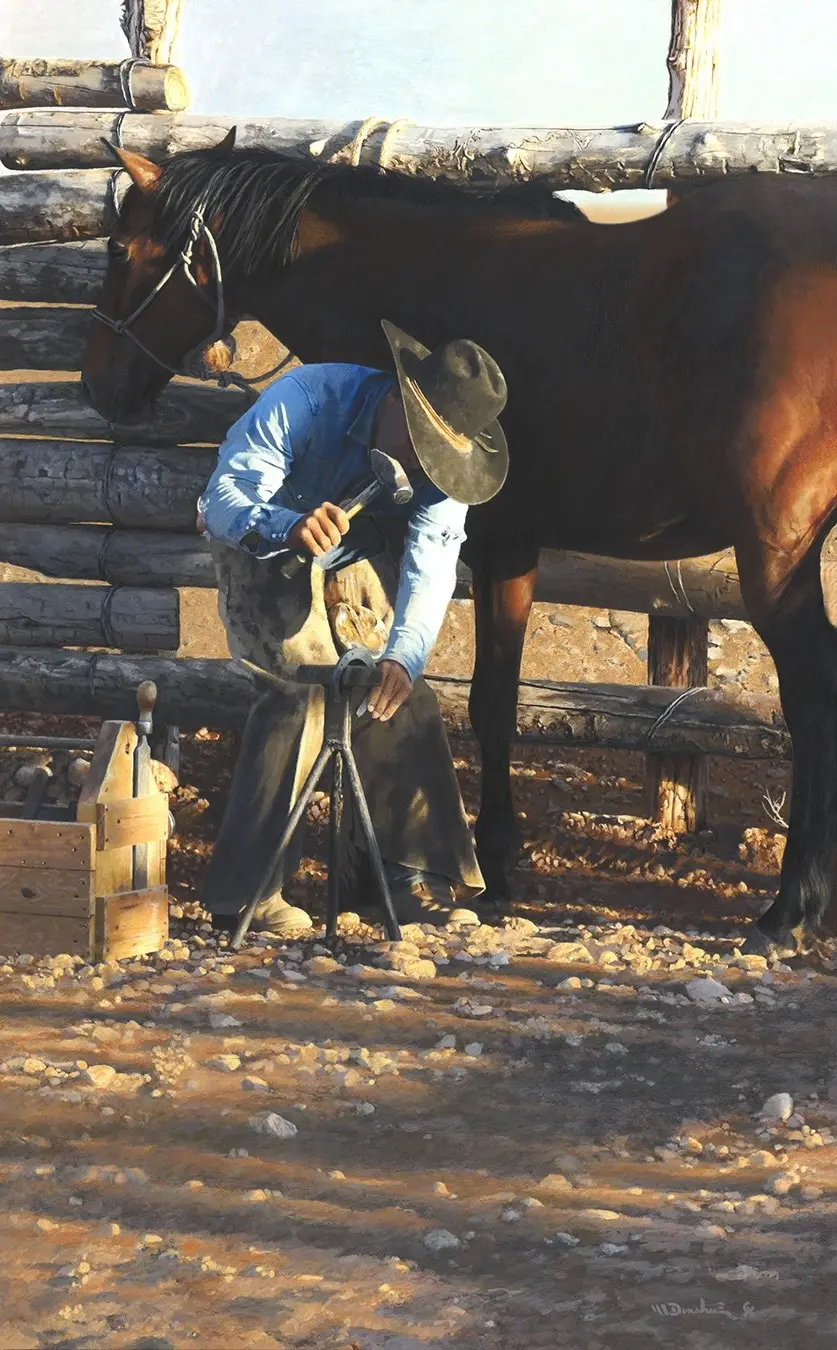
Mikel Donahue (A Day in the Life, Acrylic on Board, 20 x 32) & Grant Redden (A Change of Seasons): These pieces ground the exhibition in the daily, grueling labor of ranch life. From managing cattle herds to preparing for seasonal shifts, these works honor the unglamorous, backbreaking work that sustained frontier civilization.
Dustin Payne (Trail Dust, Bronze): Payne elevates the iconic Texas longhorn from a utilitarian ranch animal to a creature of mythic, heroic proportions through masterful sculptural dynamism.
Martin Grelle (Blending Cultures): An emeritus CAA member, Grelle offers an optimistic vision of the frontier’s future. His canvas explores how historical conflict ultimately paved the way for a vibrant, hybrid society born from the convergence of diverse cultures native to the American West.
Official Responses: Honoring Craftsmanship and Legacy
Speaking on the rigorous standards that define the organization, Wes Allison, President and CEO of the National Western, emphasized why the partnership represents a natural alignment of values.
"Artists have long coveted an invitation to join the CAA, which selects its members for their unwavering devotion to ‘authenticity, craftsmanship, and storytelling,’" Allison stated, noting the profound cultural impact the collective has maintained for half a century.
Art critic and historian James D. Balestrieri, writing on the milestone in Southwest Art magazine, reflected on the original founders’ improbable vision:
"One wonders what Beeler, Dye, Hampton, and Phippen would make of their idea 60 years on. Given the strength of the institution they founded and its ability to seek out and find new sources of excellence even as the West itself changes and changes again, they would surely smile, not only at the endurance of the CAA, but at its capacity to adapt without compromising its mission or principles."
Implications: The Future of Western Art in a Changing World
The 60th Annual Exhibition and Sale at The Legacy at the Stock Yards is much more than a retrospective celebration; it is a declaration of intent for the next generation of Western art.
As urban sprawl encroaches upon traditional ranch lands and the mythology of the frontier faces modern re-examinations, the Cowboy Artists of America provide a vital cultural anchor. By maintaining uncompromising technical standards while welcoming evolving narratives—such as the complex cultural intersections explored by Grelle and the psychological depth brought by Blackshear—the CAA proves that the American West is not a dead, static period of history, but a living, evolving ethos.
Through their five-year partnership with the National Western, the CAA is poised to introduce its brand of storytelling to broader audiences than ever before. For collectors and enthusiasts gathered in Denver this October, the message etched into every bronze casting and oil glaze is clear: the spirit of the American West is alive, well, and in the hands of master storytellers.
For more information on tickets, schedules, and participating artists for the 60th Annual Exhibition and Sale, visit the official website at cowboyartistsofamerica.com.