

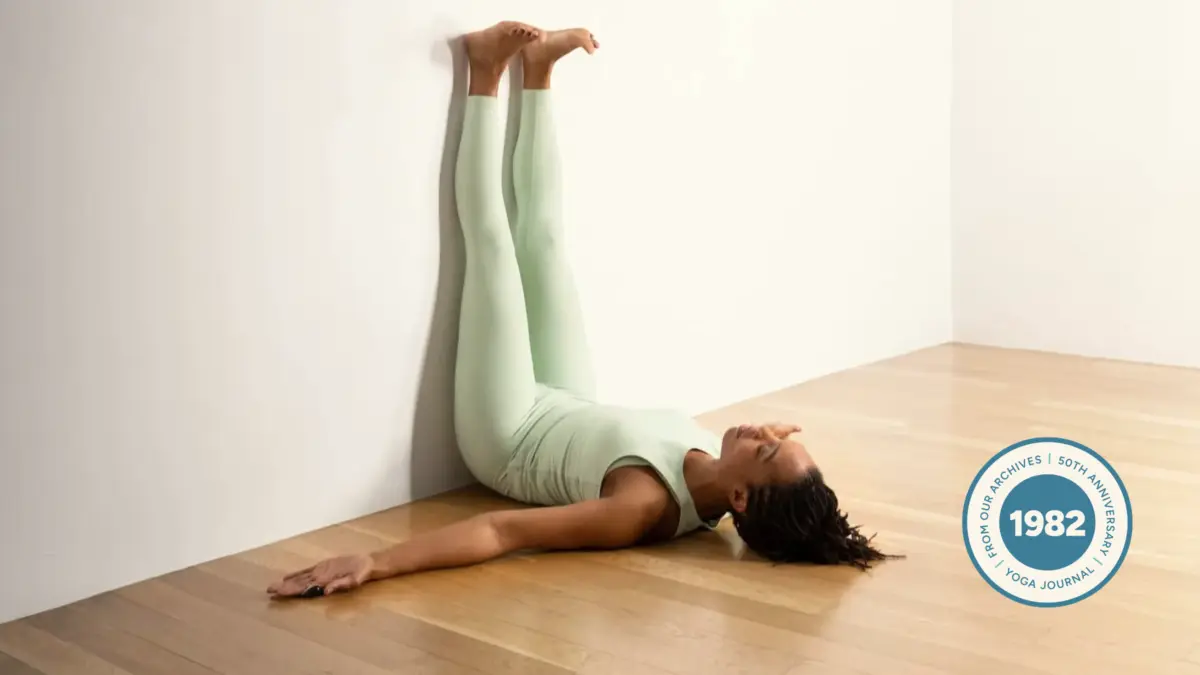
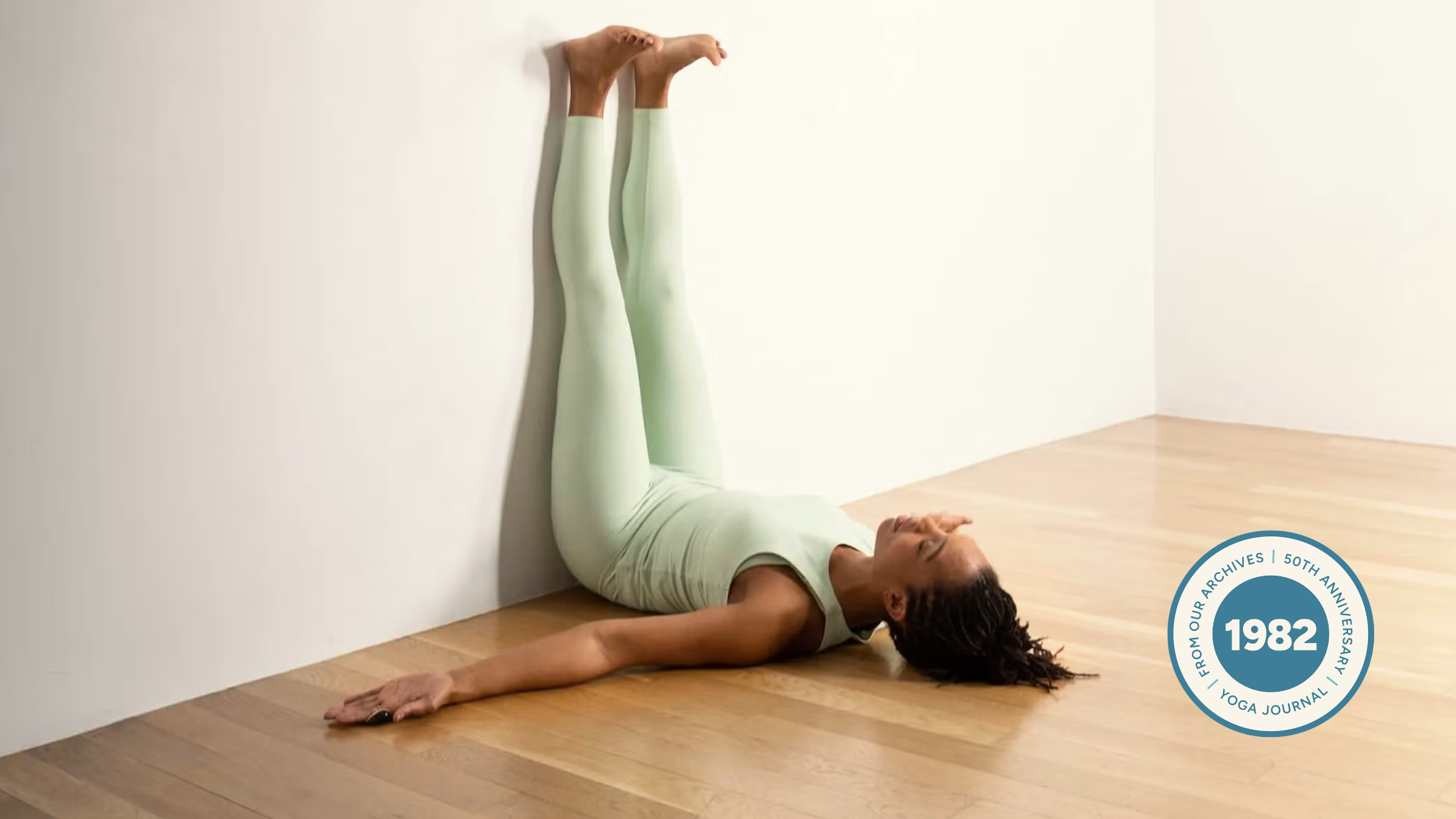
Originally published in the January–February 1982 issue of Yoga Journal, this foundational text on restorative yoga explores the radical physiology of deep relaxation long before burnout became a clinical buzzword.
Main Facts: The Rediscovery of Intentional Stillness
In the autumn of 1971, a newly minted yoga instructor in Austin, Texas, encountered an anomaly. Every evening, a quiet man would enter the studio, bypass the physical postures entirely, and walk straight to the corner to lie down in Savasana (Corpse Pose). He remained motionless for the entire sixty-minute duration of the class, expressed polite gratitude at the sound of the closing bell, and slipped away into the night.
This routine persisted for several weeks before the student finally integrated into the active physical sequences, reserving his motionless vigil for the final fifteen minutes. When questioned about his peculiar habit, he offered a stark explanation: his profession demanded unrelenting mental fortitude, and the studio floor was the sole sanctuary on Earth where he could truly decompress. He found that listening to the quiet cadence of the instructor’s voice and abandoning the need to perform was profoundly medicinal. When he eventually transitioned to dynamic movement, his body flowed with a newfound fluidity and ease.
In the exuberant rush of early-career teaching, the instructor initially dismissed the man as an eccentric outlier. Decades later, however, that student appears remarkably prescient. His visceral recognition of an unmet human need for deep, uninterrupted physical relaxation predated by years a global epidemic of chronic stress and lifestyle-related illness. Today, what was once viewed as an idiosyncratic coping mechanism is recognized by clinical researchers as an essential physiological imperative.
Chronology: From Studio Curio to Medical Orthodoxy
To understand how modern medicine caught up with the quiet corners of yoga studios, it is helpful to trace the timeline of stress research and its intersection with ancient contemplative practices:
- 1971: A stressed professional in Austin, Texas, pioneers his own restorative protocol by spending entire yoga classes lying in Savasana.
- Late 1970s to Early 1980s: Medical researchers begin charting the physiological damage caused by persistent, low-level environmental and professional stressors. Pioneers like Dr. Herbert Benson coin terms like the "relaxation response," quantifying what yogis had known for millennia.
- January–February 1982: Yoga Journal publishes a landmark archive piece codifying restorative yoga practices, detailing the precise geometry of props (blankets, bolsters, and straps) required to bypass muscular exertion and tap into deep nervous system recovery.
- Late 20th Century: The emergence of psychoneuroimmunology bridges the historical gap between Cartesian mind-body dualism, proving empirically that psychological distress directly alters physical and immunological health.
- Modern Era: Restorative yoga and prop-supported asanas graduate from countercultural wellness circles into mainstream cardiology, oncology, and mental health clinical settings as frontline preventions for systemic burnout.
Supporting Data: The Physiology of the Relaxation Response
The human body reacts to modern stressors through a cascade of hormonal and muscular activations designed for acute physical survival—the fight-or-flight response. When activated chronically, however, this system depletes physical and mental energy reserves, breaking down tissue and eroding systemic health.
Medical science has successfully isolated the exact biological mechanisms that counteract this decline:
The Benson "Relaxation Response"
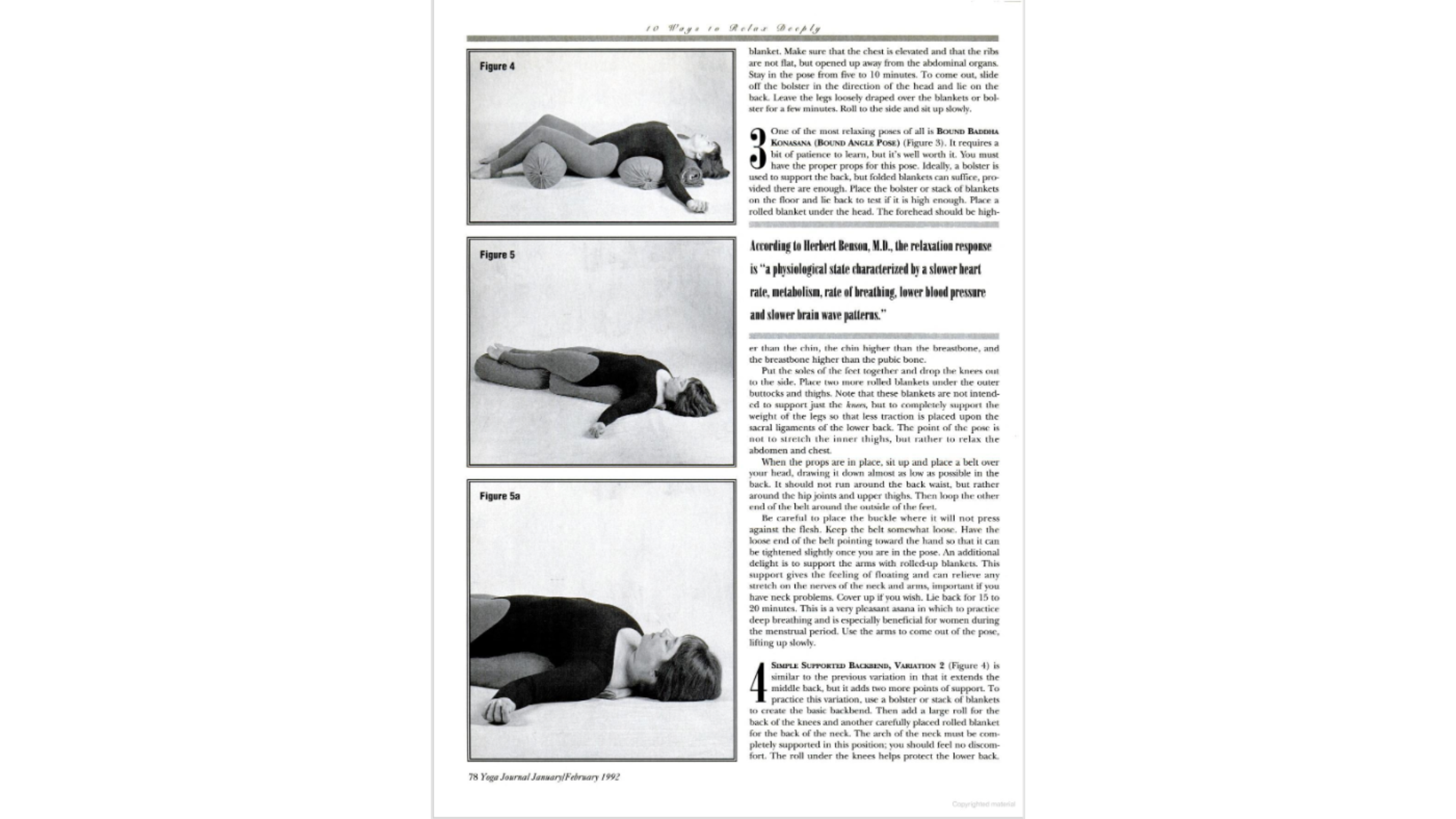
Dr. Herbert Benson, then chief of the behavioral medicine division at New England Deaconess Hospital, categorized the physiological antidote to stress as the "relaxation response." According to Benson’s Wellness Workbook, this state is clinically defined by:
- A decelerated heart rate and metabolic output
- Reduced respiratory rates
- Lowered systemic blood pressure
- Slower, more synchronized brain-wave patterns
Regular practitioners of targeted relaxation techniques consistently report steep drops in chronic anxiety and elevated markers of psychological well-being.
The Ornish Lifestyle Interventions
Dr. Dean Ornish, developer of lifestyle programs aimed at reversing atherosclerotic heart disease, integrated yoga, meditation, and structured relaxation into his clinical protocols (Opening the Heart). Ornish’s research demonstrated that daily periods of deliberate rest are not merely supplementary lifestyle choices, but critical interventions for preventing future cardiac deterioration and rehabilitating patients already suffering from diagnosed heart disease.
Psychoneuroimmunology: The Mind-Body Continuum
Modern medicine has birthed the field of psychoneuroimmunology to study the bidirectional communication network between the central nervous system and the immune system. This discipline provides empirical validation for a core yogic tenet: the body, mind, and emotions cannot be treated as isolated silos. Psychological health is dynamically reflected in—and partly generated by—the physical integrity of the somatic vehicle.
Official Responses and Mechanisms: How Prop-Supported Yoga Heals
True relaxation is distinct from standard sleep. During deep sleep cycles, dreaming states can trigger micro-muscular tension and autonomic spikes that mimic physical stress. In contrast, the deep states cultivated by restorative yoga involve zero voluntary movement, absolute neuromuscular quietude, and a profound deceleration of cognitive output.
1. Muscle Memory and Tension Release
The vast majority of psychological and environmental stress is stored directly within skeletal muscle tissue. Muscles possess a somatic "memory" of past traumas, chronic postures, and high-stakes emotional events. When a muscle is artificially forced to stretch, it often resists, triggering a protective tightening reflex.
However, when supported by strategic props—such as dense wool blankets, bolsters, and adjustable belts—muscles are invited to surrender rather than fight. This structural support coaxes the tissue to release its stored memory, dramatically lowering systemic tension.
2. Micro-Circulation and Cellular Health
Chronic stress creates localized ischemic conditions: areas of the body tighten up, restricting local blood flow. Adequate and free micro-circulation is a primary hallmark of physiological health. By removing the muscular friction that impedes blood flow, deep relaxation restores systemic circulation, bathing starved tissues in oxygenated blood.
Implications: The 10 Essential Poses for Modern Recovery
To reap these physiological rewards, practitioners do not require aggressive flexibility; rather, they require the patience to arrange proper props. The foundational props include five to seven firm wool blankets, a six-foot adjustable yoga belt, a supportive bolster (roughly two feet long, 15 inches wide, and six inches high), a thin head pillow, and a light cloth to shield the eyes from environmental stimuli.
Below are the 10 classic asanas adapted for deep, supported relaxation:
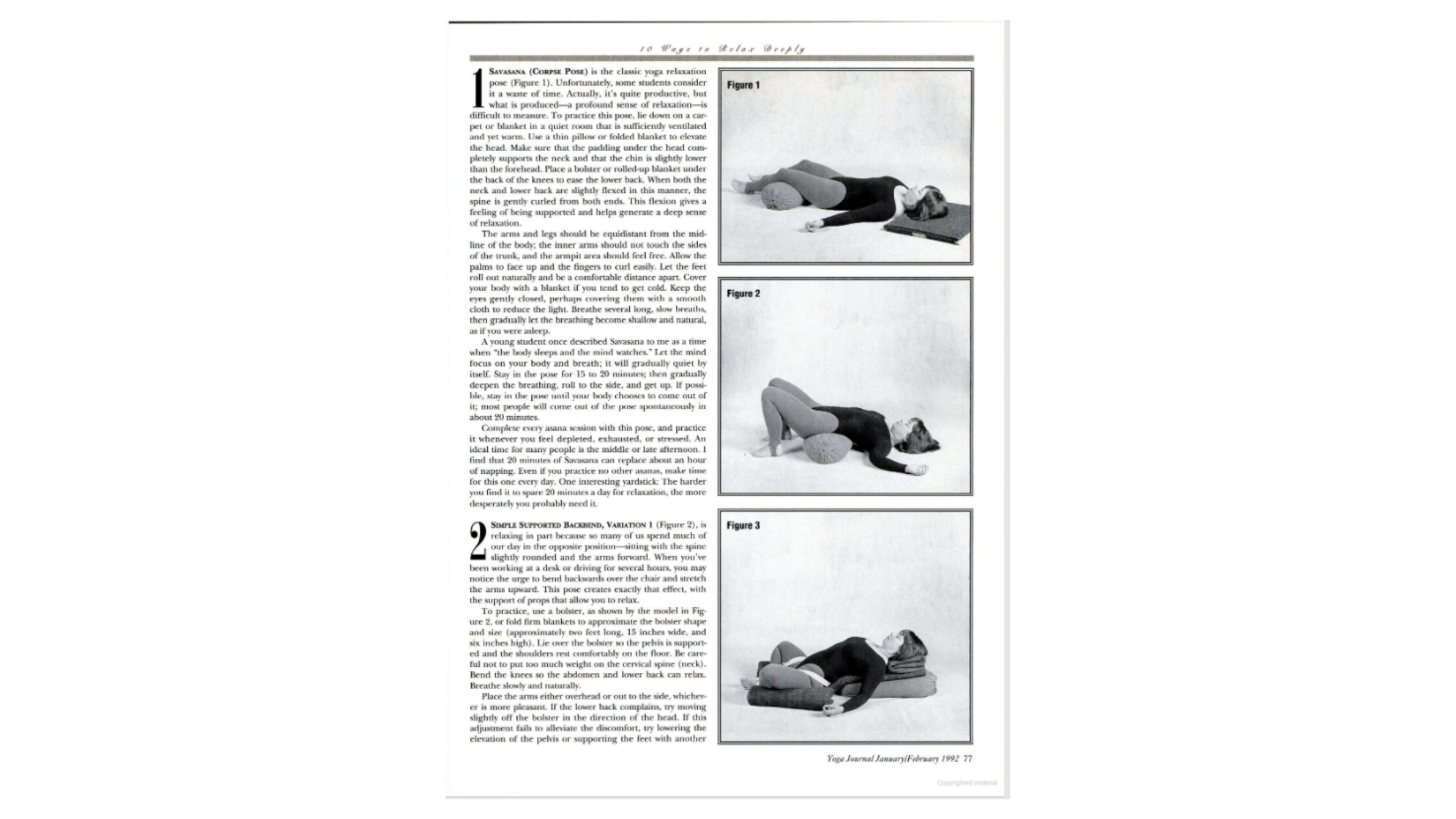
1. Savasana (Corpse Pose)
- The Practice: Lie down in a well-ventilated, warm room. Support the neck with a thin pillow or folded blanket so the chin rests slightly lower than the forehead. Place a bolster beneath the knees to flatten and release the lower back. Keep the arms equidistant from the torso with palms facing upward, and let the feet splay naturally.
- The Benefit: Often dismissed as unproductive, Savasana allows the body to sleep while the mind remains quietly observant. Twenty minutes of proper Savasana can replace up to an hour of standard napping.
2. Simple Supported Backbend, Variation 1
- The Practice: Lie backward over a firm bolster or stack of blankets positioned horizontally across the mid-back. The pelvis remains grounded, the shoulders rest on the floor, and the knees are bent to free the lower back.
- The Benefit: Counteracts the forward-slumped posture characteristic of desk work and driving, opening the chest cavity and expanding the ribcage away from abdominal organs.
3. Baddha Konasana (Reclining Bound Angle Pose)
- The Practice: Bring the soles of the feet together and let the knees drop outward. Use rolled blankets beneath the outer thighs to fully support the leg weight, preventing any undue traction on the sacral ligaments. Loop a belt around the hip joints and the outer edges of the feet to secure the lower body without active muscular effort.
- The Benefit: Relieves pelvic tension, calms the nervous system, and offers profound relief during menstrual cycles.
4. Simple Supported Backbend, Variation 2
- The Practice: Building on Variation 1, introduce an additional roll beneath the knees and a carefully positioned neck roll to fully cradle the cervical arch.
- The Benefit: Creates a wave-like spinal release, allowing the upper body to drape effortlessly over the props like a stream over smooth stones.
5. Setu Bandhasana (Bridge Pose)
- The Practice: Align bolsters or blankets end-to-end to support the full length of the torso while the shoulders rest lightly on the floor. Ensure the chin is not jammed into the chest by supporting the upper back with a thin rolled towel.
- The Benefit: Gently inverts spinal pressures without the intensity of a full shoulder stand, relieving lumbar compression.
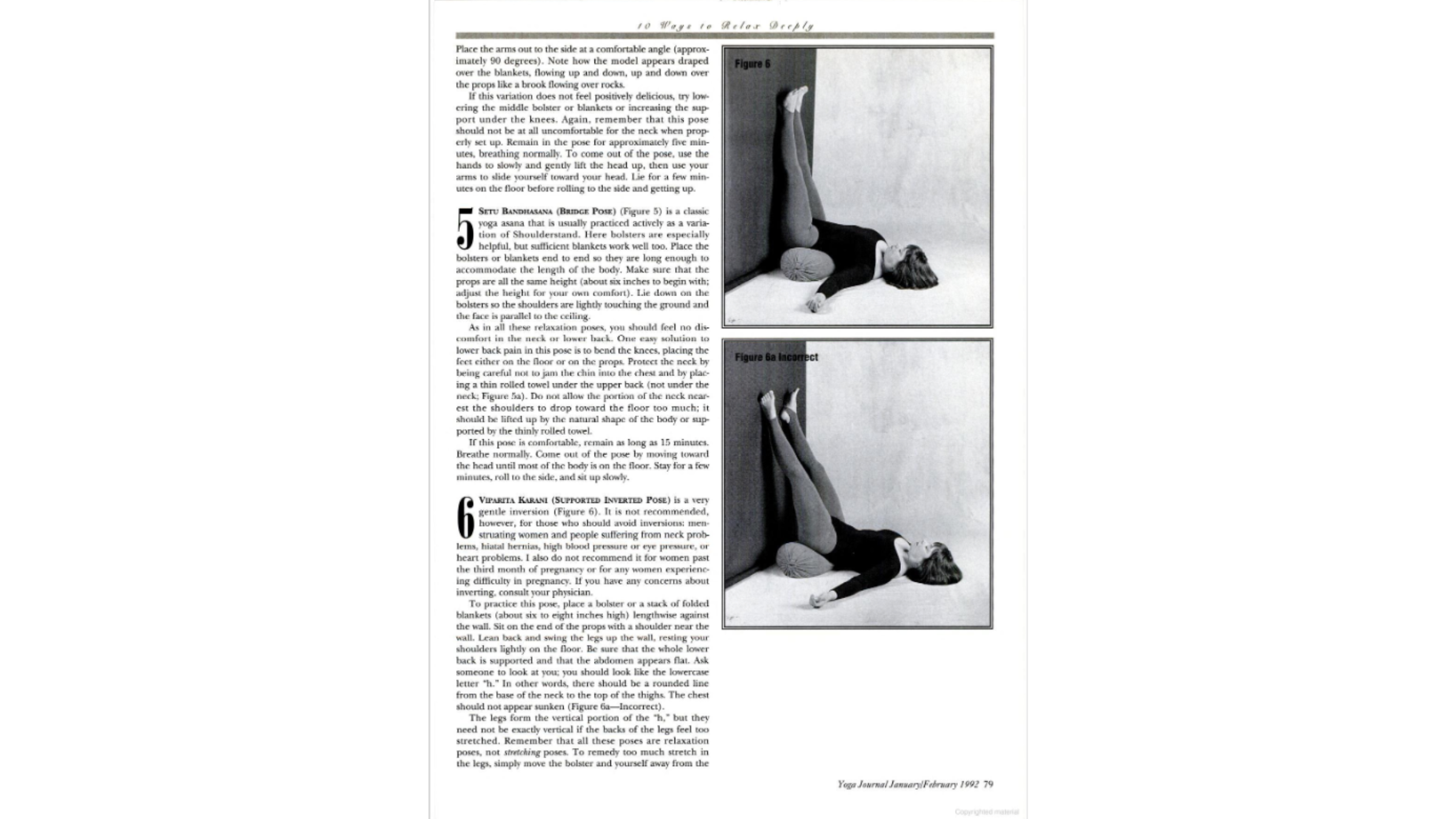
6. Viparita Karani (Supported Inverted Pose)
- The Practice: Position a bolster or blanket stack six to eight inches high against a wall. Sit on the edge, swing the legs vertical against the wall, and let the shoulders rest on the floor, forming a lowercase "h" shape with the torso and legs. (Cautions apply for menstruating individuals, pregnant women past the first trimester, and those with high blood pressure or glaucoma).
- The Benefit: Encourages venous return from the lower extremities, quiets an overactive mind, and rests the heart.
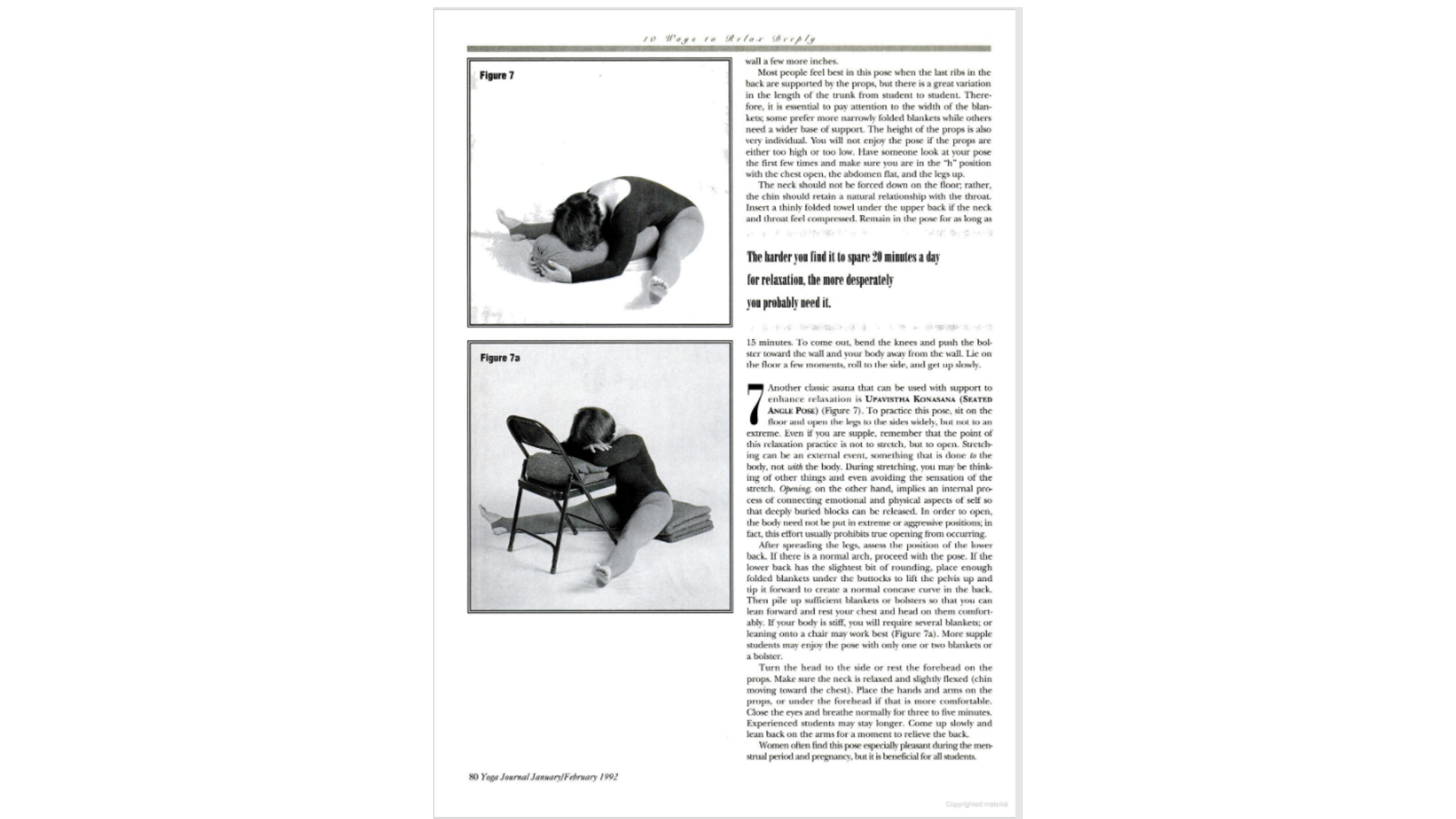
7. Upavistha Konasana (Seated Angle Pose)
- The Practice: Open the legs wide while seated on the floor, elevating the pelvis on blankets if the lower back rounds. Fold forward, resting the torso and head onto a stack of bolsters or a chair.
- The Benefit: Shifts the practice from aggressive external stretching to internal somatic opening, releasing deeply buried emotional and physical blocks.
8. Simple Supported Cross-Legs
- The Practice: Sit in an easy cross-legged posture with a bolster or stack of blankets resting in front of you. Fold forward gently, resting the chest and forehead on the support for several minutes before reversing the cross of the shins.
- The Benefit: Soothes the lower back and encourages inward reflection.
9. Halasana (Plow Pose – Supported)
- The Practice: Intermediate: Using a bolster placed on a nonskid mat, roll backward to support the shoulders while allowing the legs to extend overhead, keeping them shoulder-width apart. Ensure the cervical spine bears zero weight.
- The Benefit: Decompresses the entire posterior chain and profoundly quiets the central nervous system for experienced practitioners.
10. Supported Savasana
- The Practice: Elevate the lower legs on high bolsters so they run parallel to the floor, flattening the lumbar spine completely against the mat. Cover the eyes and remain motionless for 15 to 20 minutes.
- The Benefit: Serves as the gateway to pratyahara (sense withdrawal), acting as a healthy, restorative escape hatch from the relentless agitation of modern life.
Conclusion
As contemporary society continues to grapple with burnout, chronic fatigue, and stress-induced pathologies, the wisdom preserved in these 1982 Yoga Journal archives shines with enduring relevance. The hardest part of restorative yoga is rarely the physical execution; rather, it is carving out the twenty minutes of permission required to stop. As the archives remind us: The harder you find it to spare twenty minutes a day for relaxation, the more desperately you probably need it.
