

Published: October 2, 2026
Series: Yoga Journal Archives (Originally published in the July-August 1993 issue)
Main Facts
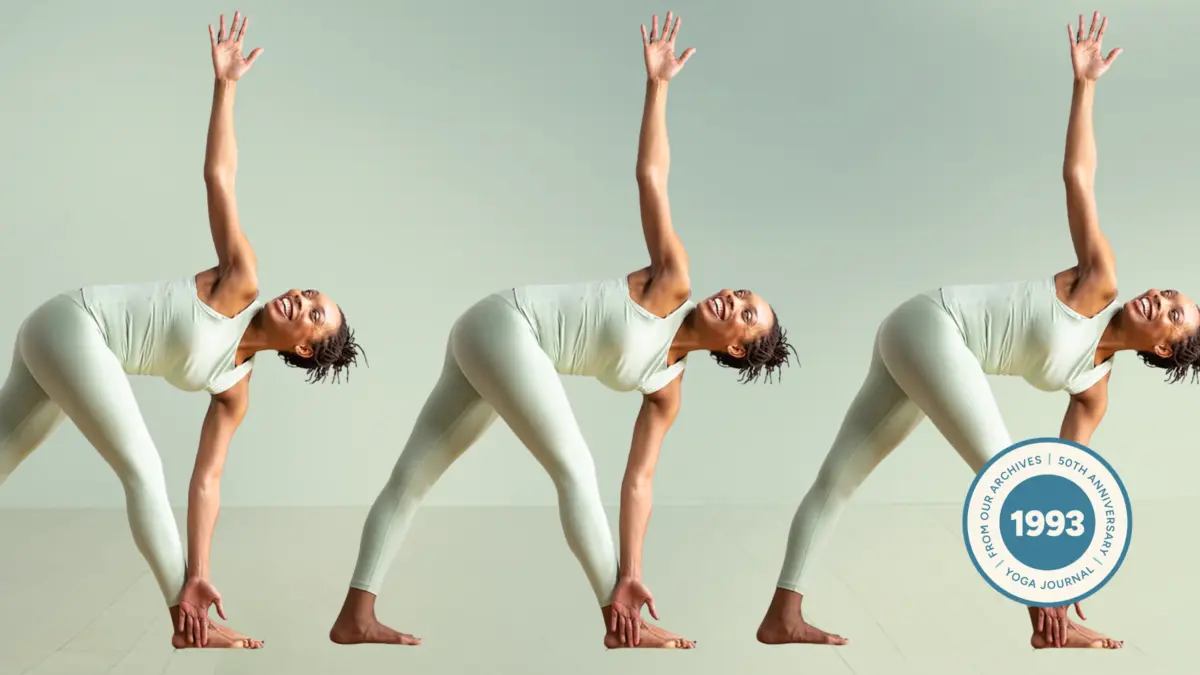
The practice of yoga has long walked a tightrope between ancient intuition and modern biomechanical science. Decades before the advent of digital alignment apps and motion-capture yoga analysis, foundational teachers were already unlocking the complex relationship between human anatomy and natural physical laws. Among these insights, the mechanics of Parivrtta Trikonasana (Revolved Triangle Pose) stand out as a masterclass in physical geometry.
As explored in the historical Yoga Journal archives, mastering Revolved Triangle Pose requires navigating three distinct biomechanical challenges simultaneously: it functions as a deep forward bend, a potent spinal twist, and a demanding balancing posture.
Rather than viewing gravity as an adversary to be overcome through brute muscular strength, classical teachings—rooted in the philosophies of Vanda Scaravelli’s Awakening the Spine—reframe gravity as a collaborative partner. When harnessed correctly, the downward force of the body anchoring into the earth triggers an equal and opposite "rebound" force. This upward kinetic energy lengthens the spine, opens the thoracic cavity, and allows practitioners to achieve stability without tension.
Chronology
To understand the evolution of how modern yoga treats foundational standing postures, it is helpful to trace the philosophical and technical timeline of somatic movement education:
- 1980s–Early 1990s: Pioneering movement educators like Vanda Scaravelli challenge conventional, rigid interpretations of yoga asana. Their work emphasizes spinal waves, breath-led movement, and the "undoing" of muscular tension rather than forcing shapes.
- July–August 1993: Yoga Journal publishes a landmark instructional guide detailing the anatomical physics behind Revolved Triangle Pose, introducing readers to the diaphragm as a central "connecting structure" rather than a mere divider.
- Present Day: Modern biomechanical research validates these archive-derived insights, confirming that stabilizing core joints—such as aligning sitting bones with heels—significantly reduces torque on the lumbar spine and knees during complex multi-planar movements.
Supporting Data and Anatomical Mechanics
The human body is an intricate system of intersecting kinetic chains. At its core, three primary anatomical planes intersect at a central point of gravity, located near the front of the spine between the fourth and fifth lumbar vertebrae.
The Diaphragm as a Bridge
Historically, Western anatomy textbooks classify the diaphragm as a separating structure—a dome-shaped sheet dividing the thoracic cavity from the abdominal space. However, somatic philosophy and advanced yoga practice re-envision it as a primary connecting bridge. When excess tension grips the diaphragm, it creates physical isolation between the upper and lower body, making fluid movement impossible. By prioritizing the breath, practitioners establish a vital communication channel between the grounding energy of the lower body and the expressive openness of the upper chest.
The Physics of the "Rebound"
Newton’s third law states that for every action, there is an equal and opposite reaction. In Parivrtta Trikonasana, this is mirrored in the relationship between the feet and the crown of the head:
- The Descent: On every exhalation, the pelvis, tailbone, and back heel release downward, anchoring deeply into the earth.
- The Ascent: This downward pressure creates a proportional upward and outward "anti-force" (rebound) that lengthens the spinal column toward the crown of the head.
Official Responses and Expert Perspectives
Mastering a posture as complex as Revolved Triangle Pose often exposes a common practitioner dilemma: the struggle between maintaining stability and achieving mobility. When attempting to twist, students frequently sacrifice their grounded base; conversely, when focusing exclusively on anchoring the legs, the upper body often locks up.
According to classical instructional frameworks preserved in the Yoga Journal archives, the resolution to this dilemma lies in understanding that unboundedness has its roots in the ground.
Expert instructors emphasize that structural integrity begins with skeletal alignment rather than muscular exertion:
- Heel-to-Sitting-Bone Alignment: Ensuring that sitting bones align precisely with the heels in standing poses keeps the torso balanced directly over the lower limbs. This alignment prevents unnecessary torque on the knee joints and eliminates compensatory gripping in the back muscles.
- The Counter-Force Principle: Just as opening a stubborn jar requires holding the base steady while twisting the lid, a successful spinal twist requires the lower body to provide a resistive counter-force. In Revolved Triangle, this is achieved by gently turning the back shin and inner arch outward, preventing the spine from collapsing into itself.
Step-by-Step Practical Integration
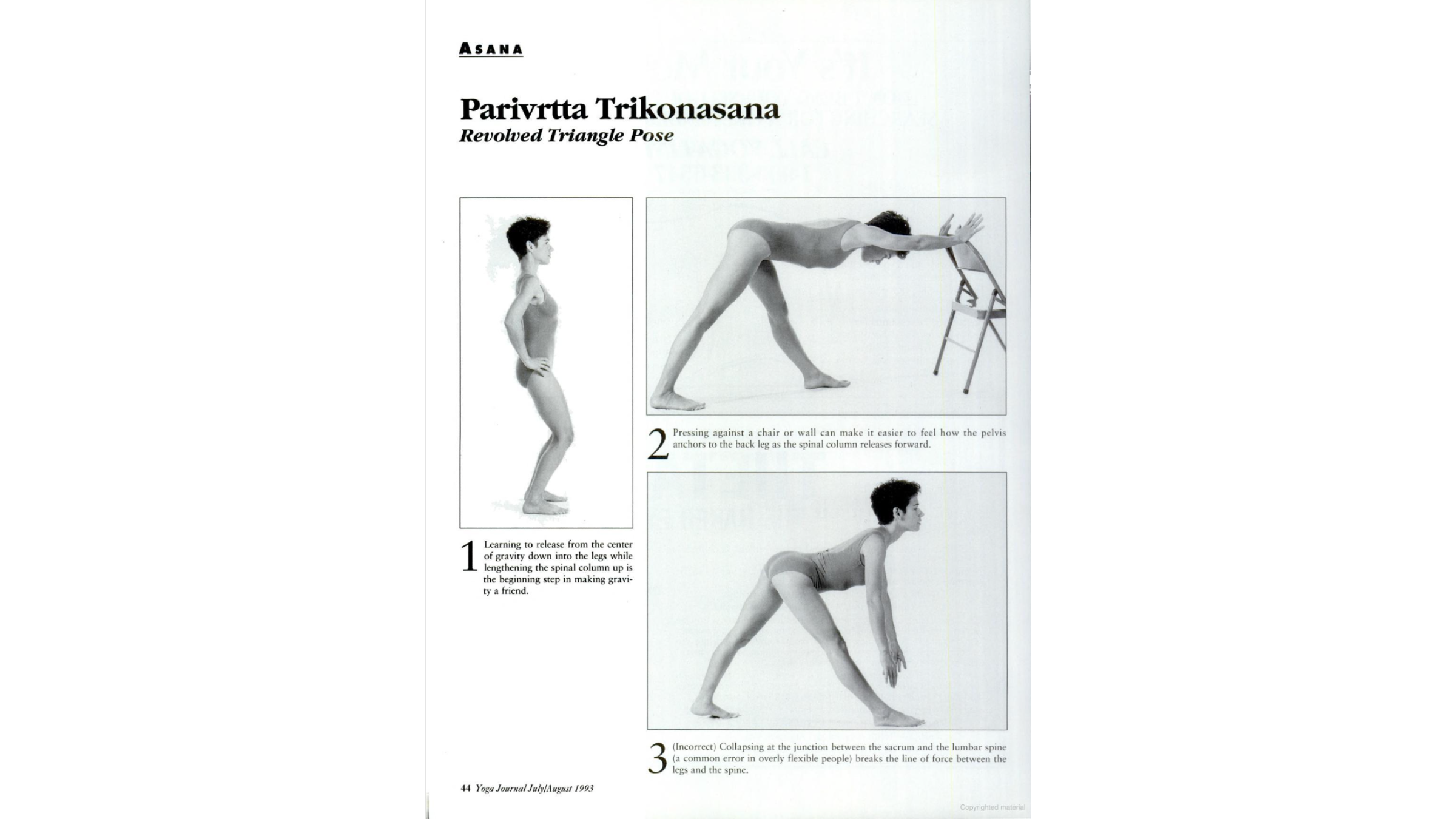
To safely build toward the full expression of Parivrtta Trikonasana, practitioners are encouraged to progress systematically through foundational exercises, beginner modifications, and advanced integrations.
1. Preliminary Exercise: Establishing the Baseline
- Setup: Stand in Mountain Pose (Tadasana) with feet hip-width apart. Bend the knees slightly and exhale to release the pelvis, tailbone, and sacrum downward.
- Execution: Place your hands (or have a partner place theirs) on the sides of the pelvis, pressing directly down. Simultaneously, reach the spine upward from the waist to the base of the skull.
- Feeling: Experience the tension between the downward pull of the lower body and the upward release of the spine. This opposing energy line is the blueprint for all yoga asanas.
2. Beginner’s Practice: Using Props for Stability
- Setup: Position a chair against a wall. Step your right foot forward and your left leg back about three feet, turning the back foot inward at a 30-degree angle to align the pelvis parallel to the wall.
- Execution: Tip forward from the hip joints (femurs) until your spine is parallel to the floor, extending your hands to press firmly into the back of the chair. Maintain an open chest and a fully elongated spine.
- Integration: After 10 steady breaths, integrate a twist by placing a yoga block inside the right foot. Bring your right hand to your right hip, rotating your navel toward the ceiling sequentially: abdomen, waist, rib cage, and chest, before extending the right arm skyward.
3. Advanced Practice: The Simultaneous Bend and Twist
- Setup: Stand in the center of the room with feet wide apart. Turn the right foot out 90 degrees and the left foot in 30 degrees.
- Execution: Extend the left arm overhead, reach forward, and rotate toward the right simultaneously. Touch the left fingertips to the floor (or a block) inside the right foot while reaching the right arm toward the ceiling.
- Refinement: Rather than forcing the spine with arm strength, initiate the twist by softening the frontal body. Allow the rib cage to expand away from the spinal column on inhalation, and gently roll the abdomen and chest into the back body on exhalation.
Implications
The enduring relevance of instructional archives from decades past highlights a timeless truth in movement education: physical mastery is not about overriding the body’s natural limitations through force, but about listening to its internal architecture.
By treating gravity as an ally, prioritizing breath as a connecting bridge, and respecting the kinetic relationship between grounding and extension, practitioners of Parivrtta Trikonasana discover a profound sense of ease within complexity. Ultimately, the lessons learned on the yoga mat—where stability breeds freedom, and surrender unlocks strength—extend far beyond the practice space, offering a blueprint for balance in everyday life.
