

By Global Science Correspondent
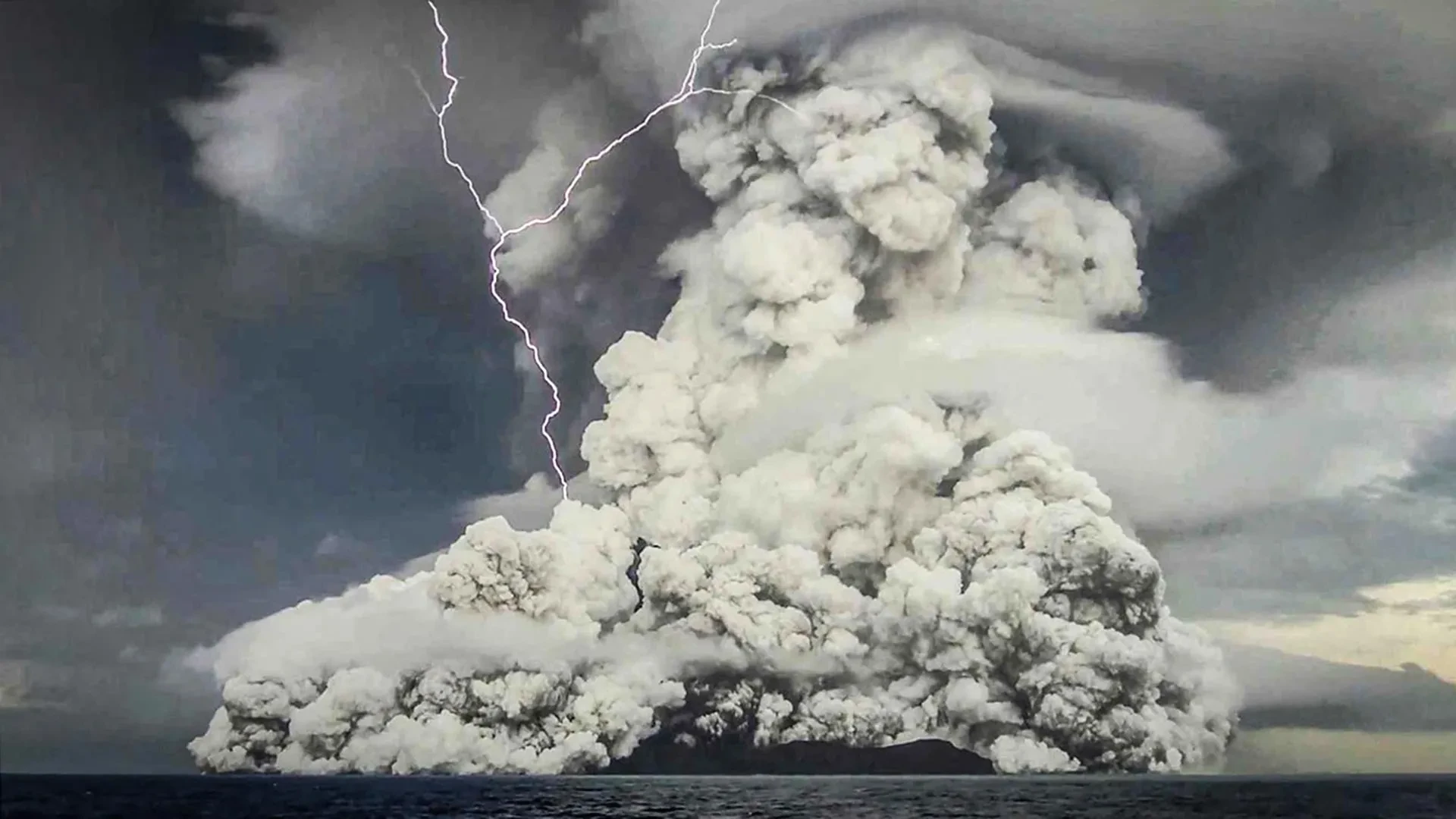
When the Hunga Tonga-Hunga Ha’apai volcano violently erupted beneath the South Pacific waves in January 2022, it sent shockwaves, tsunamis, and atmospheric anomalies around the globe. The cataclysm easily ranked among the most powerful volcanic events of the modern era, injecting unprecedented amounts of water vapor, ash, and gases high into the stratosphere.
Now, an international team of researchers has uncovered a surprising and previously unknown silver lining to the disaster. Amidst the chaos of the massive explosion, the volcanic cloud appears to have actively scrubbed away a portion of the very methane pollution it produced.
The discovery, recently published in the prestigious journal Nature Communications, offers a rare glimpse into a potent natural cleaning mechanism in the atmosphere. More importantly, it provides scientists with a potential blueprint for addressing global warming on human timescales, offering a new perspective on atmospheric chemistry, global climate models, and deliberate climate intervention.
Main Facts: The Discovery and the Mechanism
At the heart of the discovery is an unexpected chemical fingerprint detected by satellites orbiting hundreds of miles above Earth. As researchers analyzed the massive plume churned out by Hunga Tonga, they noticed exceptionally high concentrations of formaldehyde—a short-lived chemical byproduct generated when methane is broken down in the atmosphere.
Because formaldehyde typically degrades within a matter of hours, finding massive, sustained quantities of it tracked across the globe for ten days signaled an extraordinary continuous reaction. The volcanic ash, heavily laced with seawater blasted upward from the ocean floor, had interacted with sunlight in the stratosphere to produce highly reactive chlorine atoms. These chlorine atoms systematically attacked and destroyed methane molecules within the plume.
- The Event: The January 2022 eruption of Hunga Tonga-Hunga Ha’apai in the South Pacific.
- The Discovery: Satellite observations captured record-high levels of formaldehyde within the volcanic plume, tracking it continuously for 10 days all the way to South America.
- The Chemistry: A unique mixture of volcanic ash, salty seawater, and sunlight generated reactive chlorine atoms, which act as a powerful catalyst to break down atmospheric methane.
- The Scale: The volcano released approximately 300 gigagrams (Gg) of methane, while the plume simultaneously destroyed roughly 900 megagrams (Mg) of methane per day.
- The Significance: This marks the first time volcanic ash has been shown to chemically reduce methane pollution on a stratospheric scale, forcing a reevaluation of global methane budgets and offering clues for future climate interventions.
Chronology of the Event and Discovery
To understand how this remarkable natural phenomenon came to light, researchers had to piece together a timeline stretching from the initial undersea explosion to advanced satellite data processing months later.
January 2022: The Cataclysmic Eruption
Hunga Tonga-Hunga Ha’apai erupts with cataclysmic force. Because the volcano sits beneath the ocean surface, the explosion vaporizes massive quantities of seawater, violently lofting a complex mixture of sea salt, ash, sulfur dioxide, and newly generated gases straight into the stratosphere—far higher than normal weather patterns occur.
Spring 2022 – Early Analysis
Scientists worldwide begin tracking the unprecedented injection of water vapor and aerosols into the stratosphere using ground-based instruments and satellite telemetry. Among the monitoring systems is TROPOMI (TROPOspheric Monitoring Instrument), an advanced sensor aboard the European Space Agency’s Sentinel-5P satellite designed primarily to monitor air pollution and climate gases in the lower atmosphere.
2023–2024: Connecting the Chemical Dots
Researchers begin noticing anomalous signals in the TROPOMI data. High above the troposphere, deep within the stratospheric plume, the instrument detects massive spikes of formaldehyde.
To confirm that the reading is not an instrument error caused by sulfur dioxide interference or unusual altitude, a collaborative team—including scientists from the Netherlands, Belgium, Spain, and Denmark—undertakes rigorous data corrections. They determine that the formaldehyde signal is genuine, proving that methane destruction is actively occurring inside the cloud for over a week.
Supporting Data: Crunching the Numbers
The quantitative scale of the Hunga Tonga eruption and its aftermath reveals a fascinating balance between emissions and natural destruction.
According to calculations performed by the research team, the volcano released approximately 300 gigagrams (Gg) of methane during its explosive phases. To put that figure into perspective, it is roughly equivalent to the annual methane emissions produced by more than two million cattle.
However, the clearing mechanism operating within the plume worked at a staggering pace. The researchers estimate that the reaction removed approximately 900 megagrams (Mg) of methane per day—an amount equivalent to the daily emissions of another two million cows.
Understanding the Methane Threat
Why does this matter so profoundly for the climate? Methane currently accounts for approximately one-third of contemporary global warming. While carbon dioxide dominates discussions due to its massive volume and multi-century persistence, methane is a far more aggressive heat-trapping agent.
- Potency: Over a 20-year timescale, methane is roughly 80 times more potent at warming the planet than carbon dioxide.
- Atmospheric Lifespan: Methane typically breaks down in the atmosphere after about a decade, compared to centuries for CO2.
- The "Emergency Brake": Because methane disappears relatively quickly, cutting its atmospheric concentration yields rapid climate benefits. Lowering methane levels now could act as an emergency brake on global warming, mitigating near-term temperature spikes and reducing the risk of triggering irreversible climate tipping points.
Official Responses and Expert Insights
The study, supported by Spark Climate Solutions and published in Nature Communications, has drawn widespread attention from the global atmospheric science community. The researchers themselves emphasize both the elegance of the discovery and the extreme caution required if humanity attempts to mimic it.
"When we analyzed the satellite images, we were surprised to see a cloud with a record-high concentration of formaldehyde. We were able to track the cloud for 10 days, all the way to South America. Because formaldehyde only exists for a few hours, this showed that the cloud must have been destroying methane continuously for more than a week."
— Dr. Maarten van Herpen, Acacia Impact Innovation BV (Lead Author)
Dr. van Herpen highlights that while volcanoes are known sources of greenhouse gases, their capacity to partially clean up their own pollution via ash chemistry was entirely unknown until now.
The underlying chemical pathway—involving iron salt aerosols and reactive chlorine—was initially documented in 2023 regarding Saharan mineral dust blowing across the Atlantic Ocean. However, observing this process operating at extreme altitudes in the stratosphere caught the scientific community off guard.
"What is new—and completely surprising—is that the same mechanism appears to occur in a volcanic plume high up in the stratosphere, where the physical conditions are entirely different."
— Professor Matthew Johnson, University of Copenhagen
Validating these findings from space required overcoming immense technical hurdles. TROPOMI was never engineered to sniff out stratospheric volcanic formaldehyde plumes.
"Retrieving formaldehyde from TROPOMI in a stratospheric volcanic plume is far outside the instrument’s standard operating conditions—we had to carefully correct the satellite’s sensitivity for the unusual altitude of the signal and account for interference from the high sulfur dioxide concentrations. Getting these corrections right was essential to confirm that what we were seeing was real."
— Dr. Isabelle De Smedt, Royal Belgian Institute for Space Aeronomy
Broader Implications: Rewriting the Global Budget and Future Engineering
The ramifications of the Hunga Tonga study extend across multiple scientific disciplines, touching on global climate accounting, technological innovation, and atmospheric governance.
1. Correcting the Global Methane Budget
For decades, atmospheric scientists have relied on a "methane budget"—a global accounting ledger that balances known emissions sources (such as wetlands, agriculture, fossil fuel extraction, and geological activity) against known chemical sinks (such as hydroxyl radicals that break methane down in the troposphere).
Atmospheric dust, particularly from intermittent events like volcanic eruptions or massive dust storms, has historically been omitted from these calculations. The new findings prove that mineral dust and volcanic ash play a quantifiable role in regulating atmospheric chemistry. As a result, researchers argue that global climate models and methane budget estimates must be adjusted to account for these natural dust sinks.
2. A Blueprint for Methane Removal Technologies
The discovery opens an intriguing door for climate engineering and industrial research. For years, scientists have debated whether active atmospheric methane removal is feasible. One of the greatest hurdles in developing such technologies has been verification: how can a company prove that its intervention actually destroyed methane spread across vast, dynamic air masses?
Hunga Tonga demonstrated that satellite monitoring—specifically tracking transitional chemicals like formaldehyde—can successfully verify large-scale methane destruction from space.
"How do you prove that methane has been removed from the atmosphere? How do you know your method works? It’s very difficult. But here we address that problem by showing that methane breakdown can in fact be observed using satellites."
— Dr. Jos de Laat, Royal Netherlands Meteorological Institute (Senior Author)
While engineering a safe, artificial version of iron-salt aerosol generation to scrub methane remains a distant and environmentally sensitive prospect, the natural precedent is now established. Industry and researchers now have a theoretical model to study.
3. A Word of Caution
Despite the appeal of a technological "quick fix" for methane, the scientific community remains unified on one vital point: natural removal mechanisms and potential geoengineering concepts are not substitutes for cutting greenhouse gas emissions at the source. Long-term climate stabilization ultimately depends on aggressive reductions in both carbon dioxide and methane.
Nevertheless, as the world navigates an increasingly volatile climate future, nature has provided an unexpected lesson—proving that even the most catastrophic geological events can sometimes trigger delicate, intricate chemical reactions that help heal the sky.
