

By Science & Environment Desk
Published in Communications Biology
For generations, the global public has associated Antarctica’s avian life with the iconic, four-foot-tall Emperor penguin. Yet, the Emperor is far from alone in the frigid waters of the Southern Hemisphere. Seventeen other distinct penguin species inhabit these treacherous latitudes, many of them making their homes on isolated, wind-swept islands that remain profoundly challenging for researchers to access.
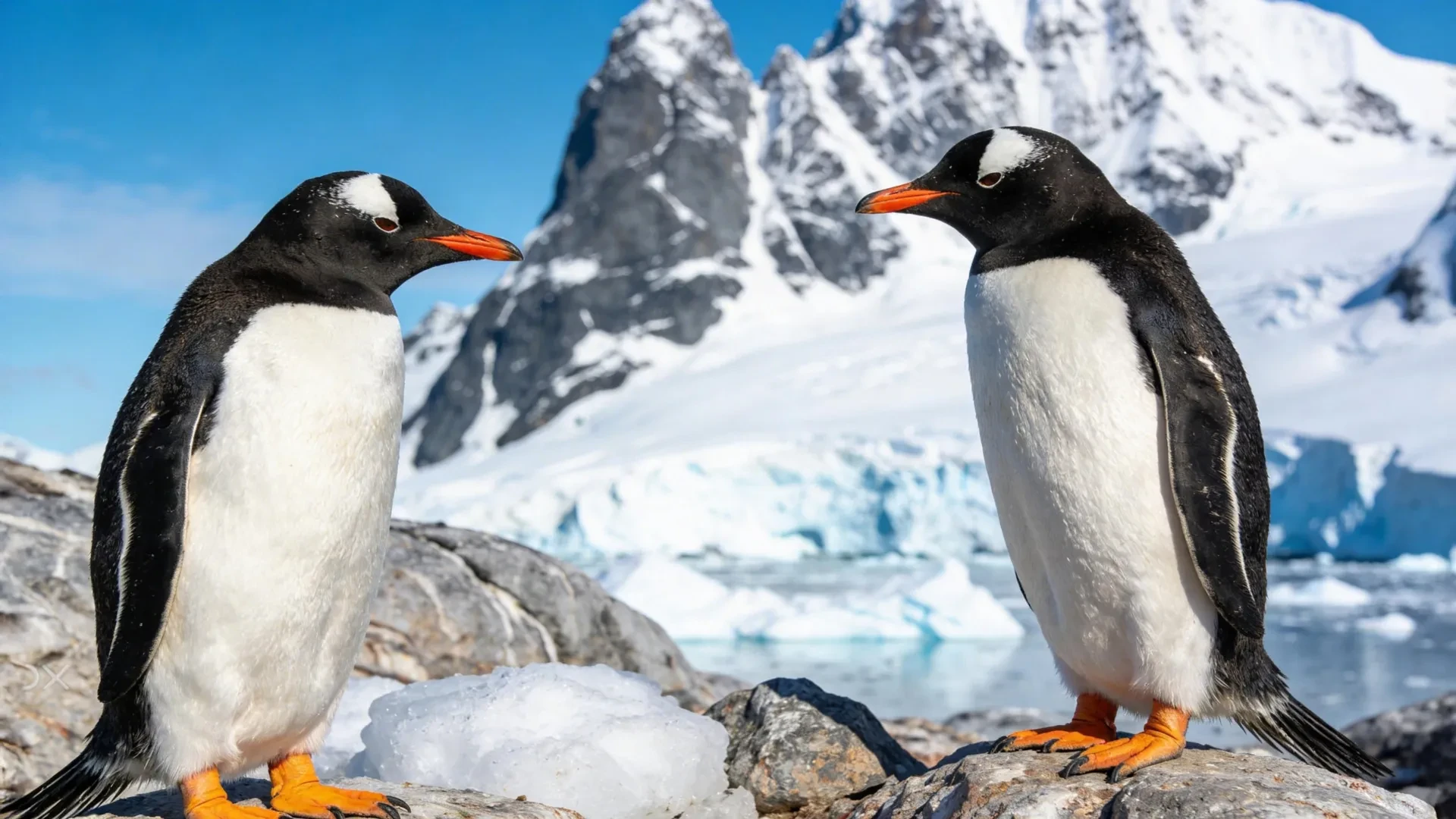
This extreme geographic isolation has long acted as a veil, obscuring the true diversity of Antarctic and sub-Antarctic wildlife. Now, that veil has been partially lifted. An international team of scientists spanning Chile, the United States, and numerous other nations has analyzed whole-genome sequencing data to reveal that what was once universally categorized as a single, widely distributed gentoo penguin species is actually a complex of four distinct species.
Among these is a population that has never before been formally recognized by science. Living nearly 2,000 miles away from any permanently inhabited landmass on the remote Kerguelen Islands—historically known in French as the Îles de la Désolation, or Desolation Islands—this newly identified lineage marks the first time in more than a century that a brand-new penguin species has been officially named. The landmark findings were recently published in the journal Communications Biology.
Main Facts
The core of the discovery centers on the genetic restructuring of the gentoo penguin (Pygoscelis papua complex). By utilizing high-resolution genomic data, researchers determined that four distinct populations have evolved along separate evolutionary trajectories over the last 300,000 to 500,000 years.
- The New Discovery (Pygoscelis kerguelensis): Officially named the southeastern gentoo penguin, this cryptic species inhabits the Kerguelen Islands and likely nearby Heard Island. While it shares the familiar physical attributes of other gentoos—such as a stark white underside and a sleek black back designed for ocean navigation—its genome is entirely distinct.
- Subspecies Elevated to Full Species: Three other populations previously classified merely as subspecies have been elevated to full species status due to profound genetic divergence:
- The Southern Gentoo (Pygoscelis ellsworthi): Inhabiting the Antarctic Peninsula, coastal Antarctica, and South Georgia Island, this is the most numerous lineage and the only one residing directly on the Antarctic continent.
- The Eastern Gentoo (Pygoscelis taeniata): Found north of the Antarctic Polar Front on the Crozet, Marion, and Macquarie Islands.
- The Northern Gentoo (Pygoscelis papua): Restricted strictly to the Falkland (Malvinas) Islands and Martillo Island off the coast of South America.
- Conservation Vulnerability: While the southern gentoo is currently thriving and may even expand its range as climate change reshapes the continent, the three sub-Antarctic island species face severe conservation risks. Confined to isolated landmasses with nowhere to retreat as temperatures rise, these populations could lose substantial portions of their suitable habitat by the year 2050.
Chronology of a Century-Long Scientific Debate
The taxonomy of the gentoo penguin has been a lightning rod for academic debate for over a hundred years. The timeline of this biological mystery highlights the complexities of studying remote marine species:
- Early 20th Century: Naturalists and early taxonomists began noting minor morphological variations—such as differences in body size, bill coloration, and vocalizations—among gentoo populations scattered across thousands of miles of ocean. However, without genetic tools, these observations led to fragmented classifications, with historical proposals suggesting as many as six distinct subspecies. Consensus remained entirely out of reach.
- 2010–2019 (Laying the Groundwork): Co-senior authors Rauri Bowie, a professor of integrative biology at UC Berkeley, and Juliana Vianna, a professor of ecosystems and environment at Andrés Bello National University in Santiago, Chile, spent nearly a decade studying how Southern Hemisphere penguins evolved. In 2019, they published pivotal research indicating that penguins originated near Australia and New Zealand approximately 22 million years ago, eventually spreading across the globe via the circumpolar current.
- The Global Collaboration: To definitively settle the century-old gentoo debate, Vianna and Bowie joined forces with Elie Poulin, a professor at the University of Chile. Together, they assembled a global consortium of penguin specialists spanning Australia, Spain, Venezuela, South Africa, the United Kingdom, France, Argentina, Monaco, and Brazil.
- Genomic Breakthrough (Recent): Led by University of Chile graduate student Daly Noll, the research team gathered whole-genome sequences from 64 penguins across 10 breeding colonies. For the first time, sampling covered nearly the entire geographic range of the gentoo penguin, leading directly to the identification of Pygoscelis kerguelensis and the formal elevation of the other lineages.
Supporting Data: Genetics and Dietary Flexibility
The genomic analysis relied on examining thousands of genetic variations known as single nucleotide polymorphisms (SNPs). This deep dive into the code of life revealed fascinating local adaptations:
- Extreme Polar Survival (Pygoscelis ellsworthi): The southern gentoo, thriving in the harsh Antarctic environment, carries genetic enrichments associated with heat production, heavy fat and lipid storage, and enhanced light perception. The latter adaptation likely helps the birds cope with extreme seasonal shifts in polar daylight and the intense glare of sunlight reflecting off sea ice.
- Sub-Antarctic Diving Efficiency (Pygoscelis taeniata): The eastern gentoo evolved a genome rich in genes tied to carbohydrate metabolism and superior diving performance. These include traits governing oxygen transport, blood vessel formation, mitochondrial activity, and lung development—adaptations that allow the birds to forage longer in oceans with lower biological productivity.
- South American Endurance (Pygoscelis papua): The northern lineage showed genetic enrichment linked to efficient digestion, heart contraction, and muscle excitation, supporting the sustained physical exertion required for prolonged underwater feeding.
- The Power of a Flexible Diet: Unlike many of their penguin relatives—such as Emperor and Adélie penguins, which rely heavily on krill—gentoos are nutritional generalists. They consume almost anything they can catch underwater, including fish, squid, cuttlefish, and krill. This flexibility means they do not have to travel vast distances from their breeding colonies to forage. Over hundreds of thousands of years, this localized site fidelity, reinforced by the physical barrier of the Antarctic Polar Front (where water temperatures and salinity shift sharply), allowed distinct populations to adapt to their local environments and ultimately diverge into separate species.
Official Responses and Expert Perspectives
The formal recognition of four distinct gentoo species carries immediate policy implications for governments overseeing the sub-Antarctic islands.
"It’s very important that conservation institutions in all the different countries involved recognize and take appropriate action to save these three gentoo penguin species," stated Dr. Juliana Vianna, senior author of the study from Andrés Bello National University. Vianna emphasized that while Antarctic populations are currently resilient, sub-Antarctic islands governed by nations such as Chile, South Africa, France, Australia, New Zealand, and the Netherlands require immediate, localized conservation strategies.
Reflecting on the century-long controversy, Dr. Rauri Bowie, a curator in UC Berkeley’s Museum of Vertebrate Zoology, noted: "There’s probably no species of penguin where the taxonomy has been more debated than the gentoo penguin. For over 100 years it’s been controversial as to how many species or how many subspecies there are. What this paper does is try to address that question using cutting-edge integrative approaches."
Bowie also highlighted the broader value of the genomic dataset. Vianna and her colleagues are already utilizing the sequenced genomes to investigate genetic markers associated with survival rates against avian influenza—a devastating disease currently sweeping through global bird and mammal populations. Identifying natural resistance or vulnerability will allow conservationists to prioritize interventions for the most threatened colonies.
Implications for Conservation and Climate Change
While the southern gentoo is projected to potentially expand its range southward as sea ice retreats, the outlook for its island-dwelling relatives is starkly different.
Climate models mapping suitable gentoo habitat out to the year 2050 suggest that sub-Antarctic species could face catastrophic habitat loss. Because these populations are endemic to isolated volcanic and rocky islands separated by vast expanses of open ocean, they cannot simply migrate northward or southward to find cooler climes.
Furthermore, climate change is far from the only anthropogenic pressure these birds face. Warming oceans, destruction of nesting grounds, predation by introduced species (such as rats and feral dogs), direct competition with commercial fisheries, and accidental entanglement in fishing gear continue to threaten island ecosystems.
By shifting our understanding of gentoo penguins from a single, robust global population to four fragile, distinct species, this research redefines conservation priorities in the Southern Ocean. As global temperatures continue to rise, protecting these newly recognized sentinels of the sub-Antarctic will require an unprecedented level of international cooperation and data-driven environmental policy.
