

Main Facts: A Century-Old Legacy of Submerged Toxicity
Deep beneath the grey, churned-up waters of the North Sea, a slow-motion environmental catastrophe is unfolding. More than a century after the guns fell silent on the Western Front, the industrial wreckage of the First World War continues to bleed toxins into the marine ecosystem. At the center of this modern ecological alarm is the UC-30, an unlucky German submarine that met its fiery end in April 1917 after striking a British naval mine off the coast of Rømø, Denmark.
Packed to capacity with 18 high-explosive mines and six torpedoes, the UC-30 carried enough ordnance to obliterate multiple surface vessels. When it sank, it took all 27 members of its crew down with it, entombing them in a watery grave that remained undisturbed and undiscovered for nearly a century.
Today, however, the submarine is no longer just a war grave. It is a leaking toxic waste site.
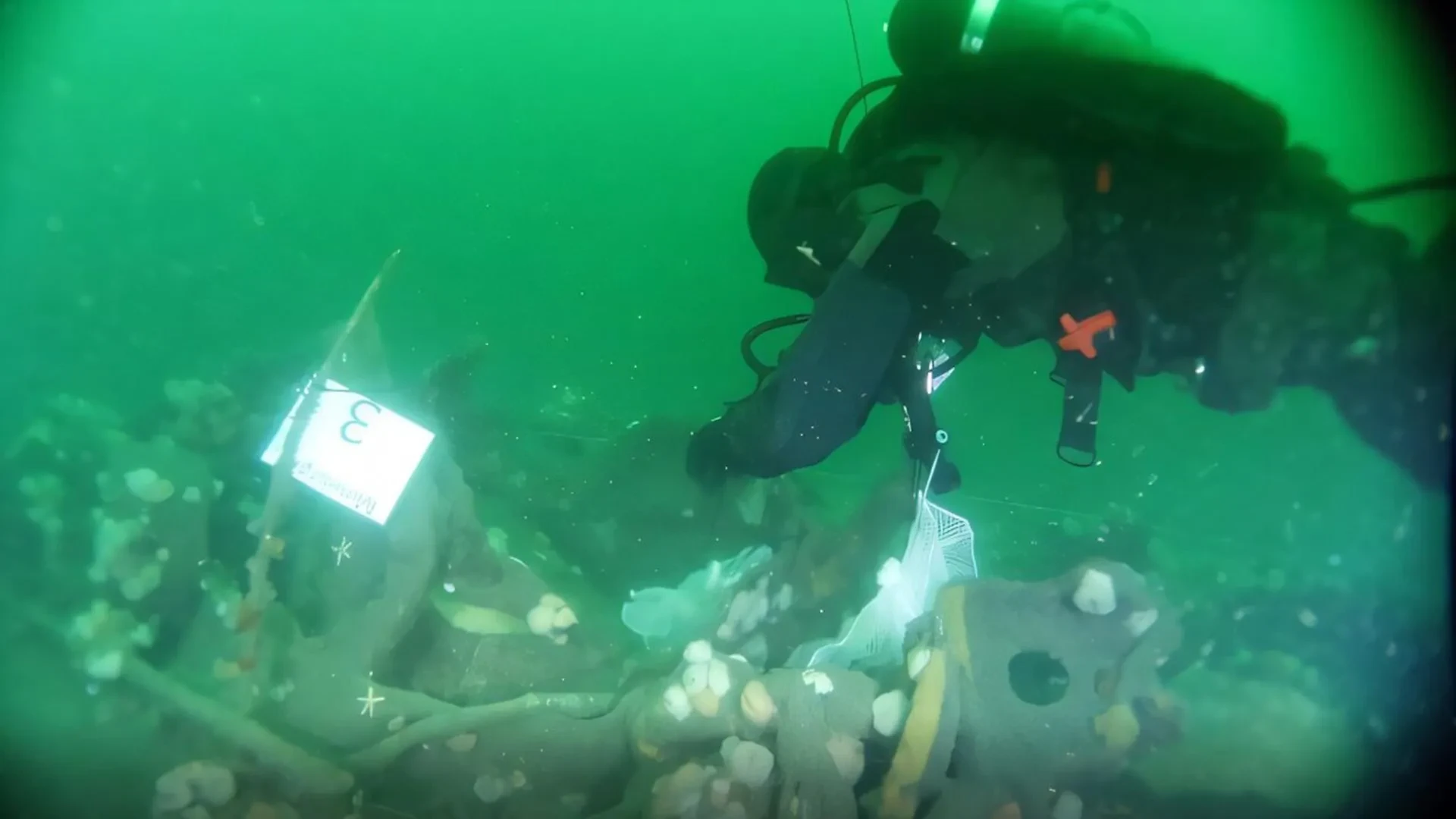
Recent investigations conducted as part of the landmark NorthSeaWrecks research project have revealed that trinitrotoluene (TNT)—a synthetic, highly toxic chemical compound used extensively in military explosives—is leaking from the deteriorating hull and munitions of the UC-30. Researchers from Aarhus University, working alongside elite Danish navy divers, have detected traces of TNT not only in the water column and surrounding seabed sediment, but also inside local marine wildlife, including starfish and mussels.
This alarming discovery is far from an isolated incident. Marine geoscientists estimate that thousands of historical shipwrecks and dumping sites from both World Wars are scattered across European waters, posing a persistent, long-term threat to marine biodiversity and human health. As these iron and steel structures continue to corrode under the relentless pressure of saltwater, the sealed chambers of history are cracking open, releasing a cocktail of heavy metals and chemical explosives into the ocean.
Chronology: From Naval Warfare to Marine Pollution
To understand how the seabed of the North Sea transformed from a maritime battlefield into a toxic chemical repository, one must look back at the harrowing geopolitical struggles of the early 20th century.
April 1917: The Demise of the UC-30
In the spring of 1917, the German submarine UC-30 was limping home. Having abandoned a scheduled patrol and minelaying mission near the coast of Ireland due to persistent mechanical and engine failures, the vessel shaped a course back toward its home port in Germany. It never made it. On April 19, 1917, while navigating waters near Rømø, the submarine detonated a British defensive mine. The resulting blast was catastrophic, instantly sinking the vessel and killing all 27 crew members on board. The submarine settled quietly onto the sandy seafloor, carrying its lethal cargo of 18 mines and six torpedoes into the dark.
2016: Rediscovery After a Century
For nearly one hundred years, the exact resting place of the UC-30 remained a mystery, swallowed by shifting sands and ocean currents. It wasn’t until 2016 that noted Danish diver Gert Normann Andersen successfully located the wreck, bringing renewed historical attention to the site and setting the stage for modern scientific inquiry.
Post-WWII: The Great Ocean Dumping
The threat posed by sunken ordnance is not limited to WWI combat losses. Following the conclusion of the Second World War in 1945, Allied forces faced a massive logistical challenge: what to do with mountains of surplus ammunition, chemical weapons, and conventional explosives. The expedient, short-sighted solution adopted at the time was ocean dumping. Tons of leftover munitions were systematically cast into the Baltic Sea, the North Sea, and other strategic bodies of water to prevent them from falling into the hands of hostile actors or domestic insurgents. Decades later, these underwater dumps have become secondary ticking time bombs.
February 2024: The Danish EPA Report
Recognizing the escalating environmental stakes, Dr. Katrine Juul Andresen of the Department of Geoscience at Aarhus University published a comprehensive report in February 2024 commissioned by the Danish Environmental Protection Agency (EPA). The report cataloged the immense density of historical wrecks in Danish waters and evaluated their capacity to breach EU environmental directives, transforming theoretical anxieties into documented scientific evidence.
Supporting Data: The Scale of the Submerged Arsenal
The sheer volume of historical debris resting on the seabed defies casual imagination. According to Dr. Andresen’s 2024 inventory, there are precisely 10,127 shipwrecks resting within Danish jurisdictional waters alone.
Of this staggering total:
- Approximately 15%—amounting to roughly 1,500 vessels—date directly to the epochs surrounding the two World Wars (1910–1920 and 1940–1945).
- 190,000 naval mines were laid across the North Sea during the First World War alone, as both the British Royal Navy and the Imperial German Navy sought to starve each other of resources and blockade enemy ports.
The naval strategy of the era relied heavily on attrition. Because the German Empire possessed a smaller surface fleet than the British Empire, it heavily favored asymmetric warfare through unrestricted submarine campaigns. Meanwhile, both sides blanketed crucial maritime corridors with contact and acoustic mines.
When these vessels and munitions sink, they do not simply vanish. They enter a prolonged phase of structural degradation. Metals rust, wooden hulls rot, and copper-sheeted fasteners disintegrate, eventually exposing the chemical contents of torpedoes, depth charges, and mines directly to seawater.
The NorthSeaWrecks project quantified the biological impact of this decay. By analyzing samples gathered by navy divers—who navigated strict civilian exclusion zones around the protected UC-30 wreck—scientists confirmed that TNT is actively migrating into the local food web. Mussels and starfish, which are sessile or slow-moving bottom-dwellers, absorb these mutagens and carcinogens, passing them upward through the marine trophic levels.
Official Responses and Scientific Challenges
As empirical data mounts, environmental regulators and governmental bodies find themselves wrestling with a policy nightmare. The discovery of active TNT pollution directly challenges national and international water quality standards, including the stringent requirements of the EU Water Framework Directive, which mandates the achievement of "good environmental status" for all European marine waters.
The Limits of Removal
While the problem is clear-cut, the solutions are devilishly complex and exorbitantly expensive. Germany has emerged as a frontrunner in remediation efforts, allocating substantial federal funds to locate, recover, and neutralize dangerous WWII munitions resting in the Baltic Sea. However, the costs associated with deep-water salvage operations are astronomical.
Furthermore, physical removal is not always a panacea. When experts contemplate destroying submerged munitions in situ—detonating them underwater to neutralize the chemical hazard—they face a dangerous paradox.
"It depends on the area where the wreck and munitions lie," explains Dr. Andresen. "Currents and seabed morphology play a major role. In some cases, detonating them can do more harm than good."
A controlled underwater explosion can instantly disperse massive, concentrated plumes of toxic chemical compounds into the surrounding water column, causing acute localized damage to fish populations, marine mammals, and delicate benthic habitats. Consequently, blowing up a wreck is often rejected as a viable remediation strategy.
Technological Innovation: Seabed Crawlers
To navigate these dangerous operational constraints, researchers are turning to high-tech innovations. Through participation in the EU-funded REMARCO project, scientists are pioneering non-invasive and low-impact remediation techniques.
Among the most promising tools being tested are autonomous or tethered seabed-crawling robots. These robotic systems are designed to traverse the rugged, debris-strewn ocean floor to map the exact geographical coordinates of unexploded ordnance and assess the structural integrity of corroding wrecks with millimeter precision.
Future iterations of these aquatic robots may even be equipped with specialized robotic manipulators capable of gently grasping, lifting, and recovering hazardous munitions from the seabed, bringing them safely to the surface for proper, contained disposal.
Implications: Prioritizing the Environmental Threat
Despite the alarming reality of TNT pollution leaching from historical shipwrecks, marine scientists caution against uncalculated panic or undertaking impossible clean-up efforts. Not all 10,000-plus wrecks in Danish waters pose an immediate or equal environmental hazard.
A critical factor dictating the severity of a wreck’s pollution potential is its burial state. Shipwrecks and munitions that have become fully or partially entombed beneath thick layers of marine sediment and sand experience significantly reduced rates of oxygen exposure and structural corrosion. The sediment acts as a natural containment barrier, trapping escaping chemicals and heavily mitigating the risk of widespread ecological contamination.
Therefore, modern marine management is shifting toward a philosophy of strategic triage.
"It is a matter of identifying where the environmental threat is greatest—and then deciding whether the munitions on the wrecks should be removed," Dr. Andresen concludes.
Attempting to dredge, dismantle, or sanitize every single WWI and WWII wreck resting on the European seabed is neither economically feasible nor ecologically sound. Instead, the path forward demands targeted monitoring, advanced robotic surveillance, and precise interventions focused on the highest-risk, actively leaking sites like the UC-30.
As the ghosts of the 20th century continue to rust away in the dark, humanity’s challenge in the 21st century is to clean up the detritus of past conflicts before the silent chemical bleed of the seabed permanently alters the future of our oceans.
