

As the global transition toward renewable energy accelerates, the solar industry faces a paradoxical crisis: while demand for clean power has never been higher, the availability of viable land is rapidly shrinking. Developers are increasingly squeezed by a complex web of community opposition, stringent municipal regulations, and competing land uses. Nowhere is this pinch felt more acutely than in urban and suburban environments, where open parcels are rare, irregular, and often encumbered by infrastructure.
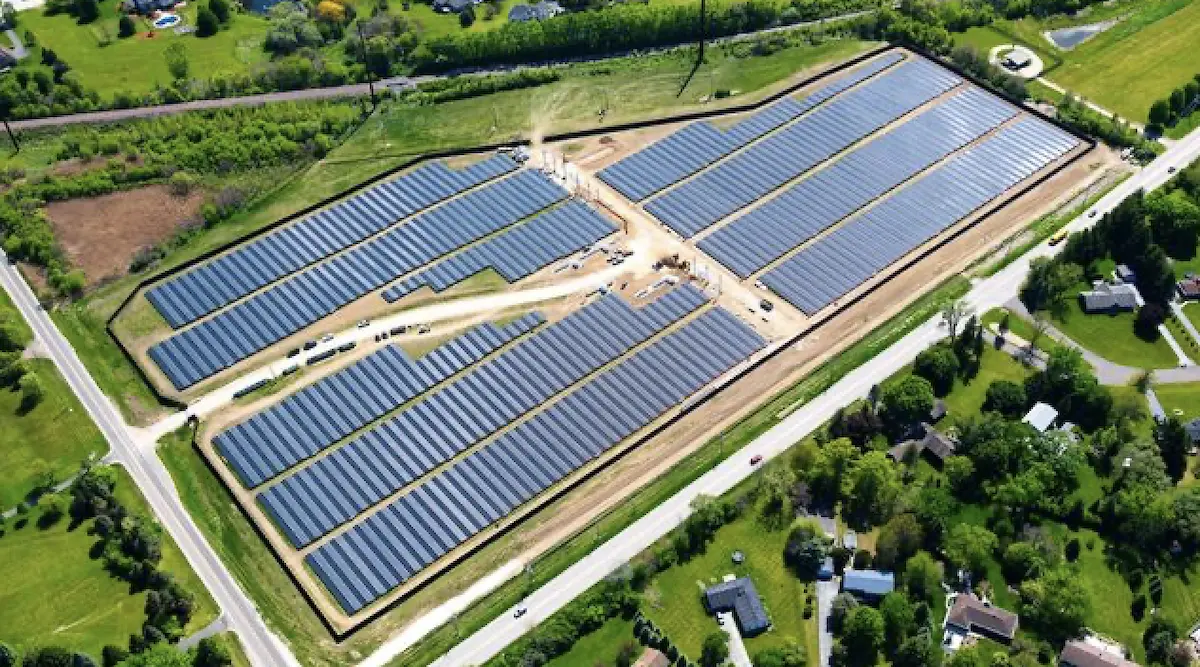
However, necessity continues to drive innovation. A striking example of this ingenuity is unfolding in Elgin, Illinois, where renewable energy firm Cultivate Power has successfully brought an 11-megawatt (DC) solar power plant to life on a notoriously difficult 22-acre plot. By leveraging cutting-edge, high-density racking technology and forging deep community partnerships, the project demonstrates how developers can turn seemingly unbuildable land into a powerhouse of clean energy, local savings, and economic revitalization.
Main Facts: The Bowes Solar Project At a Glance
The Bowes Solar array is not your average clean energy installation. Built on a tight, irregular 22-acre parcel within the city limits of Elgin—one of Illinois’s largest cities outside of Chicago—the project represents a masterclass in spatial optimization and modern engineering.
- Total Capacity: 11 megawatts (DC), divided strategically into two distinct sub-arrays to navigate physical obstacles.
- Footprint: 22 acres, yielding an exceptionally high output-to-space ratio made possible by Planted Solar’s high-density racking system.
- Technology: Low-profile, terrain-following, software-enabled high-density racking that compresses the land requirement from a traditional 5–7 acres per megawatt-peak down to roughly 2 acres per megawatt-peak.
- Beneficiaries: 580 low- and moderate-income households, three small businesses, two municipalities, and a local church, all receiving power distributed through Commonwealth Edison (ComEd).
- Economic Impact: Projected subscriber savings of $13.9 million over the next 40 years, coupled with $2.1 million in local property tax revenues destined for school districts and municipal agencies.
Chronology: From an Unusable Plot to a State-of-the-Art Solar Plant
Developing a solar installation on a standard greenfield site is straightforward, but transforming an encumbered, irregular urban parcel requires a meticulous, multi-phase approach. The journey of the Bowes Solar project highlights the persistence required to bring constrained-site solar from concept to reality.
Phase 1: Identifying the Challenge and Assembling the Land
For years, the 22-acre parcel in Elgin sat largely ignored by developers. Wedged tightly between two existing residential subdivisions, the property came with a litany of physical hurdles. High-voltage overhead power lines bisected parts of the air space, active train tracks bordered the property, and a sensitive wetlands ecosystem claimed a significant portion of one corner. Furthermore, the irregular shape of the parcel made traditional rectangular solar layouts impossible.
Phase 2: Engineering Around Obstacles
Recognizing the site’s potential despite its flaws, Cultivate Power took the helm. To tackle the irregular footprint and strict environmental setbacks, the engineering team split the installation into two distinct arrays. This division provided the spatial flexibility needed to maintain safe distances from the rail lines, power corridors, and—most importantly—the protected wetlands.
To solve the spatial crunch, Cultivate partnered with Planted Solar, utilizing their high-density, low-profile racking system. This technology allowed the project to achieve an 11-megawatt capacity on acreage that normally could only support a fraction of that output.
Phase 3: Mitigating Aesthetic and Community Concerns
Because the site is sandwiched directly between residential areas, managing visual and community impact was paramount. Cultivate utilized the low-to-the-ground profile of the Planted Solar racking system to keep the panels discreet. Combined with the installation of a sturdy opaque fence and extensive perimeter landscaping, the array remains virtually invisible to surrounding homeowners, completely short-circuiting typical aesthetic complaints.
Phase 4: Commissioning and Grid Integration
With construction complete, the Bowes array was integrated into the Commonwealth Edison grid. By structuring the project as a community solar initiative, Cultivate ensured that the energy generated would immediately flow back into the local grid, directly offsetting electricity costs for nearby residents who otherwise lacked access to rooftop solar.
Supporting Data: The Numbers Behind High-Density Solar
To understand why the Bowes project represents a paradigm shift for the solar industry, one must examine the mathematics of modern land use.
Traditional utility-scale and community solar projects operate on a well-established rule of thumb: they require approximately 5 to 7 acres of land for every megawatt-peak (MWp) of generation capacity. Under these conventional guidelines, an 11-megawatt plant would demand between 55 and 77 acres of open land—an impossibility for a 22-acre urban parcel. Conversely, trying to scale down the project to fit a smaller footprint often triggers the law of diminishing returns, rendering the project financially unviable due to fixed development and interconnection costs.
Planted Solar’s high-density racking system shatters these traditional constraints:
- Land Efficiency: The system requires only 2 acres per MWp, effectively tripling the land-use efficiency of the installation.
- Slopes and Grading: Traditional arrays usually require expensive, disruptive earth-grading if a site’s slope exceeds 10%, a factor that frequently kills project economics. Planted Solar’s terrain-following software accommodates existing grades of up to 27%, preserving natural topography and eliminating heavy grading costs.
- Financial Returns: According to data compiled by Chronicle Media and project stakeholders, subscribers to the Bowes array will save an estimated 20% on their energy charges, translating to a cumulative $13.9 million in consumer savings over four decades.
- Tax Contributions: Local taxing bodies, including regional school districts, are slated to receive $2.1 million in property tax revenues over the same 40-year lifespan.
Official Responses and Stakeholder Perspectives
The success of the Bowes Solar project has drawn widespread praise from industry leaders, municipal authorities, and community advocates alike.
Cultivate Power on Urban Constraints
Speaking with CleanTechnica, representatives from Cultivate Power emphasized that developing on constrained parcels is no longer just a niche strategy—it is the future of the industry.

"Developing solar on constrained parcels is a growing focus for the industry," Cultivate explained in an email. "It’s becoming more important as competitive land use drives solar onto smaller and smaller parcels."
Community Impact and Local Leadership
The project’s integration into the Elgin community went far beyond electrons and hardware. Cultivate Power paired its physical infrastructure investment with extensive philanthropic contributions aimed at uplifting the local educational and social fabric. Local reporters, including Bill Dwyer of Chronicle Media, highlighted the broad scope of these community-facing efforts:
"Aimed at saving customers 20 percent on energy charges, the project will also benefit several larger customers, including three small businesses, two towns and a church," Dwyer noted, adding that Cultivate officials projected total subscriber savings of $13.9 million on ComEd bills over 40 years.
Beyond bill reductions, Cultivate directed substantial financial contributions toward Elgin Community College, Food for Greater Elgin (a key partner of the Northern Illinois Food Bank), Friends of the Fox River, We Care Solar, and the Evolve Foundation.
The Broader Rural Context: Generate Capital’s Perspective
While urban and suburban community solar projects like Bowes solve land-crunch challenges in densely populated areas, Cultivate’s equity investor, Generate Capital, points out that high-density and community solar models are equally transformative in rural agricultural settings.
Highlighting another Cultivate initiative—the 5-megawatt Goldenrod Solar project in Mercer County, Illinois—Generate Capital underscored how solar can coexist with agriculture:
"In a rural farming community like Mercer County, solar savings are out of reach for renters and low- and moderate-income families who are unable to install their own panels," Generate noted. "Landowners, meanwhile, face pressure to keep every acre productive. Community solar answers both, extending savings to local subscribers, while giving a working farm stable new income alongside its crops."
The Goldenrod project successfully delivers savings to 850 subscribers—55% of whom are low- and moderate-income households—while funding local educational foundations and Future Farmers of America (FFA) chapters at regional high schools.
Implications: A New Blueprint for the Renewable Energy Transition
The completion of the Bowes Solar project in Elgin carries profound implications for the future of solar energy development across the United States.
1. Overcoming the "Not In My Backyard" (NIMBY) Hurdle
Community opposition remains one of the most stubborn bottlenecks for renewable energy deployment. By utilizing low-profile, high-density racking systems that can be entirely screened from public view with fencing and foliage, developers can neutralize aesthetic objections. When combined with direct financial benefits—such as reduced utility bills for low-income residents and increased tax revenues for local schools—solar projects transform from contested land-use battles into celebrated community assets.
2. Unlocking "Unbuildable" Land
Thousands of acres of urban, brownfield, and irregularly shaped parcels sit vacant across the country because they are deemed too steep, too small, or too environmentally sensitive for conventional development. Technologies like Planted Solar’s terrain-following, high-density racking prove that these parcels can be safely unlocked. By avoiding the need for heavy grading and squeezing high-capacity arrays into tight footprints, developers can tap into urban load centers where electricity demand is highest.
3. Democratizing Clean Energy Access
Historically, clean energy savings have been skewed toward homeowners with high credit scores and suitable roof space, leaving renters and low- and moderate-income (LMI) families behind. Community solar models—exemplified by the Bowes and Goldenrod arrays—shatter this barrier. By routing power through major utilities like Commonwealth Edison and dedicating the majority of shares to LMI households, these projects ensure that the economic benefits of the green transition are shared equitably.
Conclusion
As competitive land pressures mount and regulatory hurdles tighten, the solar industry cannot rely solely on sprawling rural greenfields to meet aggressive decarbonization goals. The success of the Bowes Solar project in Elgin, Illinois, offers a compelling roadmap for the future. By merging innovative, space-saving engineering with a genuine commitment to community enrichment, developers have proven that even the most constrained and irregular parcels of land can play a vital role in powering a cleaner, more equitable energy future.
